

Soccer field was hiding the remains of a 770-year-old convent thought lost for centuries
Using Ground Penetrating Radar, officials located the monastery six feet beneath a soccer field.

FILE: Are there tornadoes in Europe?
There are about 300 to 400 tornadoes each year in Europe.
THE TAKEAWAY
- A 770-year-old monastery was located beneath a soccer field in Denmark.
- The monastery was found using Ground Penetrating Radar beneath the soccer field.
- It will take six to 12 months to excavate the structure.
ROSKILDE, Denmark – A monastery thought to be forgotten for 770 years was discovered this summer beneath a soccer field in Denmark.
Researchers from the Norwegian Institute for Cultural Heritage Research knew of St. Clare’s Convent in the area. Still, they did not know how much of the structure was preserved, if at all.
PHOTOS: RARE ICE AGE TOOTH DISCOVERED IN CALIFORNIA PRESERVE AFTER THOUSANDS OF YEARS
This comes as local officials begin work on a parking facility for the soccer field in Roskilde, Denmark. Using Ground Penetrating Radar (GPR), officials located the monastery six feet beneath a soccer field.
The system transmits electromagnetic waves into the ground; when the waves encounter structures, such as the monastery or other traces of human activity, the signals reflect to the receiver.
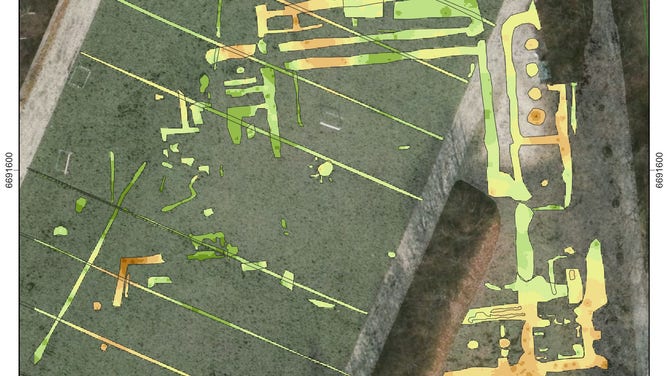
Aerial view of the GPR imaging of the monastery hidden beneath the soccer field.
(National Museum of Denmark/NIKU)
St. Clare's Convent dates back to 1256 and was one of five monasteries in the town of Roskilde, with a strong influence.
According to officials, the convent was dissolved and demolished after the Protestant Reformation in the 16th century, after which half a million bricks from the structure were sold to Selsø Castle, a historic manor house.
SEE IT: ARCHEOLOGISTS UNCOVER RESIDENTIAL CITY FROM BYZANTINE EMPIRE IN EGYPT
As a result, many thought the ruins of this sacred structure were completely gone, until GPR imaging provided a quick, non-destructive way to get a clearer view of the monastery.
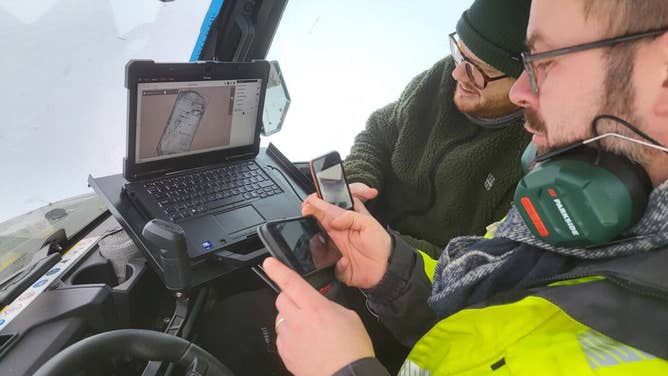
NIKU archaeologist Arne Abel Stamnes and Magnus Hjorth Jørgensen from the National Museum monitored the results.
(Jesper Langkilde/ROMU)
The imaging results were phenomenal, revealing traces of the buildings, including room divisions, cloisters and a church in the southern wing.
Despite this, researchers are unsure how many rooms are within the structure, as the monastery likely stood two stories high, with the nuns occupying various spaces.
SCIENTISTS UNCOVER FIRST KNOWN ADULT T. REX TRACKWAY DATING BACK 66.5 MILLION YEARS
Layout of the monastery
- A communal dining hall (called the Refectory).
- A Chapter house or hall, a formal meeting room where the nuns held daily meetings, read from the monastic rule and the Bible and discussed common matters.
- A parlor, which was a meeting room for external visitors.
- A kitchen.
- A library and a scriptorium, which were rooms for writing, illustrating and copying books and manuscripts.
- Storage rooms which could be in cellars (some of the structures we see in the radar image might be the remains of cellars).
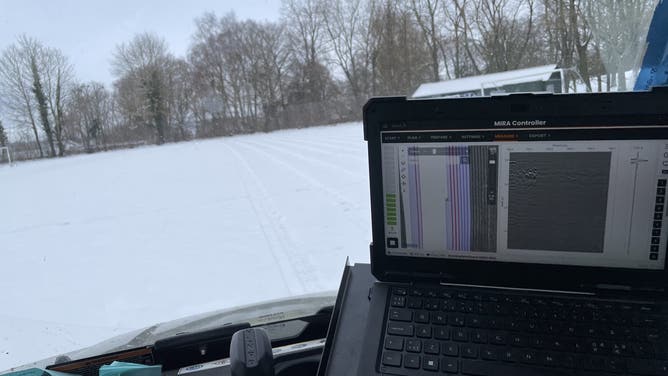
Crews conduct GPR imaging for the monastery below a soccer field in Denmark.
(Archeologist Arne Abel Stamnes / NIKU)
"The results are simply impressive," archeologist Arne Abel Stamnes said. "GPR data do not always provide such clear images and often the interpretation requires extensive analytical work."
This is the first time these experts have been able to document such a well-preserved monastery with such clear results.
ANCIENT MONUMENT WITH MYSTERIOUS CONNECTION TO SUN AND MOON FOUND AFTER 6,500 YEARS
It is unclear as to how long it will take to excavate the monastery beneath the field. Still, officials will only be able to dig out the part of the monastery directly affected by the construction of the parking facility.

Crews conduct Ground Penetrating Radar imaging of the soccer field in Denmark.
(Archeologist Arne Abel Stamnes / NIKU)
The first part of the excavation will focus on the eastern half of the monastery and could take around six to 12 months, as it is careful and delicate work.
"We hope to find lots of well-preserved artifacts and organic remains which can tell us about the daily life at the convent," Specialist in Medieval Archaeology Jesper Langkilde said. "Also, we expect to find a lot of burials which can tell us about whom the nuns were and who else was buried at the monastery."
SEE IT: ANCIENT TOMB AND ARTIFACTS UNCOVERED DURING EXPANSION OF ITALIAN PASTA FACTORY
![ITALY - FEBRUARY 02: St Clare, 1548, by Giovanni Battista Moroni (ca 1520-1578), oil on canvas, 182.7x125 cm.]() Image 1 of 2
Image 1 of 2ITALY - FEBRUARY 02: St Clare, 1548, by Giovanni Battista Moroni (ca 1520-1578), oil on canvas, 182.7x125 cm. (DeAgostini)
![ITALY - CIRCA 2003: Miracle of Saint Clare, 13th century fresco, ancient Church of Saint Clare, Nola, Campania, Italy.]() Image 2 of 2
Image 2 of 2ITALY - CIRCA 2003: Miracle of Saint Clare, 13th century fresco, ancient Church of Saint Clare, Nola, Campania, Italy. (Photo by DeAgostini/Getty Images) (DeAgostini)

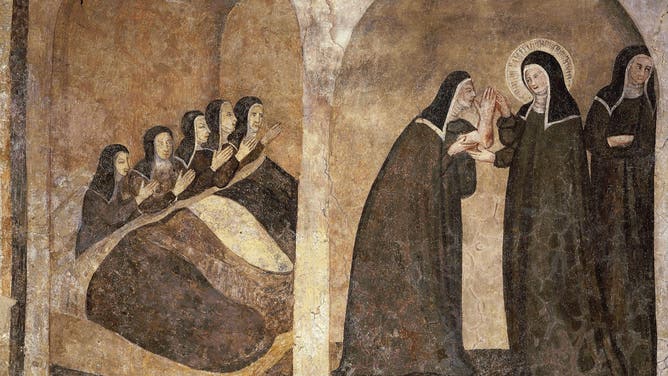
Saint Clare, born Clare Offreduccio, was born in 1194 and lived until 1253, but in 1212, she decided to dedicate her life to Jesus, giving up her wealth, clothing and jewelry for a life in the church caring for the poor, sick and dying.
VIDEO: ROMAN-ERA SHIPWRECK FROM OVER 2,000 YEARS AGO DISCOVERED AT BOTTOM OF OCEAN NEAR SICILY
Further research and discoveries at the site could provide researchers with more insight into the lives of the nuns who lived and served there, as well as how the convent changed throughout its years of operation.