

New York relaxes restrictions for eating some fish in the Hudson River for first time in 50 years
The new advice impacts fish in the lower Hudson River from Rip Van Winkle Bridge in Catskill to the New York City Battery.

FILE: How did the salamander cross the road? Spring amphibian migration starts in New York City
Conservation and Land Use Program Coordinator for the Hudson River Estuary Program Laura Heady joined FOX Weather to provide insight into an interesting question: Why salamander cross the road? Strap in as spring amphibian migration starts in New York City.
HUDSON RIVER, NY - For the first time in half a century, people can eat certain types of fish found in the lower Hudson River after chemical levels within the fish have improved.
The New York State Department of Health issued new information about specific types of fish available for eating around the state.
CREWS RESCUE HIKER THAT WAS CRITICALLY INJURED AFTER BEING STUNG BY BEES OVER 100 TIMES IN ARIZONA
Previous advice had said sensitive groups like pregnant people and children weren't able to eat any of the fish in the river due to a harmful chemical in the fish.
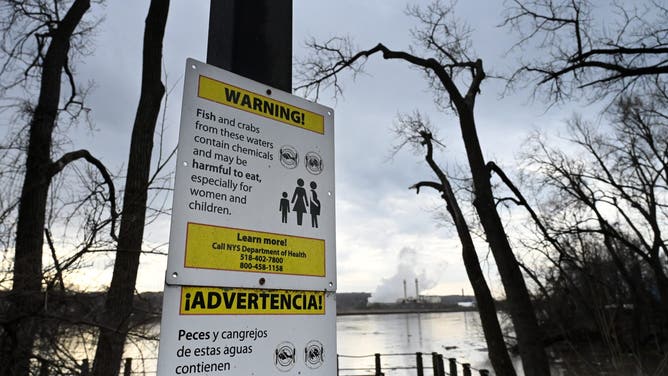
FORT EDWARD, NY - MARCH 11: Signs warning anglers that fish caught in the Hudson River are potentially harmful to consume are posted at Island Creek Park on Wednesday, March 11, 2026, in Albany, N.Y.
(Will Waldron/Albany Times Union / Getty Images)
The department analyzed levels of Polychlorinated biphenyls (PCBs), and found that they were low enough to allow certain fish to be eaten in small quantities in portions of the Hudson River from the Rip Van Winkle Bridge in Catskill to the New York City Battery.
PCBs are a human-made chemical that was banned from manufacturing in the U.S. in 1979 due to its toxicity.
WHEN AND WHERE TO CATCH THE BEST SPRING BLOSSOMS ACROSS THE COUNTRY
The chemical was once widely used in hundreds of industrial and commercial capacities, according to the U.S. Environmental Protection Agency.

FORT EDWARD, NY - MARCH 11: View of the Hudson River look north from Champlain Canal Lock C6 on Wednesday, March 18, 2026, in Fort Miller, N.Y.
(Will Waldron/Albany Times Union / Getty Images)
Now, sensitive groups are allowed to eat one 8-ounce meal per month of yellow perch, white perch, striped bass and brown bullhead from that portion of the lower Hudson River.
Everyone else is allowed to eat four 8-ounce meals per month of yellow perch, brown bullhead, blue crab meat and striped bass fish, and can eat one meal per month of several other types of fish including:
- White perch
- Rainbow smelt
- Largemouth bass
- Goldfish
- Freshwater drum
- Bluefish
- Atlantic needlefish
HIGHEST NUMBER OF NORTH ATLANTIC RIGHT WHALE CALVES RECORDED IN 17 YEARS
"New York State is a beautiful place to fish, and as we kick off the fishing season, the Department of Health wants to make sure people have the latest advice on safely eating the fish they catch," State Health Commissioner Dr. James McDonald said. "It's a great day when the Department can relax guidance for certain fish in the lower Hudson River, allowing people who may become pregnant and children to eat fish from one of the most important fisheries in New York State. We encourage everyone to visit us online to get the latest advice for waters across the state."
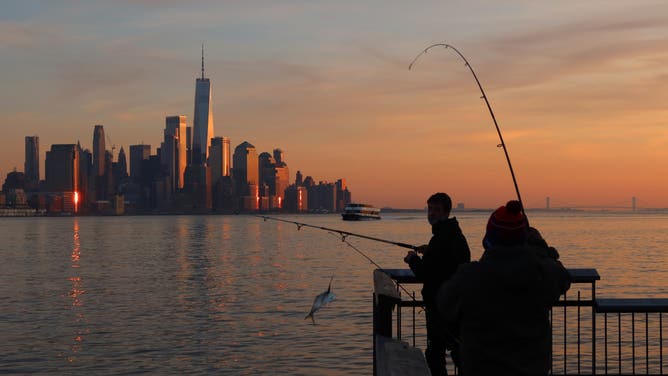
HOBOKEN, NJ - DECEMBER 11: A fisherman reels in a fish from the Hudson River as the sun sets on lower Manhattan and One World Trade Center in New York City on December 11, 2020 in Hoboken, New Jersey.
(Gary Hershorn/ / Getty Images)
There are still strict limitations on several other types of fish due to the amount of chemicals found in them.
PCBs do not have a taste or smell, and range in consistency from an oil to a waxy solid.
They do not break down easily in the environment, and they stay in the fat of fish, according to the Department of Health.
SCIENTISTS USE NEW METHODS TO MAP YELLOWSTONE'S HIDDEN UNDERGROUND PLUMBING SYSTEM
Because PCBs stay in the fat of fish, the department encourages everyone to cut the skin and fat off of fish and cook it so that the fat drips off. Doing this reduces the amount of PCBs in a fish meal by roughly half.
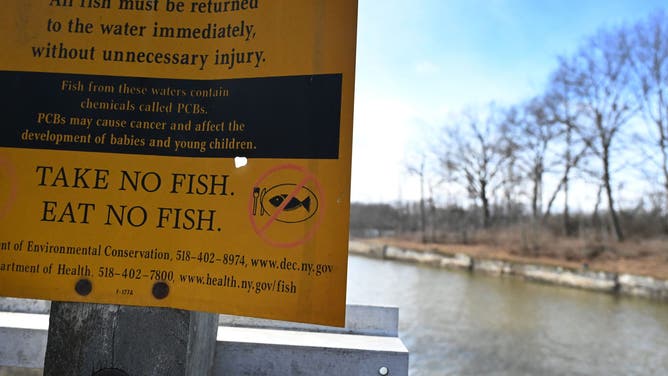
FORT EDWARD, NY - MARCH 11: A sign warning of the dangers of consuming PCB-contaminated fish is posted by the Hudson River at Champlain Canal Lock C6 on Wednesday, March 18, 2026, in Fort Miller, N.Y.
(Will Waldron/Albany Times Union / Getty Images)
People who eat Hudson River crabs can reduce the PCBs by removing the tomalley (mustard, hepatopancreas) and discarding the cooking liquid, which contains most of the PCBs, the department said.
Restrictions remain in place for other parts of the Hudson River.
To learn more about the new guidance and see the types of fish not allowed to be consumed from the lower Hudson River, click here.