

Dazzling display: Fireball streaks across the night sky in over a dozen states
The first image of the space rock was captured above Tupelo, Mississippi, as it moved northwest at a speed of 56,000 mph.
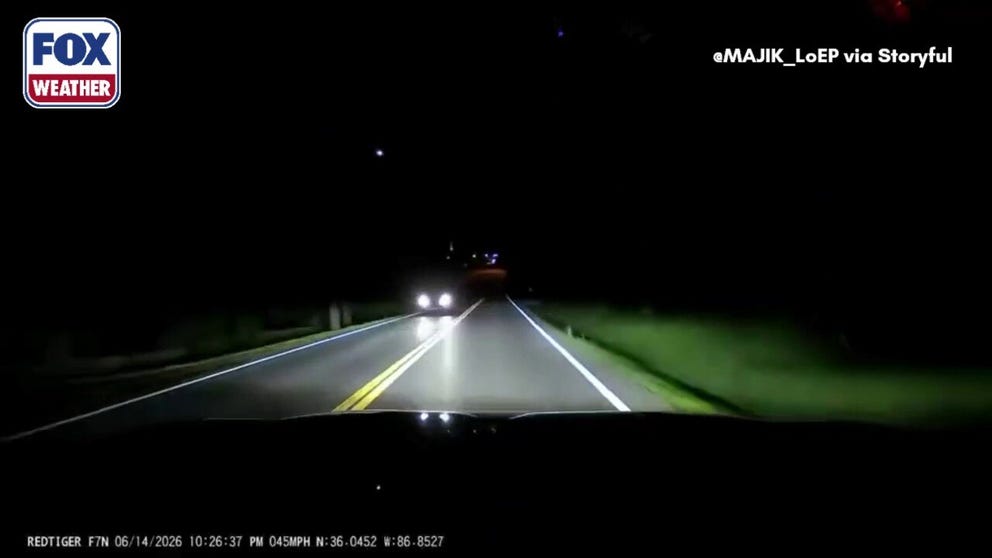
WATCH: Dashcam captures the moment a meteor streaks across sky
SEE IT: A driver in Brentwood, Tennessee, was able to capture the moment a meteor streaked across the night sky over the weekend, as the fireball was 16 times brighter than Venus.
Hundreds of eyewitnesses saw a bright fireball streaking across the night sky in over a dozen states over the weekend.
On Sunday evening, a fireball flew through the sky at 10:26 p.m., captured by three NASA meteor cameras.
According to NASA, the first image of the space rock was captured above Tupelo, Mississippi, as it moved northwest at a speed of 56,000 mph.
SKY SPECTACLE: METEOR DAZZLES MIDWEST NIGHT SKY, GENERATING REPORTS FROM 8 STATES
One traveler in Brentwood, Tennessee, encountered a stunning view of the fireball while driving Sunday evening, capturing it on dashcam as the meteor quickly moved across the sky.
The meteor traveled 300 miles across the country before it disintegrated 34 miles above the Mark Twain National Forest in Missouri.

Driver observes a meteor streak across the sky.
(@MAJIK_LoEP via Storyful)
When meteoroids enter Earth’s atmosphere at a high speed and burn up, the fireballs are referred to as meteors, according to NASA.
"The object moved too fast and was too small to produce meteorites," NASA said.
NASA ANNOUNCES ARTEMIS III ASTRONAUTS IN NEXT PHASE OF MISSION TO RETURN HUMANS TO THE MOON
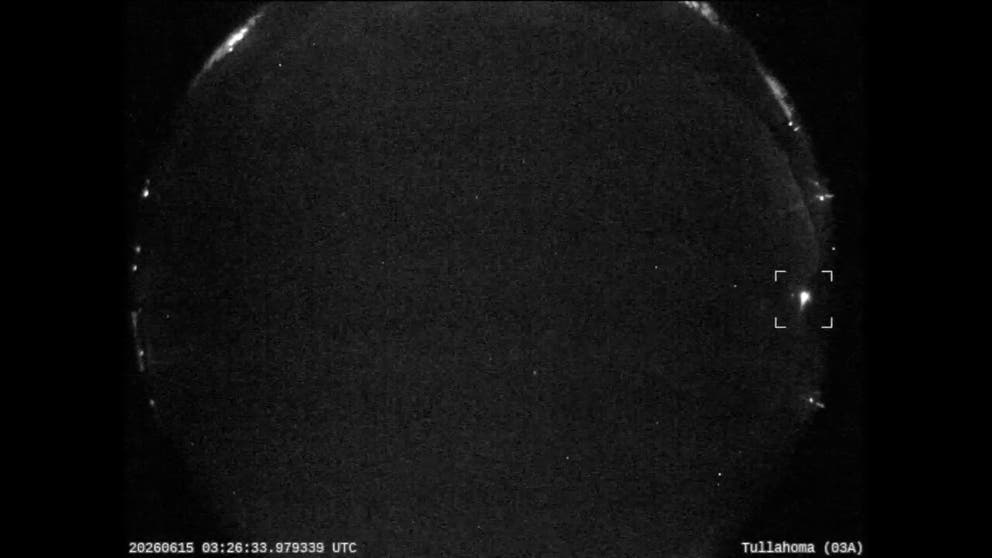
Meteor captured on NASA camera
The most recent fireball that lit up the night sky across several states in the U.S. was captured by one of NASA’s meteor cameras on Sunday.
According to the American Meteor Society, the meteor was spotted across numerous states, including Alabama, Arkansas, Georgia, Iowa, Illinois, Kentucky, Mississippi, Missouri, Minnesota, South Carolina, Tennessee and Texas.
JUNE SKYWATCHING GUIDE: FROM PLANET CONJUNCTIONS TO NEW MOONS, HERE IS WHAT TO LOOK UP FOR
The meteor became visible at an altitude of around 60 miles above Tupelo, Mississippi.
According to experts, the fireball was 16 times brighter than the planet Venus.