

The sun has gone blank as sunspots vanish for the first time since February
Friday marked the first spotless day since February, according to solar observations.
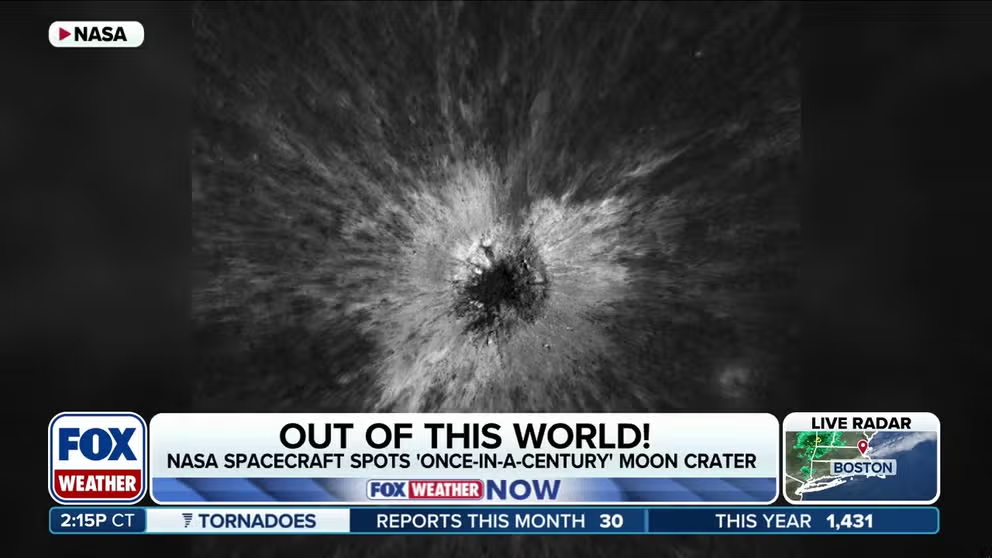
FILE: NASA spacecraft discovers 'once-in-a-lifetime' moon crater
Bethany Ehlmann, president of The Planetary Society, joins FOX Weather to discuss how a NASA spacecraft spotted a "once-in-a-lifetime" moon crater during a routine data quality check.
THE TAKEAWAY
- The sun has gone spotless for the first time in nearly seven months.
- Images captured by NASA’s Solar Dynamics Observatory showed no numbered active regions across the visible solar disk.
- However, while the sun appeared spotless, activity was still occurring near its edges.
The sun has officially gone spotless for the first time in nearly seven months, marking the first day since Feb. 24 that no numbered sunspot regions were visible on the Earth-facing side of the star.
Friday marked the first spotless day since February, according to solar observations.
WATCH THE MASSIVE SOLAR FLARE THAT EXPLODED ON THE SUN LEADING TO ‘STRONG RADIO BLACKOUT’ ON EARTH
Images captured by NASA’s Solar Dynamics Observatory showed no numbered active regions across the visible solar disk.
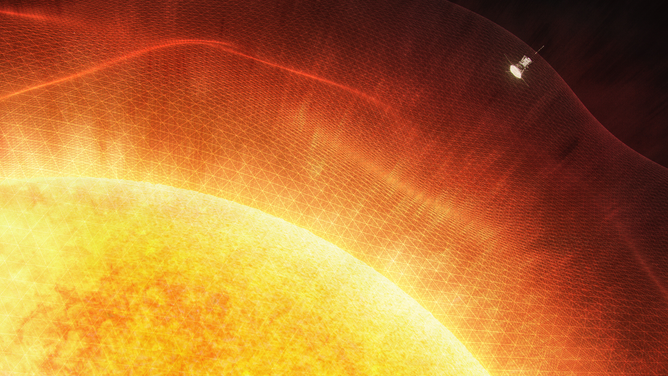
Conceptual image of Parker Solar Probe entering the Sun's corona.
(NASA Scientific Visualization Studio / NASA)
While the sun appeared spotless, activity was still occurring near its edges. Two regions near the solar southeast and northeast horizons produced weak B-class solar flares, but were classified as plage regions.
The spotless stretch comes as the sun moves away from the peak of Solar Cycle 25, the current 11-year solar cycle that reached its maximum in late 2024.
The decline in sunspot activity is a notable change from the peak of the cycle.
SOLAR VS. LUNAR: WHICH ECLIPSE GIVES YOU THE BEST CHANCE OF SEEING IT?
On Aug. 8, 2024, the sun recorded an estimated 337 sunspots, the highest single-day sunspot count recorded during Solar Cycle 25 and the highest daily estimate from NOAA’s Space Weather Prediction Center since March 2001.
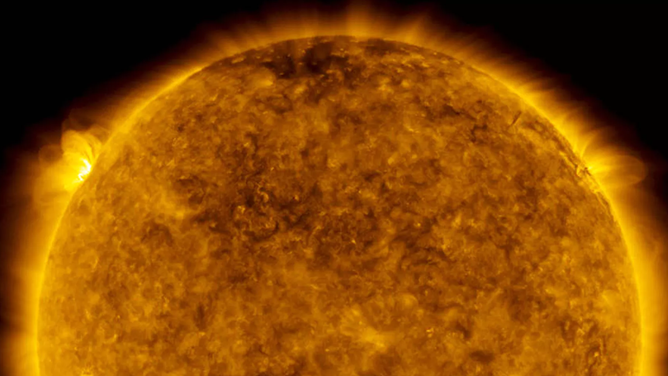
Photo of the Sun with solar flares
(NASA)
Despite the lack of visible sunspots, solar activity continued at very low levels into Saturday. Observers recorded 10 B-class flares, including a B9.9 flare that peaked at 1:35 UTC on Saturday.
Meanwhile, no new Earth-directed coronal mass ejections were observed during the period.
ANCIENT MONUMENT WITH MYSTERIOUS CONNECTION TO SUN AND MOON FOUND AFTER 6,500 YEARS
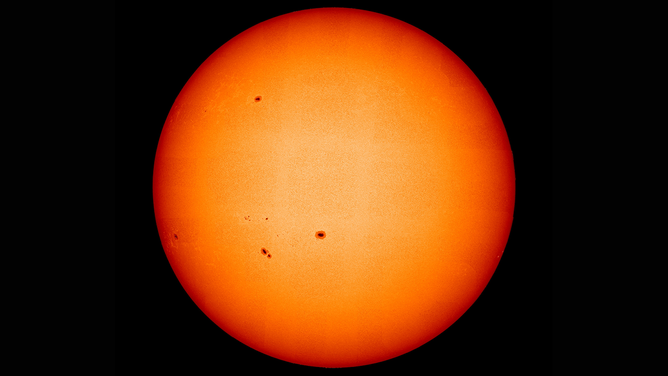
The Sun in visible light taken by ESA's Solar Orbiter's PHI instrument.
(ESA)
Solar wind speeds remained at moderate levels, driven in part by fast solar wind flowing from a coronal hole. That activity kept Earth’s geomagnetic field between quiet and unsettled levels.
THE BEST CELESTIAL EVENTS IN 2026 YOU WON'T WANT TO MISS
A coronal hole moving into a more Earth-facing position could bring increased solar wind toward Earth in the coming days, potentially causing disturbances in the planet’s magnetic field and creating opportunities for auroras.