

Severe storms on Jupiter can produce lightning 100 times more powerful than on Earth
Jupiter, the largest planet in our solar system, has humongous storms, some of which include lightning strikes that are 100 times more powerful than on Earth.
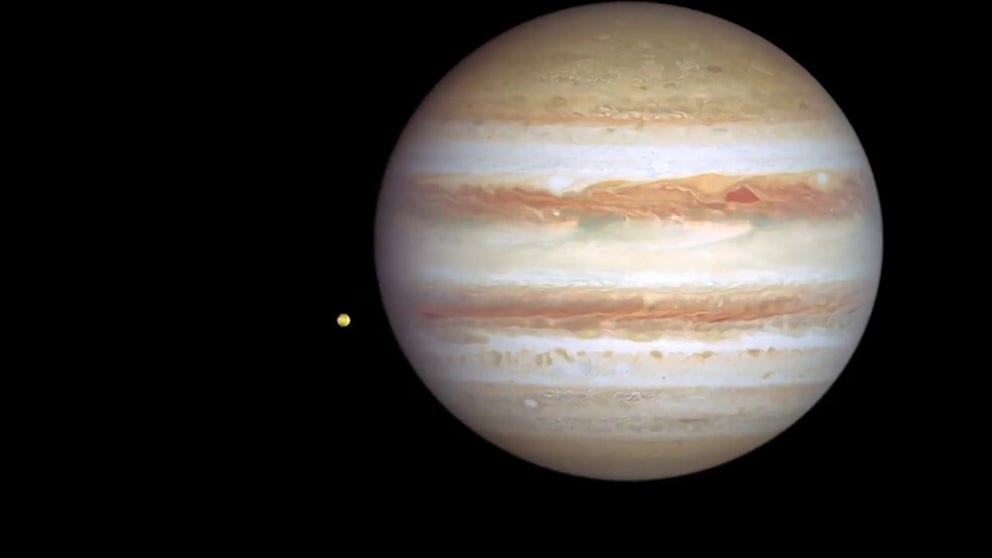
FILE: Hubble Space Telescope tracks Jupiter's changing storms
The giant planet Jupiter, in all its banded glory, takes the spotlight in these new images from NASA's Hubble Space Telescope that capture both sides of the planet. (Video credit: NASA's Goddard Space Flight Center, Paul Morris/Aaron E. Lepsch | Music credit: "From Seedling to Something" by Matt Norman)
Our solar system is full of phenomena that push humans to keep exploring the universe.
A recent study from the University of California, Berkeley revealed more about severe weather on our solar system’s largest planet.
Jupiter has humongous storms, some of which last for centuries, which include lightning strikes that are 100 times more powerful than on Earth.
According to NASA, Jupiter is about 11 times wider than Earth, with an equatorial diameter of 88,846 miles. It is also the fifth planet from the sun, orbiting at an average distance of 483.7 million miles. Jupiter is so large that if it were a hollow shell, it could fit 1,000 Earths.
There is still more for us to learn about lightning on Earth, with several new types of "transient luminous events" discovered in the last decade, according to Michael Wong, a planetary scientist at UC Berkeley’s Space Sciences Laboratory.
Studying these patterns on Jupiter could help us better understand our own planet’s powerful energy.
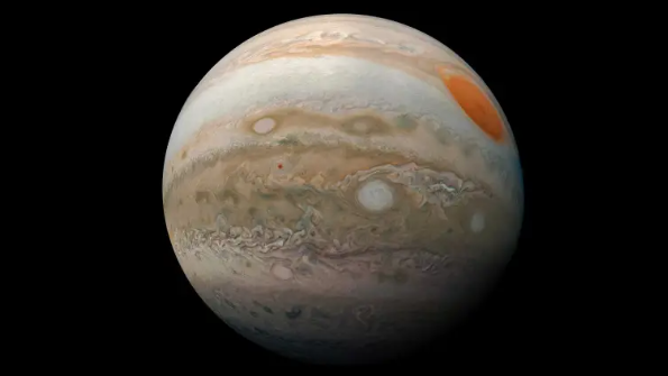
View of Jupiter from NASA's Juno spacecraft.
( NASA/JPL-Caltech/SwRI/MSSS)
"It [lightning] tells us about convection, which is how the atmosphere churns and transports heat from below," a statement from Wong reads. "Convection operates a little bit differently on Earth and Jupiter because Jupiter has a hydrogen-dominated atmosphere, so moist air is heavier and harder to bring upward."
According to Wong, almost every spacecraft that has passed by Jupiter has detected signs of lightning due to the flashes that stand out during the night side of the planet. As scientists carried out more missions, data collections showed super-powerful flashes.
HOW OFTEN DO METEORITES CRASH IN THE US?
Despite this, it is difficult to capture the raw optical power of these lightning flashes due to cloud cover on the planet’s night side.
These images and data are collected by NASA’s Juno spacecraft, which uses a microwave radiometer as its core instrument. This provides a more precise way to measure lighting power, unaffected by obscuring clouds in Jupiter’s atmosphere.
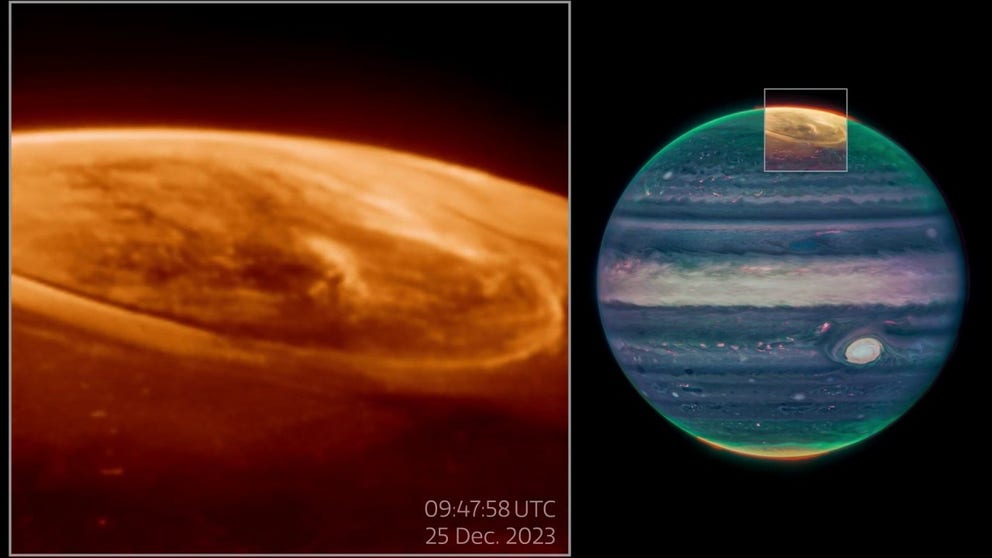
NASA's Webb telescope captured vibrant dancing aurora on Jupiter
Images captured in 2023 by NASA's James Webb Space Telescope of the massive aurora lights on Jupiter reveal unexpected activity in the gas giant's atmosphere. (Video: NASA, ESA, CSA, STScI)
There is so much storm activity simultaneously across the belts that encircle the planet that it makes it difficult to pinpoint a specific lightning storm event. That is, until 2021 and 2022, when there was a lull in storms along the North Equatorial Belt of the planet, allowing Wong to focus on one large storm at a time.
NASA STILL ON TRACK TO LAUNCH ARTEMIS II TEST FLIGHT AFTER ROLLBACK DUE TO REPAIRS
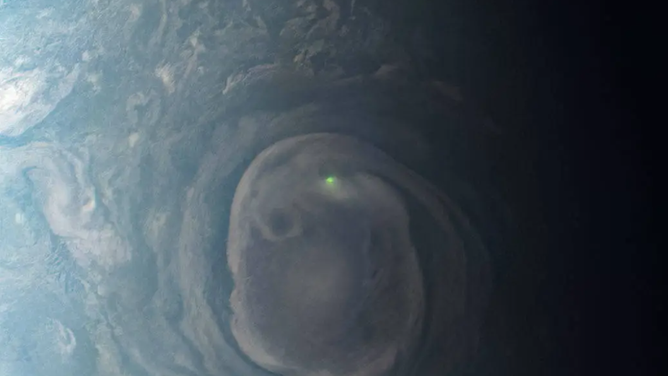
View of a lightning bolt on Jupiter taken from NASA Juno Spacecraft.
(NASA/JPL-Caltech/SwRI/MSSS)
Using the Juno spacecraft and the Hubble Space Telescope, Wong was able to pinpoint a single large storm at a time. During the research, the spacecraft got close enough to Jupiter to measure microwave radiation from lightning, with an average of three lightning flashes per second.
In total, the Juno Spacecraft detected 613 pulses of microwave radiation from lightning on the planet.
HUBBLE SPACE TELESCOPE CAPTURES DAZZLING IMAGE OF INTERACTING GALAXIES
According to Wong, the translated power from these lightning strikes was 100 or more times the power of an Earth bolt.
"Based on one study of lightning radio emissions on Earth, Jupiter’s bolts could have been a million times more powerful than those on Earth," a statement from the study reads.
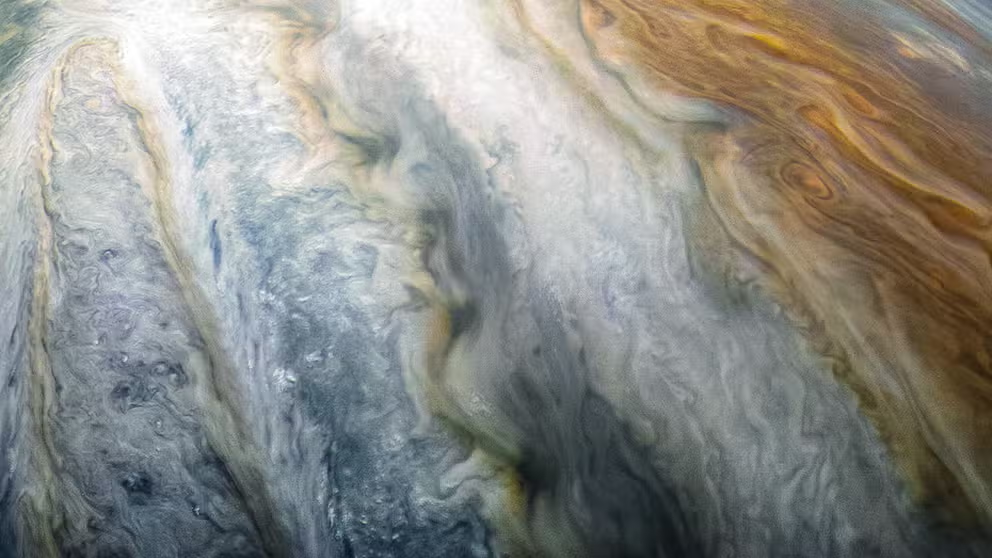
See stunning photos of Jupiter taken by NASA's Juno orbiter
On July 4, 2016, the Juno spacecraft entered orbit around Jupiter. To celebrate its 50th orbit of the gas giant, NASA released 50 images taken by the spacecraft.
Experts say that lightning on Jupiter is likely generated the same way as on Earth, but it remains a mystery.
"Lightning not only emits at radio and optical wavelengths, but also generates thermal, acoustic and chemical energy," Space Physicist at Charles University in Prague, Czechia, Ivana Kolmašová, said. "On Earth, a single bolt is estimated to release about 1 gigaJoule of total energy, or a billion Joules: enough to power 200 average homes for an hour."
Wong estimates that the energy of a lightning bolt on Jupiter ranges from 500 to 10,000 times more powerful than one on Earth.
Who knows what secrets this gaseous planet holds beneath its powerful, severe weather as experts continue to collect more data from these unknown worlds.