

This rock in Arches National Park will fall, it's only a matter of time
While it appears like the epic rock is balanced atop a pedestal, Balanced Rock is defying gravity, but this won't always be the case.
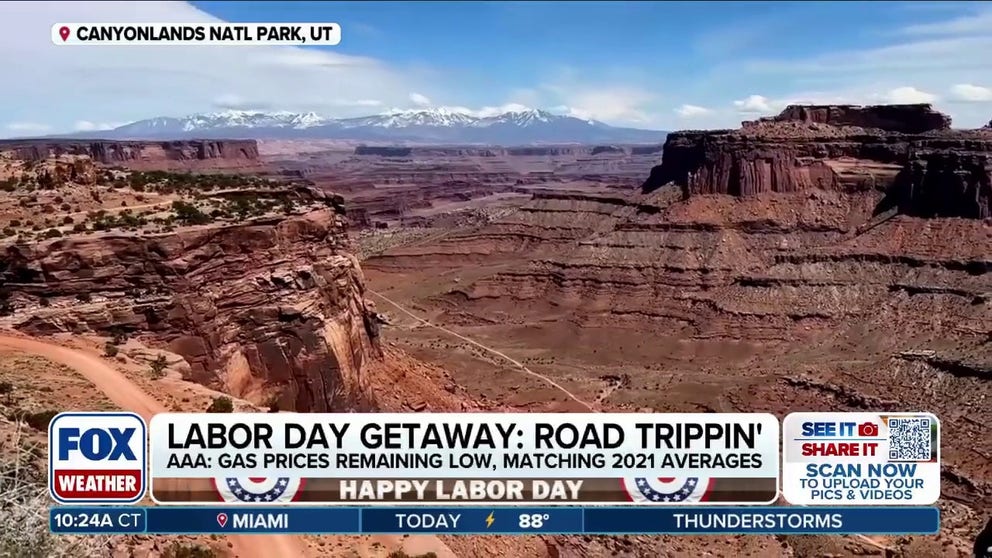
Rugged landscapes and deep canyons dazzle at Utah’s Canyonlands National Park
If you’re looking to get out into nature and explore a beautiful national park, look no further than Utah’s Canyonlands National Park. FOX Weather Correspondent Robert Ray shows us the natural wonder known for its stunning landscape and deep canyons.
MOAB, Utah – There is a 3,600-ton rock falling very, very slowly outside Moab, Utah.
Arches National Park is filled with unearthly geologic sights, and is home to Balanced Rock.
Standing an eye-popping 128-feet tall, Balanced Rock is hard to miss, and spectators should keep their distance, because it will eventually fall.
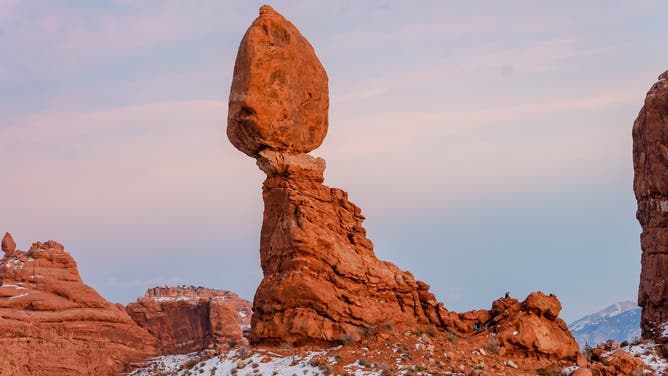
Balanced Rock at Arches National Park in Moab, Utah.
(Photo by Josh Brasted/Getty Images / Getty Images)
While it appears like the epic rock is balanced atop a pedestal, Balanced Rock is defying gravity, but this won't be the case forever.
Eventually, the 7.2 million-pound rock will tumble to the ground as the continuous process of erosion wears away and reshapes the landscape of the otherworldly park in the desert in Grand County, Utah.
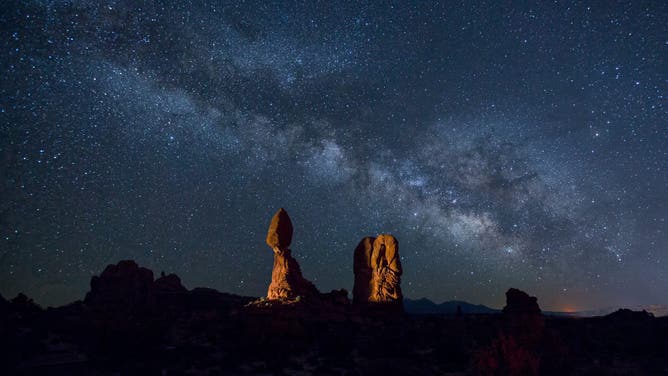
The Milky Way over Balanced Rock in Arches National Park near Moab, Utah.
(Jon G. Fuller/VWPics/Universal Images Group via Getty Images / Getty Images)
Geologists can't predict exactly when Balanced Rock will fall, though it is certain that Balanced Rock will eventually fall from its ephemeral pedestal.
Though Balanced Rock grandly sits upon a natural throne, the boulder and the throne are made up of two different types of rock.
WATCH: TRAVELERS IN UTAH FEARLESSLY DRIVE THROUGH WATERFALLS CAUSED BY FLASH FLOODING
According to the National Park Service, the massive boulder is Entrada Sandstone and the eroding throne it temporarily sits attached to is Dewey Bridge Mudstone.
Both layers were formed during the Jurassic geologic period between 144 and 208 million years ago and are the ideal ingredients for the formation of arches and balanced rocks.
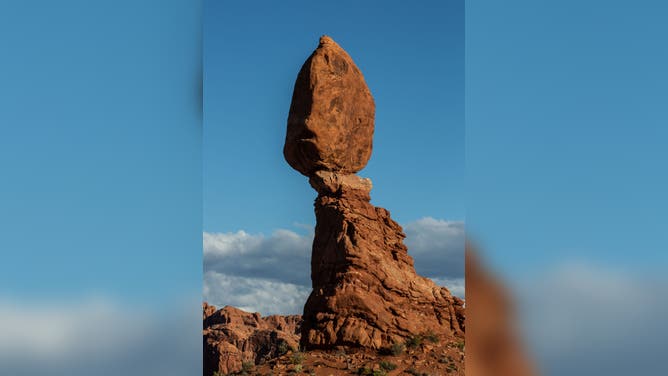
Balanced Rock at Arches National Park near Moab, Utah. Arches National Park, one of the Fabulous Five Utah Parks, is located in southeastern Utah near the town of Moab. The park preserves a colorful eroded landscape of numerous canyons, mesas, balancing rocks, and buttes, along with nearly 2,000 natural sandstone arches.
(Photo by George Rose/Getty Images / Getty Images)
According to geologists, the Dewey Bridge Mudstone pedestal holding up the 7.2 million-lb boulder of Entrada Sandstone is more susceptible to erosion, and will eventually give way for a colossal fall to the ground.
One of the things that makes Arches National Park such a unique place is the ever-changing evolution of the park that has been naturally sculpted by time. Millions of years of erosion and evolution have led to the mystical rock formations that can be observed across the roughly 76,500 acres of the national park.
FOX WEATHER CELEBRATES NATIONAL PARKS WEEK WITH INSIDE LOOK AT MOST STUNNING LOCATIONS IN AMERICA
Home to a number of geologic landmarks recognized worldwide, the most well-known of the over 2,000 documented natural arches is the Delicate Arch, a hulking 46-feet high and 32-feet wide, making it the largest freestanding arch in the park.
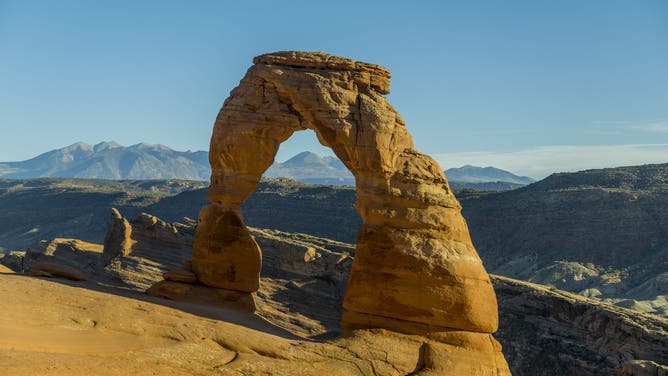
Delicate Arch at sunset in Arches National Park near Moab, Utah, United States.
(Photo by Wolfgang Kaehler/LightRocket via Getty Images / Getty Images)
In the erratic environment of Arches, all rock formations are temporary features. Through the power of water, all rock formations are constantly being carved out over time, breaking and forming new sculptures that continue to wow visitors from around the world.
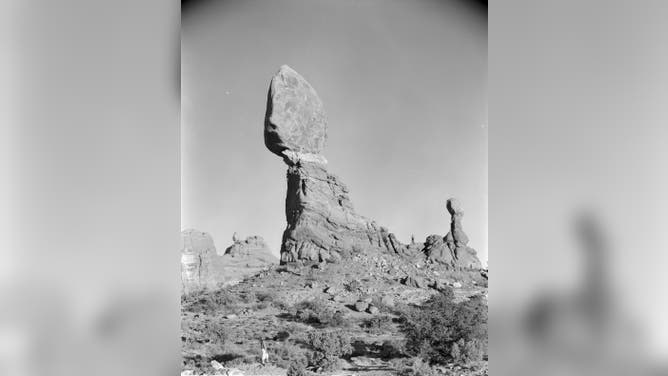
Balanced Rock and its smaller sibling photographed to the right, Chip Off The Old Block that collapsed in February 1976.
(National Park Service / FOX Weather)
Geologic time includes right now and rock structures that have stood for thousands of years could crumble, and they have.
According to the National Park Service, in the winter 1976 season, Balanced Rock's smaller sibling "Chip-Off-The-Old-Block" collapsed, leaving the massive boulder to balance on its own.
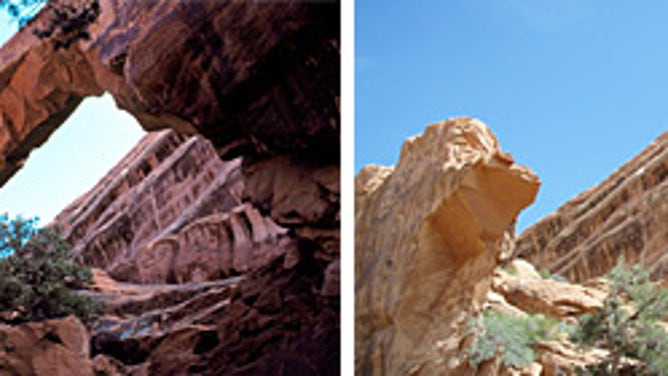
Before and after the collapse of the Wall Arch.
(National Park Service)
A notable collapse occurred overnight, with no witnesses, on Aug. 4, 2008, when nearby campers reported hearing loud rumbling noises in the night.
The Wall Arch, the 12th largest arch in the park at the time with a colossal 71-foot opening, succumbed to gravity and erosion overnight.
As one of the premier national parks the U.S. has to offer, the beauty of Arches National Park is forever changing as time progresses. So, if you're in doubt, check it out, because you never know when the next one will fall.