

Photos: Large luminous swirl of galaxy called IC 486 seen millions of light-years from Earth
NASA’s Hubble Telescope recently captured stunning images of a luminous swirl of a galaxy deep in black space.
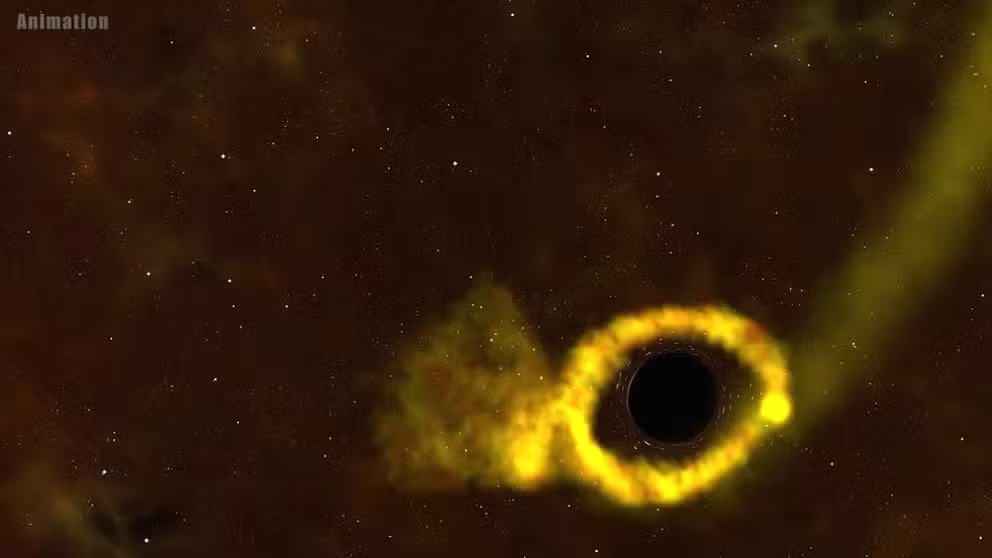
FILE: Hubble Space Telescope used to watch black hole eat a star
Astronomers used Hubble Space Telescope's ultraviolet capabilities to investigate the death of a recently devoured star nearly 300 million light-years away. These events are known as "tidal disruptions."
Space lovers have had much to be excited about with a plethora of events filling the headlines, amid the recent success of Artemis II.
NASA’s Hubble Space Telescope recently captured stunning images of a luminous swirl of a galaxy deep in black space.
What experts are looking at is a barred spiral galaxy called IC 486, which glows with ethereal light.
According to NASA, IC 486 is located on the edge of the constellation Gemini, around 380 million light-years away from Earth. A light-year is the distance light travels in one year.
Scientists sometimes categorize galaxies based on their shapes and physical features.
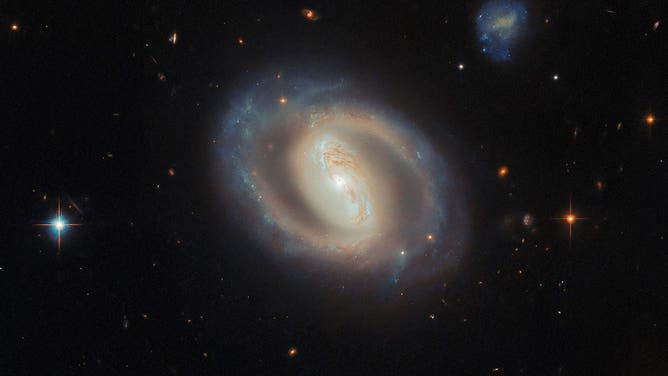
View of the galaxy IC 486 from the Hubble Telescope.
(ESA/Hubble & NASA, M. J. Koss, A. J. Barth)
Spiral galaxies are surrounded by halos, mixtures of old stars, star clusters and dark matter — invisible material that does not emit or reflect light, but still has a gravitational pull.
We cannot view these spiral arms of the Milky Way from Earth because we view the galaxy from the side.
HUBBLE TELESCOPE CAPTURES STUNNING IMAGES OF STAR SYSTEM REMINISCENT OF A VOLCANO
Thanks to the brilliant captures from the Hubble Telescope, photos reveal the variations in color across the galaxy.
Older stars dominate the pale center of the galaxy, while the faint bluish regions on the outer edges are more recent star-forming regions.
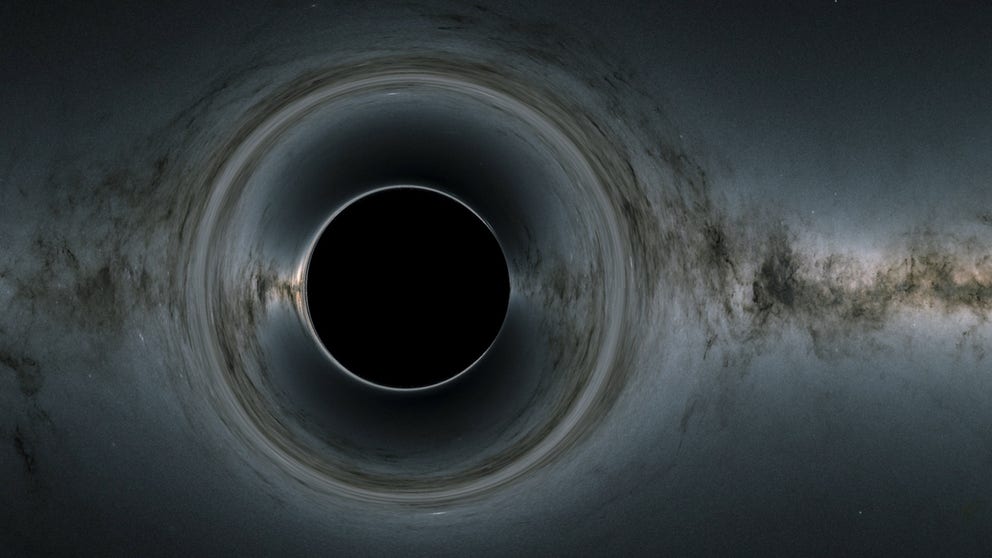
FILE: What is a black hole? Explaining the universe's most mysterious cosmic object
Much studied but not fully understood, black holes are among the most mysterious cosmic objects in our universe.
"At the galaxy’s center, a noticeable white glow outshines the starlight around it," a statement from NASA reads. "This is light from IC 486’s active galactic nucleus (AGN), which is powered by a supermassive black hole more than 100 million times the mass of the sun."
According to NASA, every sufficiently large galaxy hosts a supermassive black hole at its center, but some of these are particularly "ravenous."
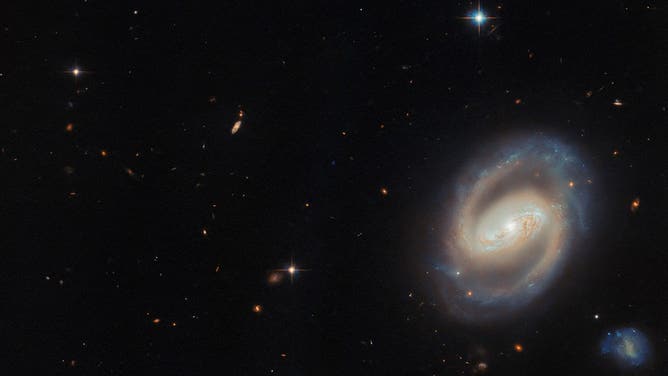
A wide-field view of the spiral galaxy IC 486 from the Hubble Telescope.
(ESA/Hubble & NASA, M. J. Koss, A. J. Barth)
Interestingly, another distant galaxy is captured in the photograph in the background of IC 486.
Through continuous observations with the Hubble Telescope, the goal is to understand how galaxies grow by linking their large-scale structures, such as the blue and white spiral arms and the activity in their nuclei.
FROM LIFTOFF TO SPLASHDOWN: SEE THE MOST PIVOTAL MOMENTS OF THE HISTORIC ARTEMIS II MISSION
Over millions of years, IC 486’s structure will continue to evolve as stars are born, age and fade, contributing to the ongoing story of galactic life.