

Severe geomagnetic storm dazzles night sky with Northern Lights in many states across US
A severe Geomagnetic Storm Watch remains in effect, as millions had the rare chance to spot the Northern Lights Monday night.
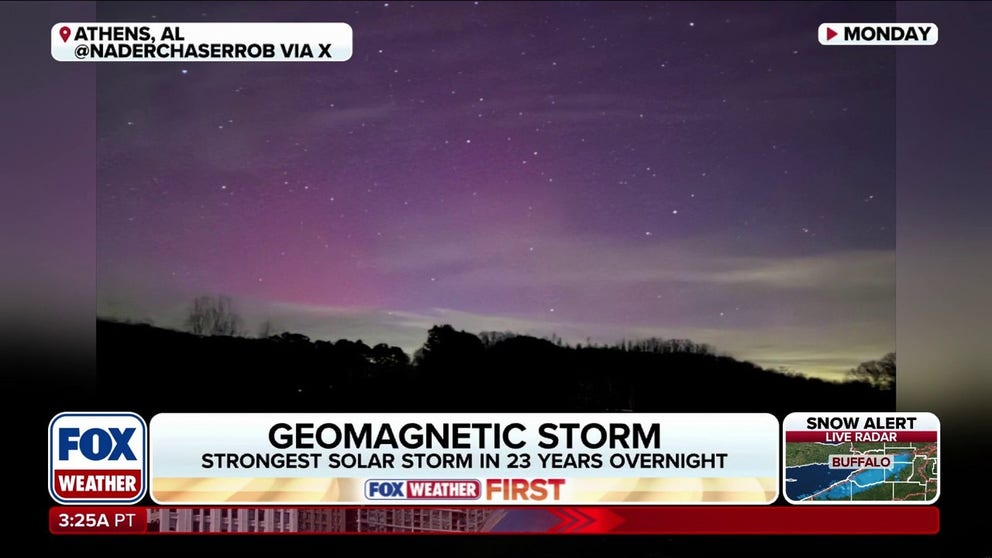
Severe geomagnetic storm lights up U.S. skies with Northern Lights
The strongest solar storm in 23 years lit up the sky last night with stunning views of the Northern Lights. Sightings were reported as far south as Arkansas and Alabama, all due to a powerful Coronal Mass Ejection.
Skywatchers across the U.S. were able to see the Northern Lights as a geomagnetic storm took place on Monday night.
A severe (G4) Geomagnetic Storm Watch was in effect, and continues into Tuesday, as people looked for pretty lights dazzling the night sky across the Northern U.S., due to the arrival of a coronal mass ejection (CME).
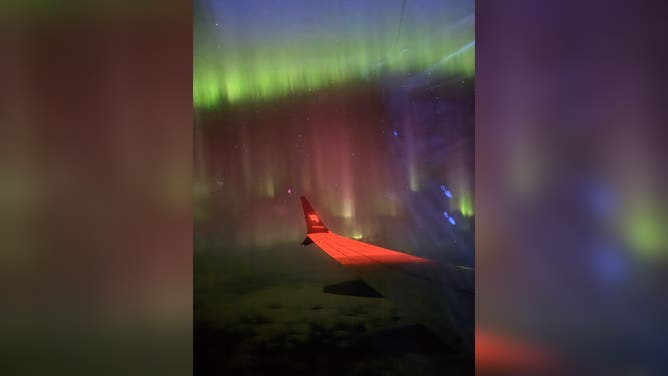
Northern Lights spotted Monday night on a flight to Iceland.
(Nicole Morrison / FOX Weather)
Shortly before 3:30 a.m. EST on Tuesday morning, the National Oceanic and Atmospheric Administration Space Weather Prediction Center reported that severe G4 geomagnetic storm levels had been reached again.
7 THINGS TO KNOW ABOUT THE NORTHERN LIGHTS
Despite an extremely powerful CME and geomagnetic storm, the Northern Lights were not as visibile as expected. This is because the solar wind magnetic field pointed north, which is the same direction as Earth.
As a result, the two repel each other and lots of charged particles are being deflected away rather than coming in and creating the aurora, according to the FOX Forecast Center.
More than 25 states had the possibility of seeing the Northern Lights due to a powerful CME that was hurling through space and was on a collision course with Earth.
We've seen photos from viewers in Alabama, Kentucky, Pennsylvania, Connecticut, Virginia, Minnesota and more.
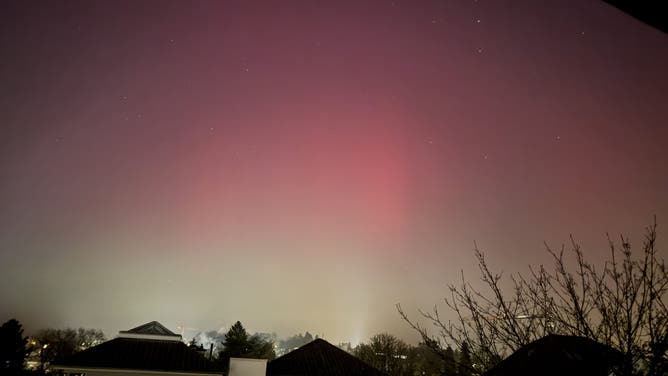
Northern Lights spotted in Wiesbaden, Germany, on Monday night
(Kim Klopp / FOX Weather)
The Northern Lights were even seen in Wiesbaden, Germany.
This event stems from an X1.9-class solar flare that erupted from the sun at approximately 11:09 a.m. on Sunday.
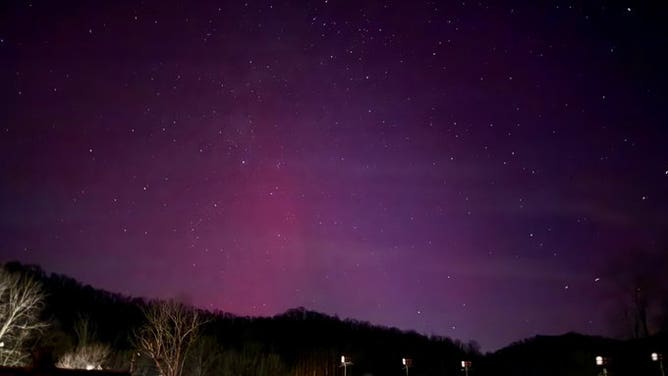
The aurora borealis were out in Floyd County, KY. The northern lights red tint was visible with the naked eye.
(@_keitharnett / X / FOX Weather)
Since this type of energy travels at the speed of light, it reaches Earth in just eight minutes. This ionized the upper atmosphere and triggered a level R3 (strong) radio blackout over Western South America and eastern South Pacific.
PHOTOS: STARGAZERS TREATED WITH BREATHTAKING DISPLAY OF NORTHERN LIGHTS ACROSS US
As this occurred, the flare was joined by a CME, which is a large expulsion of plasma and magnetic field from the sun’s corona. Unlike the flare’s light, a CME is a physical "bubble" of solar matter that travels much more slowly, acting like a shock wave as it moves through the solar system.
"Agencies around the world have modeled this specific eruption and reached a consensus that the western flank of the CME will impact Earth’s magnetic field this evening," the FOX Forecast Center said.
THESE ARE THE SKYWATCHING EVENTS YOU WON'T WANT TO MISS IN JANUARY

(FOX Weather)
Parts of the Northeast, Midwest, Mid-Atlantic and portions of the West got lucky Monday night.
![Northern Lights in Westminster, Vermont Monday night]() Image 1 of 4
Image 1 of 4Northern Lights in Westminster, Vermont Monday night (Benny Mac)
![Northern Lights in Sikeston, Missouri Monday night]() Image 2 of 4
Image 2 of 4Northern Lights in Sikeston, Missouri Monday night (Sherry Akridge)
![Northern Lights spotted in Pagosa Springs, Colorado Monday night]() Image 3 of 4
Image 3 of 4Northern Lights spotted in Pagosa Springs, Colorado Monday night (Christi Hester)
![Northern Lights in Lexington, Virginia Monday night]() Image 4 of 4
Image 4 of 4Northern Lights in Lexington, Virginia Monday night (Cynthia Cash)
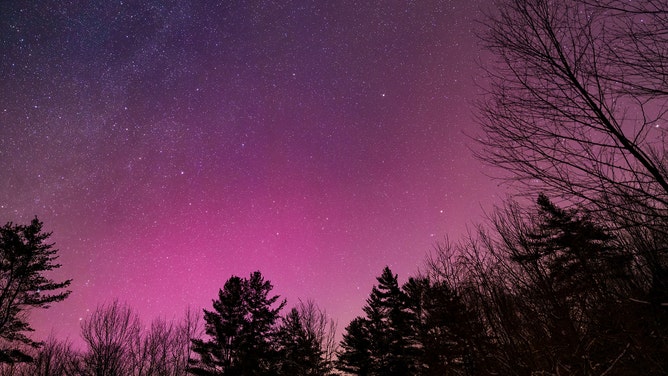
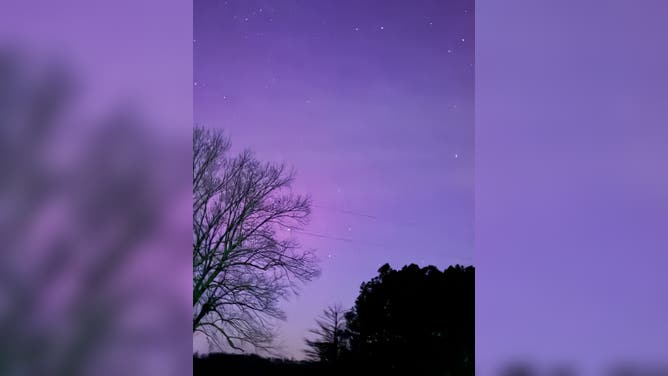
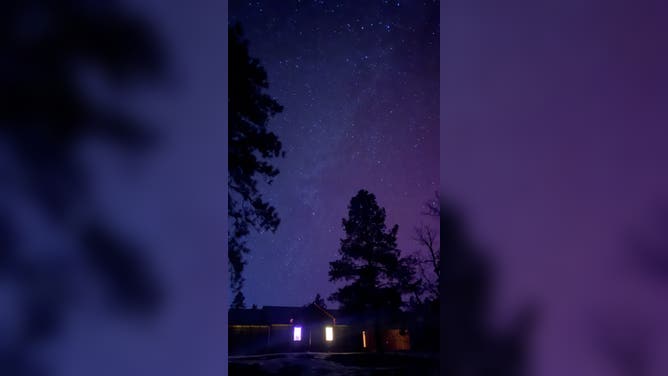
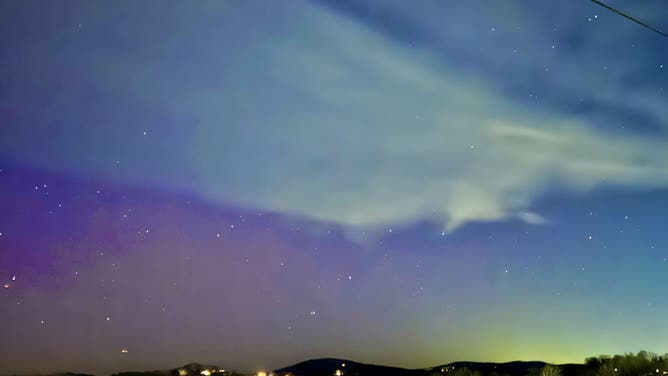
The best chance for viewers to get a clear view of the light show was in the Pacific Northwest, eastern Dakotas and Minnesota. The Northern Lights were even photographed as far south as New Mexico and Alabama.
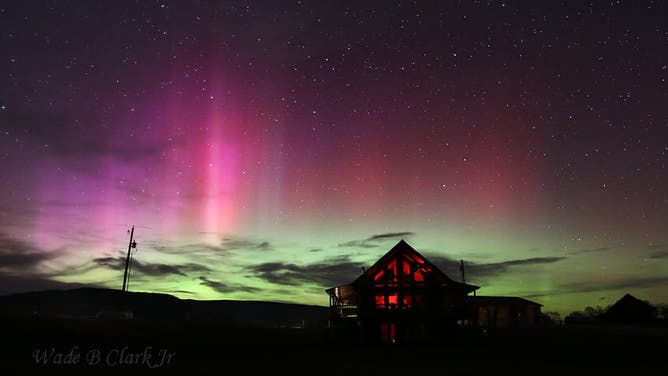
Aurora in Sapphire Village, Montana
(Wade B. Clark, Jr.)
The SWPC uses a five-point scale for the severity of geomagnetic, solar radiation and radio blackout storm events, ranging from minor to extreme.
The FOX Forecast Center said this is the largest solar radiation storm in 23 years.
THE BEST CELESTIAL EVENTS IN 2026 YOU WON'T WANT TO MISS
A geomagnetic storm is a significant disturbance of Earth’s magnetosphere that occurs when there is a very efficient exchange of energy from the solar wind into the space environment surrounding Earth, according to SWPC.