

Northern Lights could dazzle the sky in these states due to solar storm ahead of Fourth of July
The greatest impacts are expected to happen on July 3.
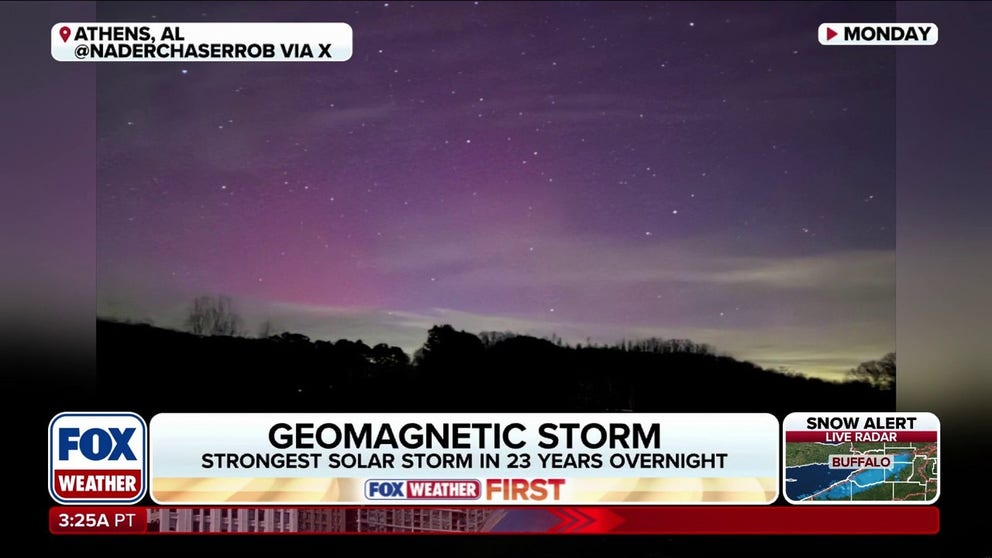
FILE: Severe geomagnetic storm lights up U.S. skies with Northern Lights
The strongest solar storm in 23 years lit up the sky last night with stunning views of the Northern Lights. Sightings were reported as far south as Arkansas and Alabama, all due to a powerful Coronal Mass Ejection.
With the Fourth of July just around the corner, fireworks might not be the only thing lighting up the night sky.
JULY SKYWATCHING GUIDE: FROM PLANETARY CONJUNCTIONS TO CLOSE ENCOUNTERS IN SPACE
A powerful solar flare that erupted on Tuesday could give people across parts of the U.S. a chance to see the Northern Lights, with the greatest impacts expected on July 3.
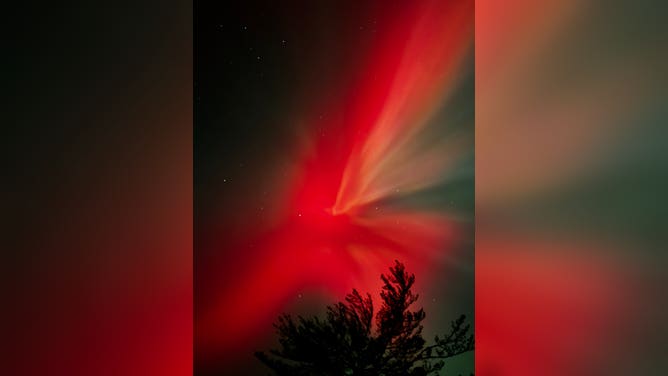
Northern Lights over Northern Minnesota
(@kkvolt/X / FOX Weather)
According to NASA, a solar storm is a sudden explosion of particles, energy, magnetic fields and material blasted into the solar system by the sun.
7 THINGS TO KNOW ABOUT THE NORTHERN LIGHTS
This typically happens when the sun creates a tangled mess of magnetic fields. As the sun rotates, those magnetic fields become twisted until they suddenly snap and release enormous amounts of energy.
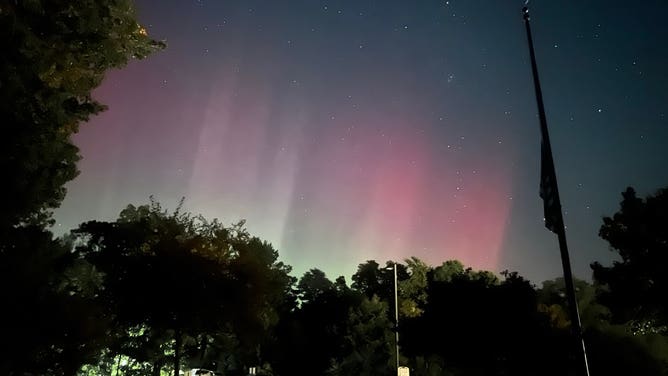
Northern Lights spotted in Ada, Michigan, on Sunday, Sept. 14, 2025.
(@MillerPrestes / X / FOX Weather)
The flare that erupted on Tuesday peaked around 4:50 p.m. EDT, according to the National Oceanic and Atmospheric Administration (NOAA).
The burst of X-rays released during the eruption reached Earth in just over eight minutes, triggering strong (R3) radio blackouts across the sunlit side of the planet.
The event disrupted high-frequency radio communications across parts of North America, where many residents experienced brief outages.
STRAWBERRY MOON DAZZLES THE NIGHT SKY AS FIRST FULL MOON OF THE SUMMER
The storm also produced a coronal mass ejection (CME), a massive cloud of magnetized solar plasma hurled into space.
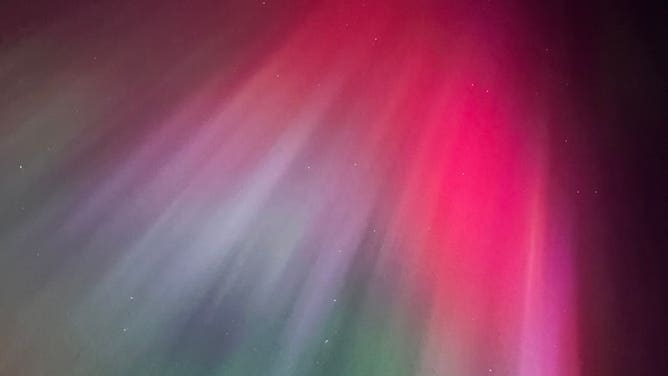
Northern Lights over Ashland, WI
(@clkoval/X / FOX Weather)
A coronal mass ejection is an eruption of solar material and magnetic fields that can create a geomagnetic storm linked to auroras. When a CME reaches Earth, it can interact with the planet's magnetic field and produce bright, active auroras.
Because of this event, officials expect the Northern Lights to be visible across parts of the northern U.S. and Upper Midwest on July 2 and July 3, according to NOAA.
HERE'S WHAT HAPPENS DURING SUMMER SOLSTICE
States with the best chance of seeing the aurora include Washington, Idaho, Montana, North Dakota, South Dakota, northern Minnesota, northern Wisconsin, northern Michigan and Alaska.
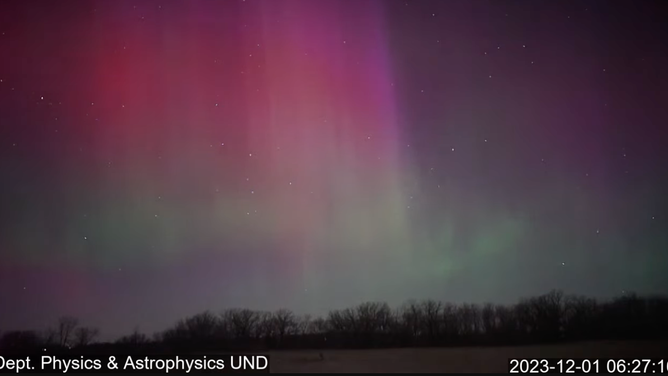
Northern Lights dazzle over the skies of Grand Forks, North Dakota on Dec. 1, 2023.
(University of North Dakota / Aurorasaurus.org / LiveAuroraNetwork.com / FOX Weather)
NOAA is forecasting a Kp index of 5 for Thursday and Friday, meaning the aurora could be visible farther south than usual if the skies are clear.
Officials say the best time to view the Northern Lights is between 10 p.m. and 2 a.m.
THE BEST CELESTIAL EVENTS IN 2026 YOU WON'T WANT TO MISS
Experts recommend finding a dark location away from city lights with an unobstructed view of the northern horizon to maximize viewing chances.