

July skywatching guide: From planetary conjunctions to close encounters in space
July will begin with a planetary conjunction, followed by multiple close encounters between the moon and various planets, before ending with a full moon.
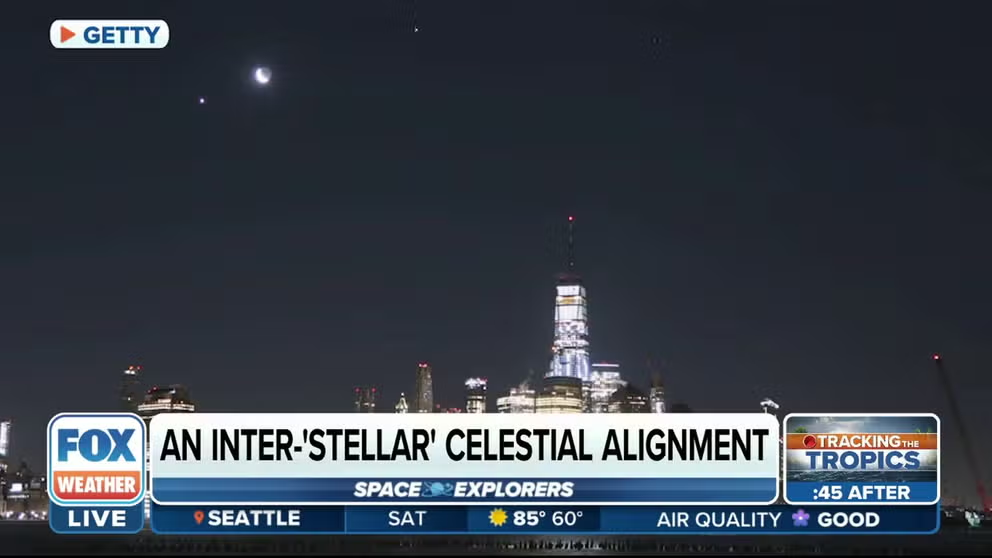
FILE: Rarity in our skies: 5 planets align together for spectacular view
This month's been a 'celestial delight' for stargazers. A rare planet alignment put on a stellar spectacle in the skies. FOX Weather's Mitti Hicks with a view that hasn't been seen in nearly two decades.
The month of July will be filled with celestial wonders, but it's the moon's close encounters with planets that will steal the show.
Almost every week brings a new spectacle to the night sky.
THE BEST CELESTIAL EVENTS IN 2026 YOU WON'T WANT TO MISS
Amateur astronomers using telescope and binoculars for watching stars, Moon, planets and other celestial objects from a countryside field in nature.
(Getty Images / m-gucci)
Following June's dazzling lineup, July will begin with a planetary conjunction, followed by multiple close encounters between the moon and various planets, before ending with a full moon.
Here's a breakdown of July's skywatching events.
July 4 — Mars-Uranus conjunction
On July 4, Mars and Uranus will appear exceptionally close to each other.
According to the College of Southern Idaho, the two will appear 0.1 degree away from each other—despite their immense physical distance—making it their closest conjunction until 2053.
The best time to witness this conjunction will be predawn.
July 6 — Earth at aphelion
Earth will reach aphelion—its farthest distance from the sun this year—on July 6.
STRAWBERRY MOON DAZZLES THE NIGHT SKY AS FIRST FULL MOON OF THE SUMMER
According to EarthSky, our planet will be exactly 94,502,961 miles from the sun during this annual July event.
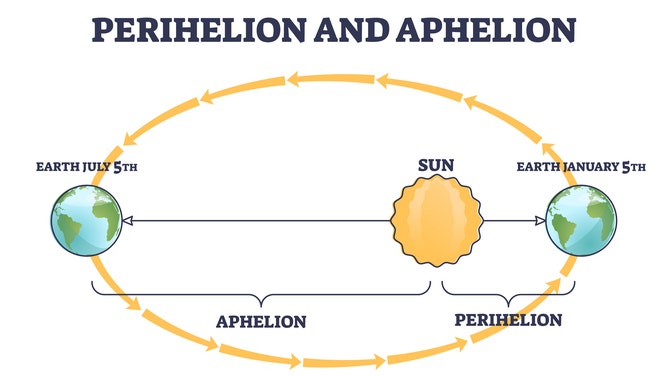
Perihelion and aphelion earth position rotating around sun outline diagram. Labeled educational planet distance from star as universe process and seasons phenomena explanation vector illustration.
(Getty Images / VectorMine)
July 7 — Moon-Saturn conjunction
On July 7, the moon and Saturn will appear in close proximity.
According to InTheSky.org, you'll actually be able to get a better look at the conjunction with the naked eye.
NASA WILL CONDUCT DARING RESCUE MISSION TO REPOSITION TELESCOPE SINKING INTO EARTH'S ATMOSPHERE
"The pair will be too widely separated to fit within the field of view of a telescope or pair of binoculars," the website said.
The pair will rise after midnight, making the best viewing window between 1 a.m. and dawn.
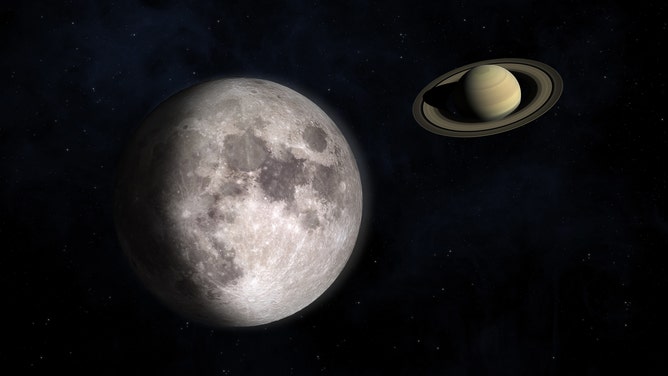
Conjunction Moon and Saturn. Meeting of the Saturn and Moon. Earth and planets of solar system. Elements of this image furnished by NASA. ______ Url(s): https://solarsystem.nasa.gov/resources/843/rare-full-moon-on-christmas-day/ https://science.nasa.gov/missions/cassini/a-valentine-from-cassini-with-love/ Adobe Photoshop CC 2023. Knoll light factory. Adobe After Effects CC 2021.
(Getty Images / buradaki)
July 11 — Moon-Mars conjunction
Shifting focus from Saturn, the moon will align close to Mars on July 11.
Once again, InTheSky.org notes that the pair will be too widely separated to fit within the field of view of a telescope or binoculars, making the naked eye your best option.
Again, predawn hours will be the best time for viewing.
NASA ANNOUNCES ARTEMIS III ASTRONAUTS IN NEXT PHASE OF MISSION TO RETURN HUMANS TO THE MOON
July 17 — Moon-Venus conjunction
Last but not least, Venus and the moon will take center stage on July 17, appearing close in proximity.
Once again, the naked eye will be your best tool.
Unlike the previous lunar and planetary conjunctions, the best time to view the moon and Venus conjunction will be shortly after sunset.
July 29 — Full moon and Jupiter at solar conjunction
Full moon:
On July 29, a full moon will grace the skies and will rise at various times depending on your local time zone.
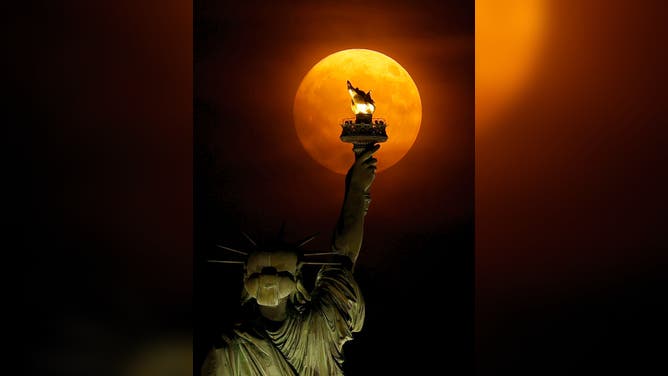
The Buck Moon rises through a haze behind the Statue of Liberty in New York City on July 2, 2023, as seen from Jersey City, New Jersey. (Photo by Gary Hershorn/Getty Images)
(FOX Weather)
Solar conjunction:
Happening the same day as the full moon, July 29 will also bring a solar conjunction.
According to NASA, a solar conjunction occurs when a planet passes directly behind the sun from Earth's perspective, making it temporarily invisible.
SEE IT: VILLA CONTAINING RUINS FROM ROMAN EMPIRE UNCOVERED IN EGYPT
This time around, Jupiter will be the planet slipping out of view.