

NASA’s new eyes: See the tech set to decode Mars and space weather
As Mars’ atmosphere continues to change, NASA activated a new instrument to study how the Sun influences the planet and what drives space weather near Earth.
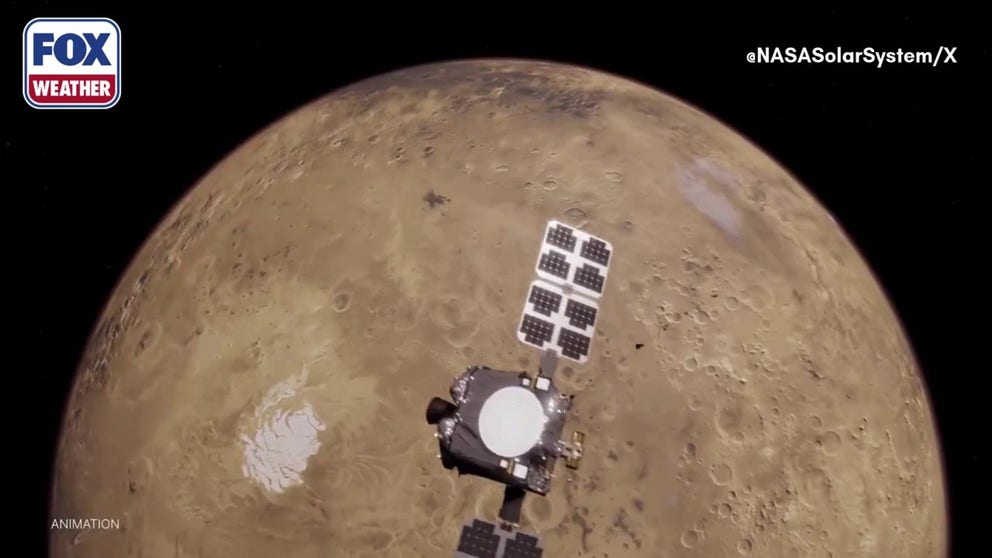
NASA ESCAPADE mission to study Mars and space weather
NASA launched ESCAPADE (Escape and Plasma Acceleration and Dynamics Explorers) on Nov. 13, 2025, which is a mission to investigate how the Sun continues to influence Mars and will begin to study space weather in new ways.
As Mars’ atmosphere continues to change, NASA activated a new instrument on Wednesday to study how the Sun influences the planet and what drives space weather near Earth.
NASA launched ESCAPADE (Escape and Plasma Acceleration and Dynamics Explorers) on Nov. 13, 2025, which is a mission to investigate how the Sun continues to influence Mars and will begin to study space weather in new ways.
MARCH SKYWATCHING GUIDE: CATCH A BLOOD MOON, PLANET CONJUNCTION, AURORAS, AND MORE
Scientists believe Mars was once warm and wet, with a thick atmosphere. But today the planet is cold and dry.
NASA suspects that the streams of particles from the Sun, known as solar wind, impacted this change by stripping away much of the planet’s atmosphere.
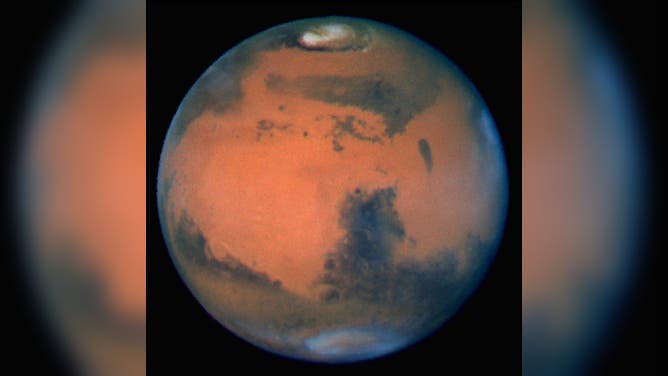
The Sharpest View Of Mars Ever Taken From Earth Was Obtained By The Recently Refurbished Nasa Hubble Space Telescope (Hst).
(Photo By Nasa/Getty Images / Getty Images)
The ESCAPADE mission will help determine the Sun’s role on Mars and could find ways to protect future explorers.
"The pioneering ESCAPADE duo will help inform the development of space weather protocols for solar events directed at Mars during future human missions to the Red Planet," said Joe Westlake, heliophysics division director at NASA Headquarters in Washington.
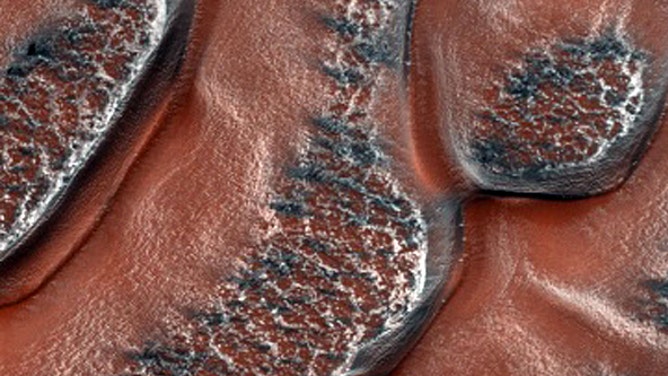
A group of crescent-shaped barchan dunes with a layer of carbon dioxide frost and ice that built up over the winter. The High Resolution Imaging Science Experiment (HiRISE) instrument aboard NASA’s Mars Reconnaissance Orbiter
(NASA/JPL-Caltech/UArizona / NASA)
There are two similar spacecraft part of ESCAPADE. Together the twin instruments will orbit around Mars and measure short-term changes in the planet’s environment.
"Having two spacecraft is going to help us understand cause and effect — how the solar wind, when it comes to Mars, interacts with the magnetic field," said Michele Cash, ESCAPADE program scientist at NASA Headquarters.
Once the first ESCAPADE reaches Mars, the twin spacecraft will follow, passing over the same areas at different times. This will uncover the changes that are happening
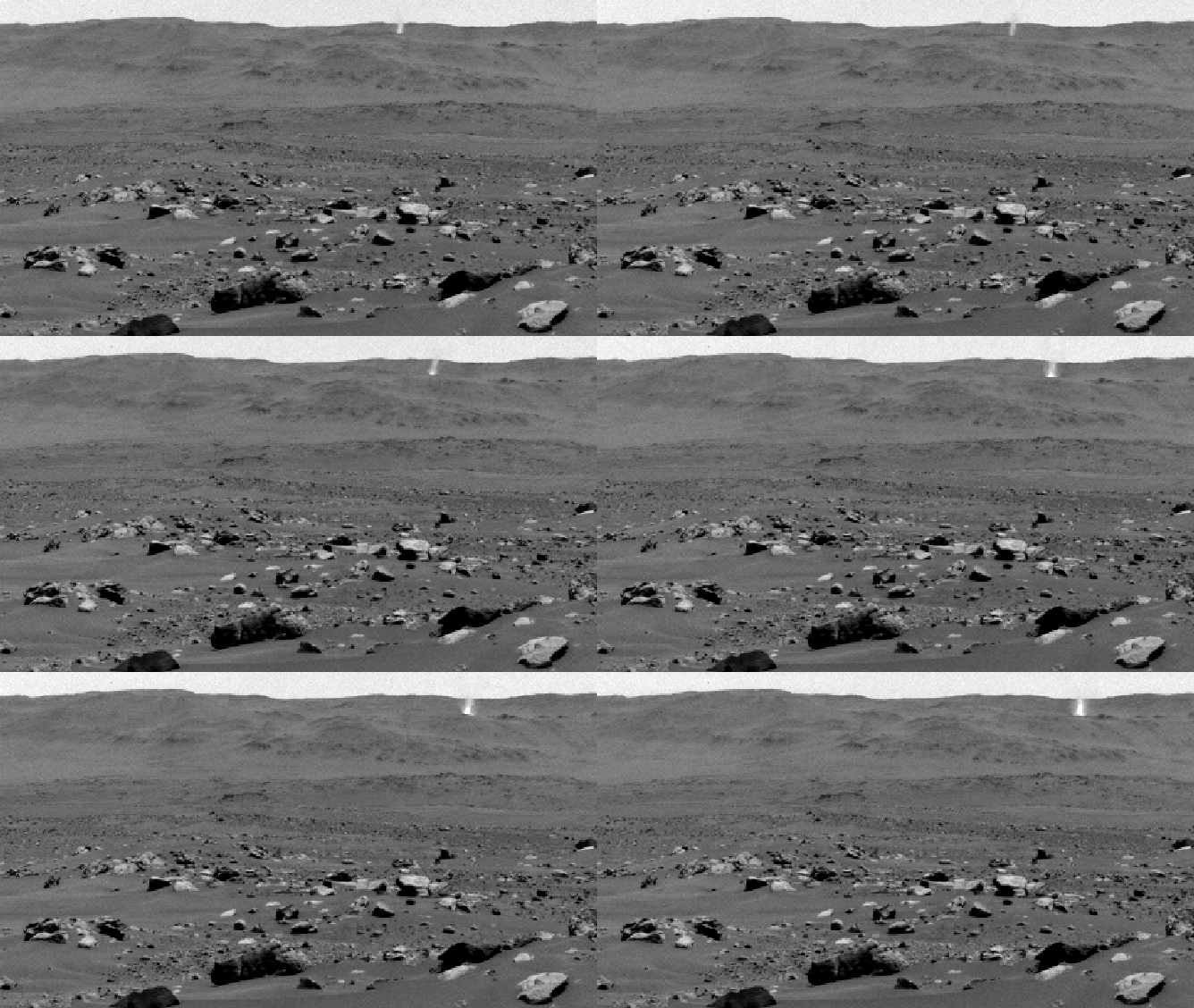
The lower portion of a Martian dust devil was captured by one of the Navcams on NASA’s Perseverance rover on Aug. 30, 2023, the 899th Martian day, or sol, of the mission.
(NASA/JPL-Caltech / NASA)
After six months, the twin ESCAPADES will shift to different orbits. One spacecraft will move farther from Mars while the other will stay closer.
This will last for five months and will investigate the solar winds and magnetosphere.
THE BEST CELESTIAL EVENTS IN 2026 YOU WON'T WANT TO MISS
"Before we send humans to Mars, we need to understand what type of environment these astronauts are going to encounter," Cash said.
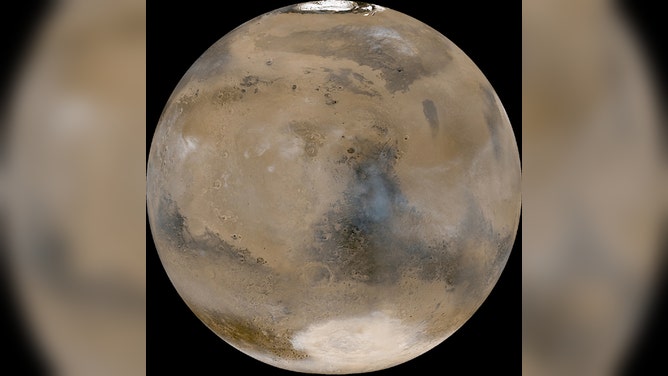
A view of Mars taken by the Mars Orbiter Camera in February 2003.
(NASA / FOX Weather)
In addition, the researchers will study Mars’ ionosphere. This will help future astronauts to send radio signals around the planet.
"The ESCAPADE mission is a game changer," said Rob Lillis, the mission’s principal investigator at the University of California, Berkeley. "The ESCAPADE mission is a game changer," said Rob Lillis, the mission’s principal investigator at the University of California, Berkeley.