

Is NASA considering reclassifying Pluto as a planet in our solar system?
In 2006, the International Astronomical Union determined Pluto was no longer able to be called a planet because other objects might cross its orbit.
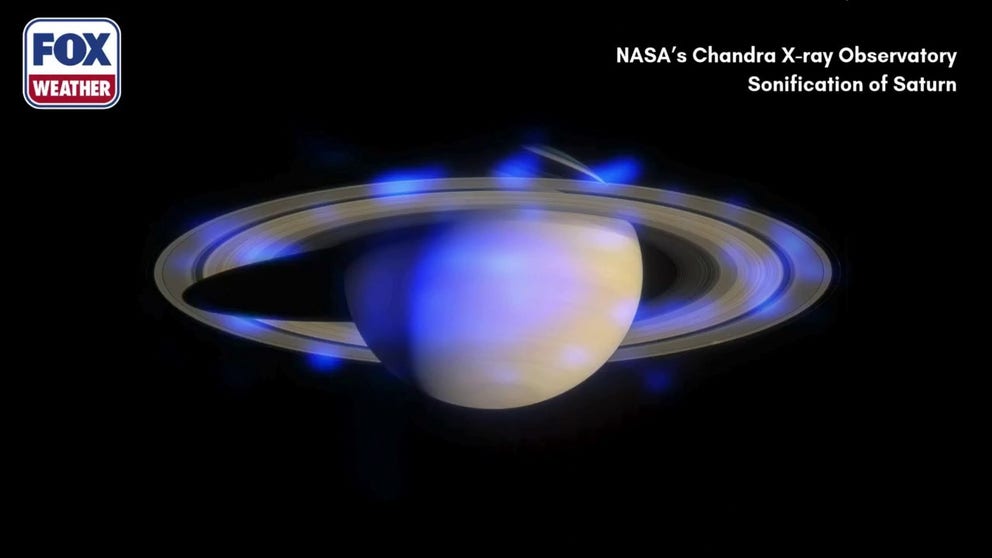
Listen: Chandra X-Ray Observatory turns planet data into sound
NASA's Chandra X-ray Observatory turns x-rays and data into sounds of planets around our solar system. These sonifications include x-rays from Chandra and data from Hubble, Cassini, and Keck telescopes.
It's been 20 years since Pluto was declassified as the ninth planet in our solar system, and many people wish it had never lost its status.
A recent comment from NASA Administrator Jared Isaacman alludes to the possibility of NASA looking into making Pluto a planet once again.
On Thursday afternoon, Isaacman replied to a post by Mike's Weather Page on X, of a letter from 10-year-old Kaela writing to NASA to tell them how much she loves Pluto and asking them to make it a planet again.
"Dear NASA, please make Pluto a planet again," Kaela's letter said. "I really want it to be a planet again!"
Kaela - We are looking into this.
— NASA Administrator Jared Isaacman (@NASAAdmin) April 9, 2026
She went on to explain the reasons why Pluto should be a planet and let NASA know her knowledge of Pluto.
Isaacman replied to the post saying, "Kaela — We are looking into this."
In 2006, the International Astronomical Union (IAU) determined Pluto was no longer able to be called a planet because other objects might cross its orbit.
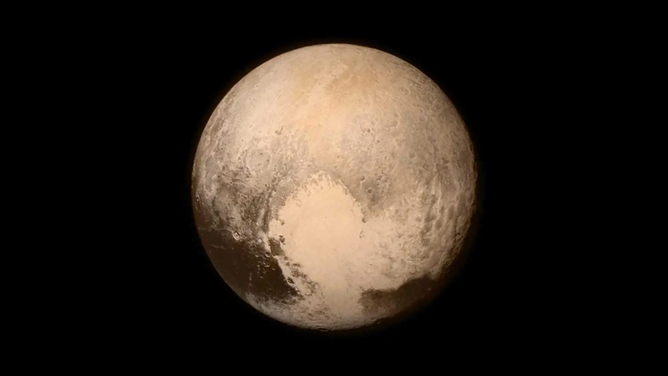
This image showing Pluto's "heart" was taken by NASA’s New Horizons spacecraft on July 13, 2015, when the spacecraft was 476,000 miles (768,000 kilometers) from the surface.
(NASA/JHUAPL/SwRI / NASA)
That same year, the IAU set a standard for what could be called a planet.
In order for something to be determined as a planet:
- It must orbit a star.
- It must be big enough to have enough gravity to force it into a spherical shape.
- It must be big enough that its gravity has cleared away any other objects of a similar size near its orbit around the sun.
WHEN WILL NASA LAND ON THE MOON? TRACKING THE ARTEMIS PROGRAM'S JOURNEY BACK TO THE LUNAR SURFACE
Pluto was discovered in 1930, and identified as the ninth planet in our solar system then.

This animation of Pluto and its largest moon, Charon, was taken by NASA's New Horizons spacecraft as it raced toward Pluto in July 2014.
(NASA/Johns Hopkins University Applied Physics Laboratory/Southwest Research Institute / NASA)
It's even smaller than Mercury, the smallest planet in our solar system, and is unlike all the other planets in the system, according to NASA.
Technical advances and discoveries led to several other objects similar to Pluto being located in the Kuiper Belt, where Pluto is.
It was then that the IAU decided to create a new category for these objects called dwarf planets.
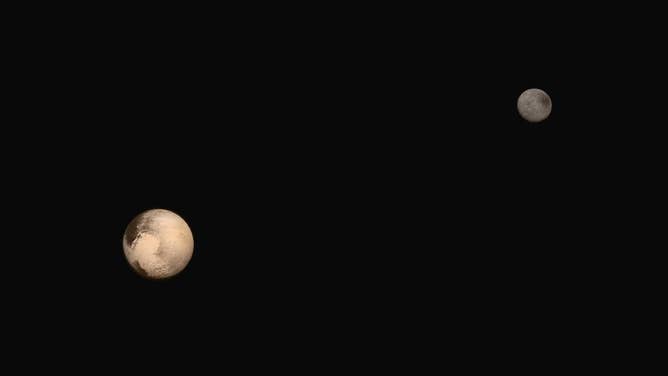
These two images of Pluto and Charon were collected separately by NASA's New Horizons during approach on July 13 and July 14, 2015. The relative reflectivity, size, separation, and orientations, and colors are approximated in this composite image.
(NASA/Johns Hopkins University Applied Physics Laboratory/Southwest Research Institute / NASA)
So, Pluto was demoted to dwarf planet, causing discourse among citizens and astronomers alike who disagreed with the IAU's definitions, NASA said.
ICE VOLCANOES SPOTTED ON PLUTO’S SURFACE FROM NASA SPACECRAFT
No official action has been taken to try and get Pluto back on the map as a planet, but will NASA petition to redeem its status? Only time will tell.