

A look at how 13 beluga whales came to live at SeaWorld San Antonio from Canada
The journey to get these whales from Canada to five different aquariums was well-planned and carefully orchestrated over the course of more than six months, with five different aquariums getting whales from the large group of 30.
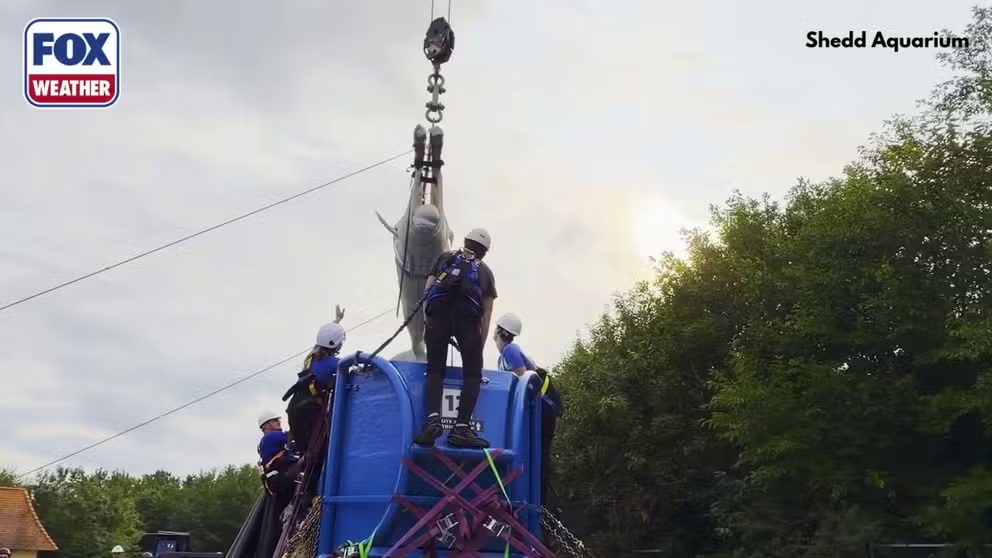
Watch: Beluga whales transported from closed marine park in Canada to US
Video taken on Aug. 13, 2026, shows the second round of relocation efforts for 30 beluga whales left at Marineland Canada, which closed in 2024. Twenty-eight of the whales are staying in the U.S. at four different aquariums while two of the whales went to an aquarium in Spain.
SAN ANTONIO– In August, SeaWorld San Antonio completed its final mission to relocate a group of beluga whales from a closed marine park in Canada and were no longer able to be cared for there.
The journey to get these whales from Canada to five different aquariums was well-planned and carefully orchestrated over the course of more than six months, with five different aquariums getting whales from the large group of 30.
SeaWord San Antonio took in 13 beluga whales, the largest number of the aquariums.
How it started
"We manage a very large collection of beluga whales in the country," said Steve Aibel, Vice President of Zoological Operations at SeaWorld San Antonio. "We're very aware of where the belugas in zoological aquariums are."
Aibel said all the aquariums involved; Georgia Aquarium, Shedd Aquarium, Mystic Aquarium and SeaWorld San Antonion and San Diego, all had their own whales, and knew about the situation in Canada, with legislation affecting the future care of the whales at the closed park.
TIMELINE: HOW 30 BELUGA WHALES JOURNEYED FROM A CLOSED CANADA MARINE PARK TO 5 NEW AQUARIUMS
"In January, we learned that there was some interest in us making a trip up to Canada to start to do an exploratory mission, if you will, to see what, if anything, could the aquarium consortium do to help these whales," Aibel said.
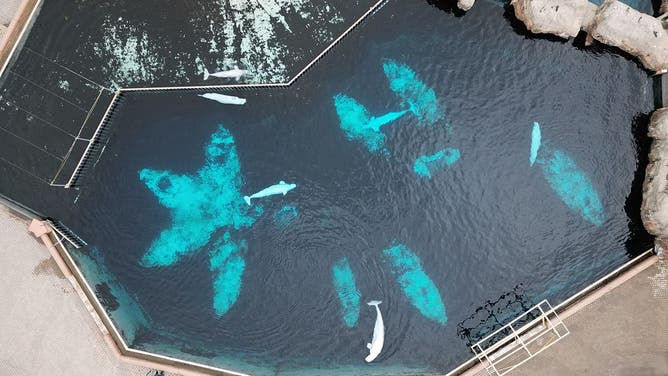
Before their rescue, the belugas had remained at the closed Marineland of Canada facility in Niagara Falls, Ontario, where they were held after the park shut its doors to the public in 2024. This aerial view shows various belugas still held in captivity at the now closed Artic Cove exhibit, at Marineland, in Niagara Falls, Canada, on November 13, 2025
( Daphné LEMELIN / AFP via Getty Images / Getty Images)
So, they made the trip up to Canada in the cold with a team consisting of behavioral experts, animal transport experts, veterinarians and more, to assess the whales' health, behaviors and if they could be moved.
Aibel said that was just the beginning, and after that trip came many meetings, discussions and coordination efforts to figure out which whales would go where and in what groups.
SCIENTISTS DISCOVER 57 NEW MARINE SPECIES LURKING IN THE DEPTHS OF THE SOUTH ATLANTIC
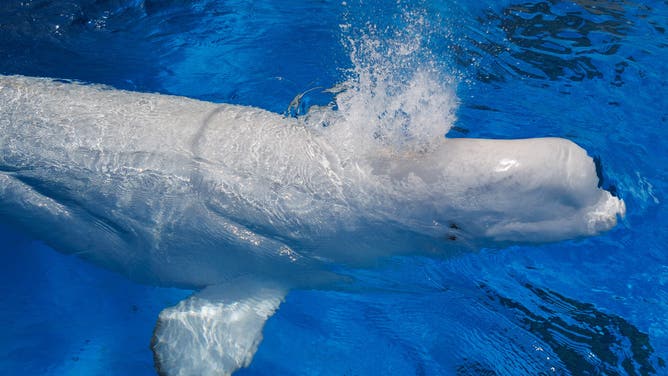
San Diego, California - After a 12-hour plane ride, a beluga whale swims around a holding pool at Sea World on Saturday, Aug. 22, 2026. This whale, along with two others, was rescued from the shuttered Marineland theme park in Niagara Falls, Ontario. Their names are Xavier, Cyprus and Jasper.
(Kristian Carreon / The San Diego Union-Tribune / Getty Images)
"None of it was set in stone as to they were going to come to an American aquarium or zoo, because those are decisions that we don't make," Aibel said. "But we wanted to offer our expertise up as subject-matter experts on beluga whales."
Months later, NOAA and the American and Canadian governments gave approval for the whales to move and in July, the relocation process began.
Relocating begins
Aibel was part of the first relocation team, when groups began moving the first few whales to their new homes.
"I did the math," he said. "I think I was on the plane with at least 20 or 21 of the whales that were moved."
SCIENTISTS DISCOVER NEW PENGUIN SPECIES THROUGH BREAKTHROUGH GENETIC ANALYSIS
SeaWorld San Antonio's first group of whales, Frankie and Bertie Botts led the pack in that first group.
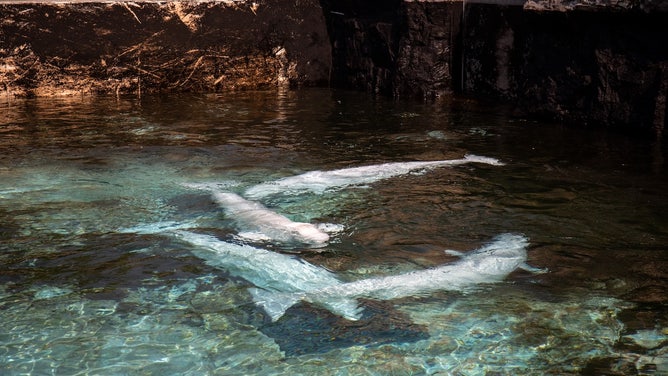
Beluga whales together at Georgia Aquarium.
(Georgia Aquarium / FOX Weather)
Aibel said they settled in very well and were integrated with the aquarium's original seven whales after a few months.
He said beluga whales have strong social groups, so it was extremely important to all the people involved that the whales who were close to one another went together.
So, that meant that the group of seven female belugas that were socially integrated came to SeaWorld San Antonio all together.
The last transport, a pack of four males, joined Frankie and Bertie and the girls in August.
How transport happened
Getting the belugas from Canada to their respective aquariums in the U.S. and Canada was no simple or spontaneous feat.
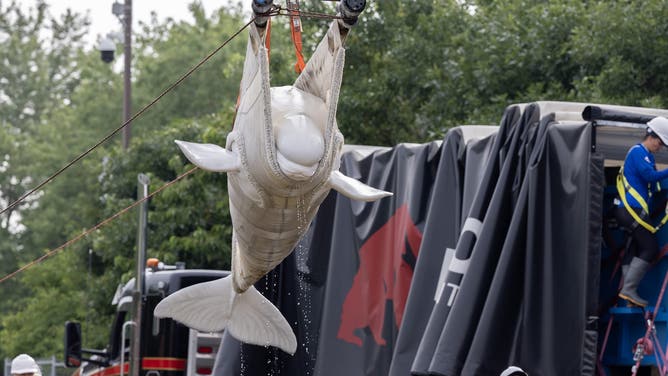
The whales were carefully placed in custom-made harnesses and put into tiny swimming pools safe for transport.
SEE IT: RARE TWO-HEADED TURTLE HATCHLING FOUND ON CAPE COD
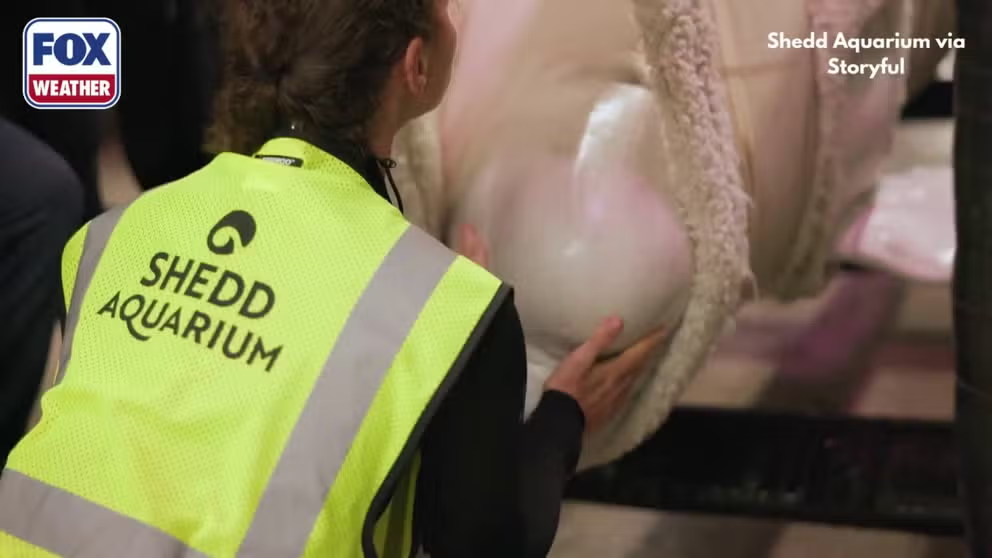
See it: Beluga whales relocated from closed Canadian marine park after nearly 2 years
When a marine park in Canada that closed nearly 2 years ago could no longer care for the 30 beluga whales housed at the park, plans went into place to relocate the whales to new homes. In late July, relocation efforts began, with four of the whales being taken to their new home at Shedd Aquarium in Chicago.
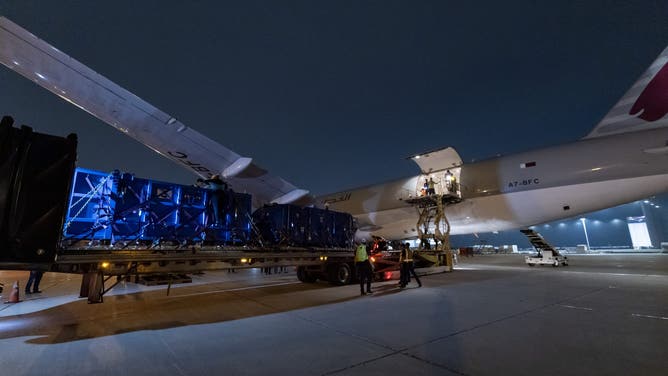
The animals were then loaded into a cargo plane.
"The most whales that we put on a cargo plane at one time, I think, was seven," Aibel said. "They are very large cargo planes."
The whales were very carefully monitored on the flights and once they got on the ground, they were put on trucks and taken to their aquariums.
MEET THE 1-IN-100 MILLION ‘GHOST’ LOBSTER HELPING SCIENTISTS UNLOCK A COLORFUL MYSTERY
Once they arrived at the park, they were lifted out of their cargo transports and placed into water waiting for them.
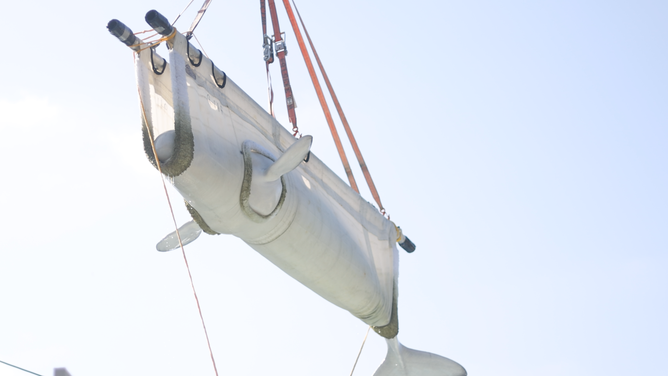
A beluga whale is transported using a crane at SeaWorld San Antonio
(SeaWorld San Antonio / FOX Weather)
Aibel said the trainers were excited and ready to meet the new whales each time.
Prior to transport, trainers from SeaWorld San Antonio were brought up to Canada to start observing the whales and working with them, so their new homes weren't as jarring for them.
A team effort
There were many people involved in the process, from police escorting tractor-trailers to the airports to the teams like Aibel, who made sure the whales weren't in distress, to the airport employees who helped get the whales on and off the planes safely.
"Hundreds of people are involved in this operation," Aibel said. "It takes a lot of coordination, a lot of talent. We brought in amazing people."
57-FOOT RARE, ENDANGERED FIN WHALE FOUND DEAD ON BOW OF CRUISE SHIP IN ALASKA
Aibel said the team they used for this experience had decades of experience caring for marine mammals and transporting them safely.
So far, 24 of Marineland’s 30 beluga whales have been relocated: eight to Shedd Aquarium in Chicago, nine to SeaWorld San Antonio, three to SeaWorld San Diego, two to Georgia Aquarium and two to Oceanogràfic València in Spain.
(Brenna Hernandez / Shedd Aquarium Sources)
The trainers involved also have a massive amount of respect and care for the whales, Aibel said, including those in Canada.
"They really were very caring people. They loved these whales, and they did a really nice job at preparing them to travel," Aibel said of the Marineland Canada trainers.
THE RACE TO SAVE THE WORLD'S MOST ENDANGERED MARINE MAMMAL ISN'T OVER YET
He said there's always a lot of focus on the trip itself, but the success is all due to the trainers at Maineland Canada and the team at the aquariums the whales were going to.
Shedd Aquarium in Chicago, which welcomes about 2 million visitors annually, is caring for seven belugas rescued from Marineland of Canada in its 3-million-gallon Abbott Oceanarium.
(Brenna Hernandez / Shedd Aquarium Sources / FOX Weather)
"Those people are amazing," Aibel said. "Amazing at how they brought these whales in, and the time and the effort they put into their well-being and care."
Aibel gave a shout-out to everyone involved in the process from start to finish.
"It's very humbling to be around these people of passion and to know that they would really do anything for these whales 24 hours, seven days a week."
What comes next…
The whales are settling in nicely. Aibel said the team is moving at their own pace, working to help them ease into their new lives, but also make sure they are comfortable.
Aibel said the whales have a lot of things to accomplish on their horizon and don't have finalized plans for their future.
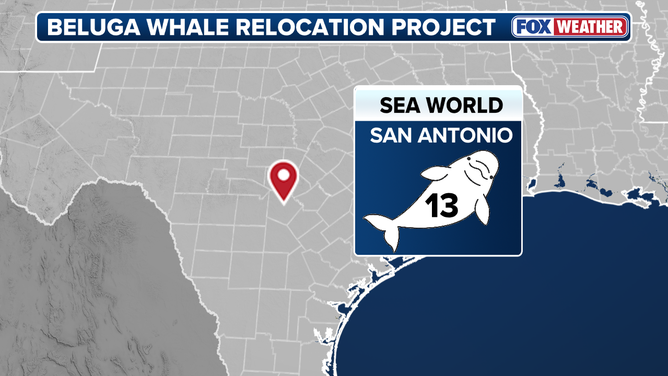
Thirteen of the whales are being relocated to SeaWorld San Antonio.
(FOX Weather)
"Right now, our focus is on their rescue and their rehabilitation and their acclimation," Aibel said.
Aibel said they're very excited to have the whales in their care and want to inspire and connect with their guests who visit and have heard about this relocation operation to do something amazing with animals after learning about the whales.
"There's nothing like looking them in the eye and becoming inspired by a whale," he said. "It's a powerful thing, and I'm very committed to making sure that people have that opportunity, because it's different if you see them up close and personal."
All 30 whales are in their new aquariums in the U.S. and Spain.