

Hybrid 'mutant' pig population explodes following 2011 Japanese nuclear accident
After the nuclear accident occurred and humans fled Fukushima, a population of domestic pigs escaped and began breeding with wild boars in the area.
FILE: Farm animals rescued after wandering away
Deputy Korporal of the Grant County Sheriff’s Office found himself in a peculiar situation when he was tasked to help return farm animals safely in Indiana on Sunday.
A population of hybrid feral pigs and wild boars is gaining attention following a 2011 nuclear accident caused by a magnitude 9.0 earthquake and tsunami in Fukushima, Japan.
After the nuclear accident occurred and humans fled Fukushima, a population of domestic pigs escaped and began breeding with wild boars in the area.
WATCH: MASSIVE ALLIGATOR MUNCHES ON SMALLER ALLIGATOR IN FLORIDA WILDLIFE PARK
A new study, published in the Journal of Forest Research, highlights these mutant pigs and their rapid interbreeding, especially as it relates to population control and genetic turnover since the accident.
ISHINOMAKI, JAPAN - APRIL 14: Survivor is devastated in Ishinomaki, Miyagi, northern Japan on April 14, 2011. A magnitude 9.0 earthquake and tsunami swept out northeast coast area in Japan on March 11.
(Hitoshi Yamada/NurPhoto / Getty Images)
The study states that breeding of wild and domesticated animals is an issue worldwide for wildlife management and conservation as well as how it disrupts evolutionary processes.
These hybrid pigs offer scientists the chance to study these animals and their genetics in a natural environment. So, scientists analyzed mitochondrial DNA inherited from these pigs' mothers, along with nuclear genetic markers, from 191 wild boar and 10 domestic pigs collected between 2015 and 2018.
VIDEO: MASSIVE SWARM OF TERMITES APPEAR IN NIGHT SKY, AND IT'S ACTUALLY MORE COMMON THAN YOU'D THINK
Scientists used the DNA to find out how many generations had passed since hybridization and how much of their domestic ancestry remained.
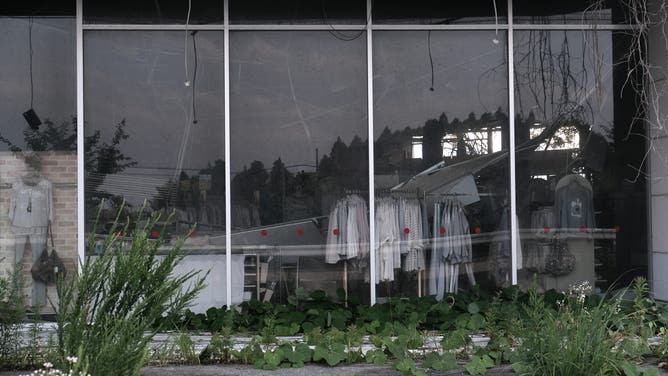
![An abandoned clothing shop in Tomioka, Fukushima Prefecture, Japan, on Monday, July 3, 2023.]() Image 1 of 2
Image 1 of 2An abandoned clothing shop in Tomioka, Fukushima Prefecture, Japan, on Monday, July 3, 2023. (Soichiro Koriyama/Bloomberg )
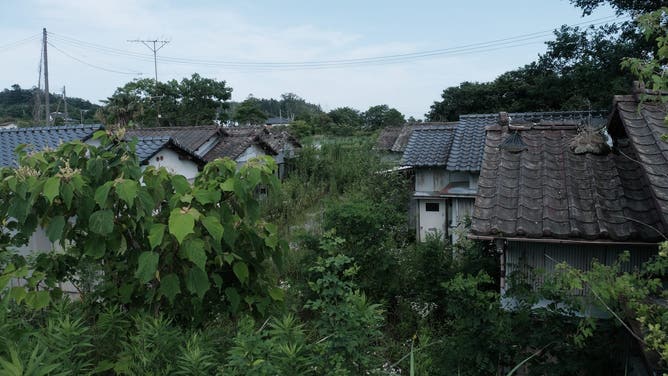
![Abandoned houses in Okuma, Fukushima Prefecture, Japan, on Monday, July 3, 2023.]() Image 2 of 2
Image 2 of 2Abandoned houses in Okuma, Fukushima Prefecture, Japan, on Monday, July 3, 2023. (Soichiro Koriyama/Bloomberg )
"We hypothesized that the domestic swine’s unique trait, a rapid, year-round reproductive cycle, might be the key," co-author of the study, Dr. Donovan Anderson of Hirosaki University, said.
The DNA actually revealed that the wild boar carrying domestic pig's DNA had significantly less pig-derived genes than hybrids whose mothers were wild boars.
SEE IT: US WILDLIFE OFFICIALS FIND SEVERAL VENOMOUS SCORPIONS BEING SMUGGLED FROM HONG KONG
Because domestic pigs' reproductive cycles are much faster than that of a wild boar, scientists found that hybrids with pig maternal lines were already five generations removed from the original hybrid cross.
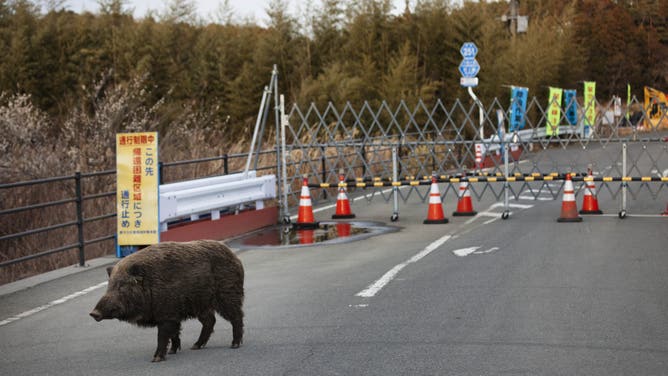
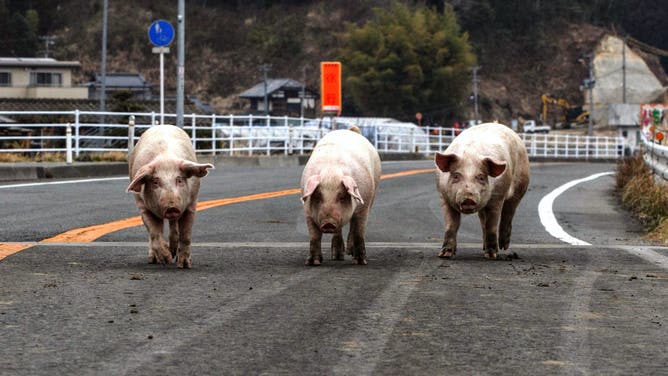
A wild animal roams around near a check point in an evacuation zone area damaged by the 2011 earthquake and tsunami in Tomioka, Fukushima Prefecture, Japan, on Wednesday, March 2, 2016.
(Ko Sasaki/Bloomberg / Getty Images)
The study showed that lack of human intervention allowed for the wild boar population to increase rapidly. Combined with the ability to breed more often, which was passed down from the pig mothers, also helped the pigs and wild boars' genes mix together more quickly.
The results of the study highlighted the importance of monitoring hybrid populations for both genetic understanding and wildlife management moving forward.