

Fossil reveals ancient giant salamander that lived 3.5 million years ago
Researchers discovered three fossilized vertebrae from a giant salamander in the Cryptobranchidae family in 1990 while working in the Ajimu area of Oita Prefecture, Japan.
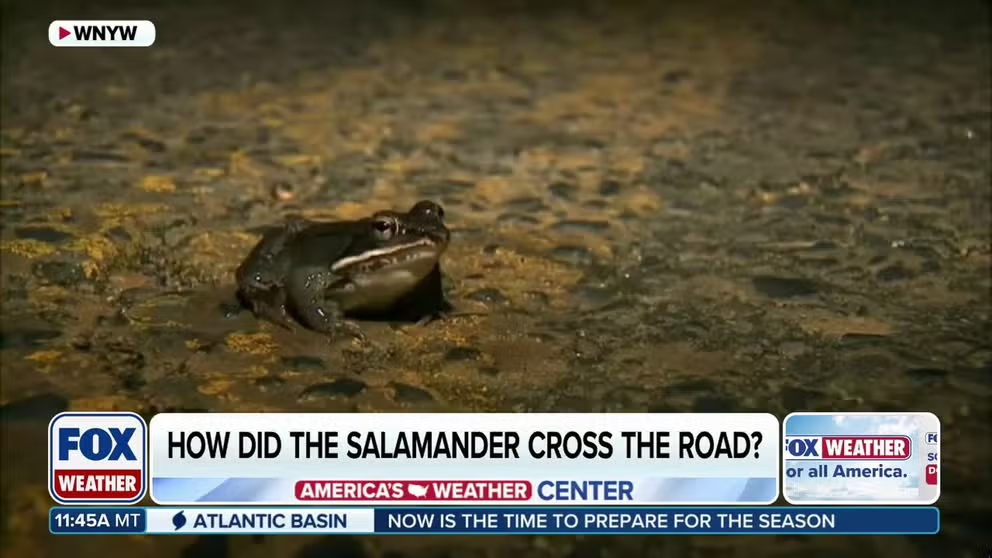
FILE: How did the salamander cross the road? Spring amphibian migration starts in New York City
Conservation and Land Use Program Coordinator for the Hudson River Estuary Program Laura Heady joined FOX Weather to provide insight into an interesting question: Why salamander cross the road? Strap in as spring amphibian migration starts in New York City.
Fossils uncovered in Japan nearly two decades ago have revealed a giant salamander believed to have inhabited the region's lakes and marshes roughly 3.5 million years ago.
ATLANTIC SHARK INSTITUTE TAGS ITS FIRST-EVER HAMMERHEAD SHARK OFF COAST OF RHODE ISLAND
Researchers discovered three fossilized vertebrae from a giant salamander in the Cryptobranchidae family in 1990 while working in the Ajimu area of Oita Prefecture, Japan.
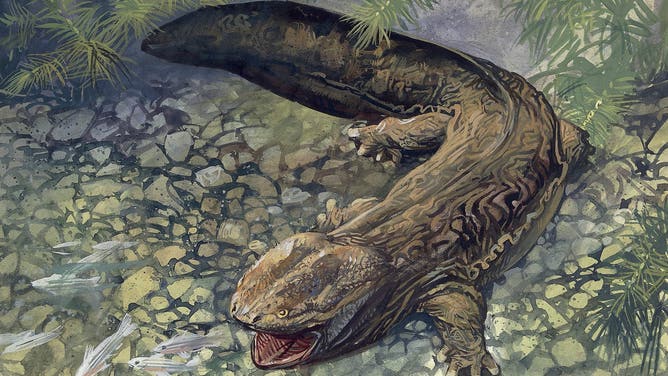
Scientist found fossils that belong to the species, Limnospondylus ajimuensis.
(De Agostini via Getty Images/De Agostini via Getty Images / Getty Images)
"Ajimu contains the only site in the world where fossils of the giant salamander family and extant genera have both been found," the lead author, Masahiro Noda, said. "I'm delighted that this study has highlighted Japan as a crucial region for understanding their evolutionary history."
The bones were preserved in the Tsubusugawa Formation, a layer of ancient lake sediments.
ARCHEOLOGISTS RESTORE LARGE FRESCO ON THE CEILING OF A HOME IN POMPEII FROM 2,000 YEARS AGO
Between 1995 and 1997, researchers continued excavating the site and collected additional fossil remains.
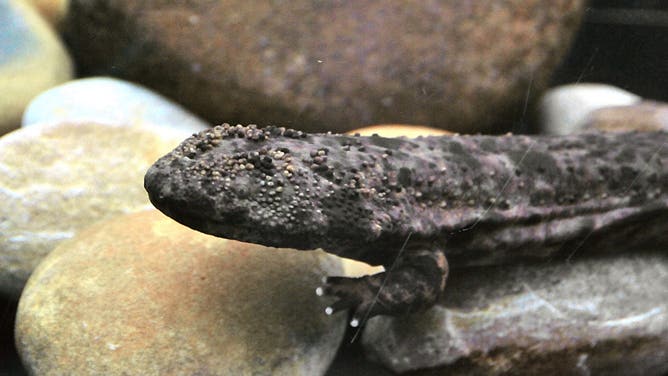
A Japanese giant salamander is seen in its habitat.
(KAREN BLEIER/AFP via Getty Images / Getty Images)
Scientists initially believed the fossils belonged to a living giant salamander species, but further analysis revealed they represented a previously unknown genus and species, Limnospondylus ajimuensis.
Using micro-computed tomography and geometric morphometric analysis, researchers determined the fossils belonged to a previously unknown species measuring about 3.6 feet long.
SCIENTISTS MAKE RARE DISCOVERY IN ONE OF EARTH'S MOST EXTREME OCEANS
By identifying this new genus, researchers gained a better understanding of how giant salamanders evolved over time and how they adapted to changing environments.
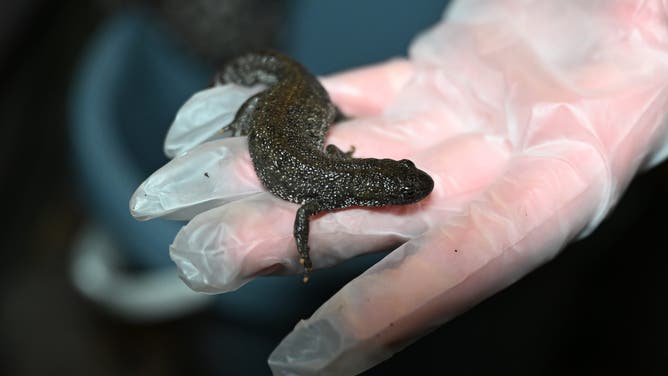
Fossils uncovered in Japan nearly two decades ago belong to a giant salamander that lived in the region 3.5 million years ago.
(David Hammersen/picture alliance via Getty Images / Getty Images)
According to the study, the region once had a warm, subtropical ecosystem inhabited by crocodilians, turtles, rhinoceroses, elephants and exotic birds.
Researchers believe Limnospondylus ajimuensis disappeared from the area after temperatures began cooling millions of years ago, altering the lake habitat the species depended on.
"Recently, Japan's native giant salamanders have faced challenges such as hybridization with foreign species and habitat destruction," Noda said. "This research has given me a renewed appreciation for the importance of preserving extant species for the future."
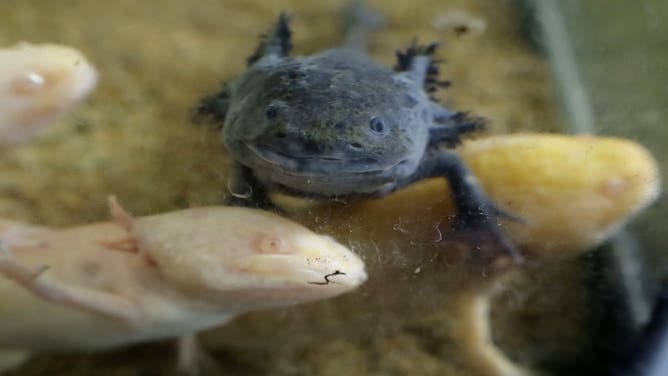
View of a salamander species in a lake.
(Gerardo Vieyra/NurPhoto via Getty Images / Getty Images)
The discovery brings researchers one step closer to understanding the evolutionary history of East Asian giant salamanders.
Because amphibians are especially sensitive to changes in water quality and habitat, the findings could also help scientists better understand how to protect the wetlands, streams and lakes that modern Japanese giant salamanders depend on.