

See it: First-of-its-kind NASA rotorcraft nearly ready to explore Saturn's moon in 2034
Scientists and engineers at NASA have developed a first-of-its-kind rotorcraft to explore another world, capable of flying to various locations like we haven’t before.
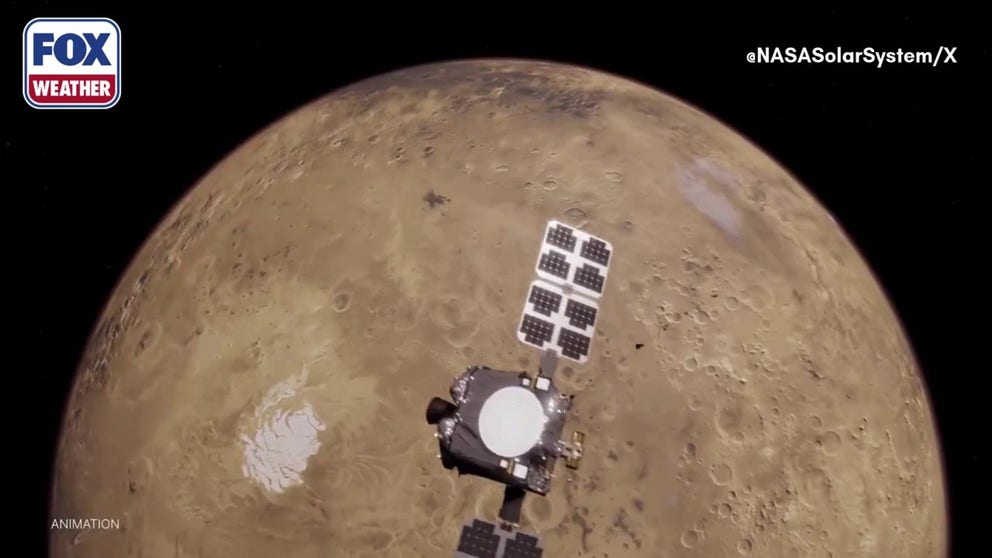
NASA ESCAPADE mission to study Mars and space weather
NASA launched ESCAPADE (Escape and Plasma Acceleration and Dynamics Explorers) on Nov. 13, 2025, which is a mission to investigate how the Sun continues to influence Mars and will begin to study space weather in new ways.
A big step in the exploration of other planets in our solar system is within reach as NASA makes a big announcement.
Scientists and engineers at NASA have developed a first-of-its-kind rotorcraft to explore another moon, capable of flying to various locations like we haven’t before.
The rotorcraft, Dragonfly, is on a mission to explore and investigate Saturn’s moon, Titan. It is an octocopter the size of a small car with four pairs of counter-rotating, three-bladed rotors.
NASA ROCKET TO CONDUCT 'CT SCAN' OF NORTHERN LIGHTS TO HELP UNDERSTAND AURORAL ELECTRICITY
"Titan is a very interesting target, very unique in our solar system," Dr. Zibi Turtle of the Johns Hopkins University Applied Physics Laboratory said. "It’s the only moon that has a dense atmosphere."
Notably, the atmosphere is actually denser than Earth’s, according to NASA. The atmosphere of the Titans is mostly nitrogen, like ours, but it also contains methane. This means there are many very complex, rich carbon molecules in the system.
SEE IT: JAMES WEBB TELESCOPE CAPTURES DETAILED IMAGES OF DYING STAR
Because Titan is a moon in the outer solar system (unlike ours), its crust is made of water ice. Experts say that at sites where the crust has melted in the past lies the potential for large complex carbon molecules to have mixed with liquid waters for extended periods of time.
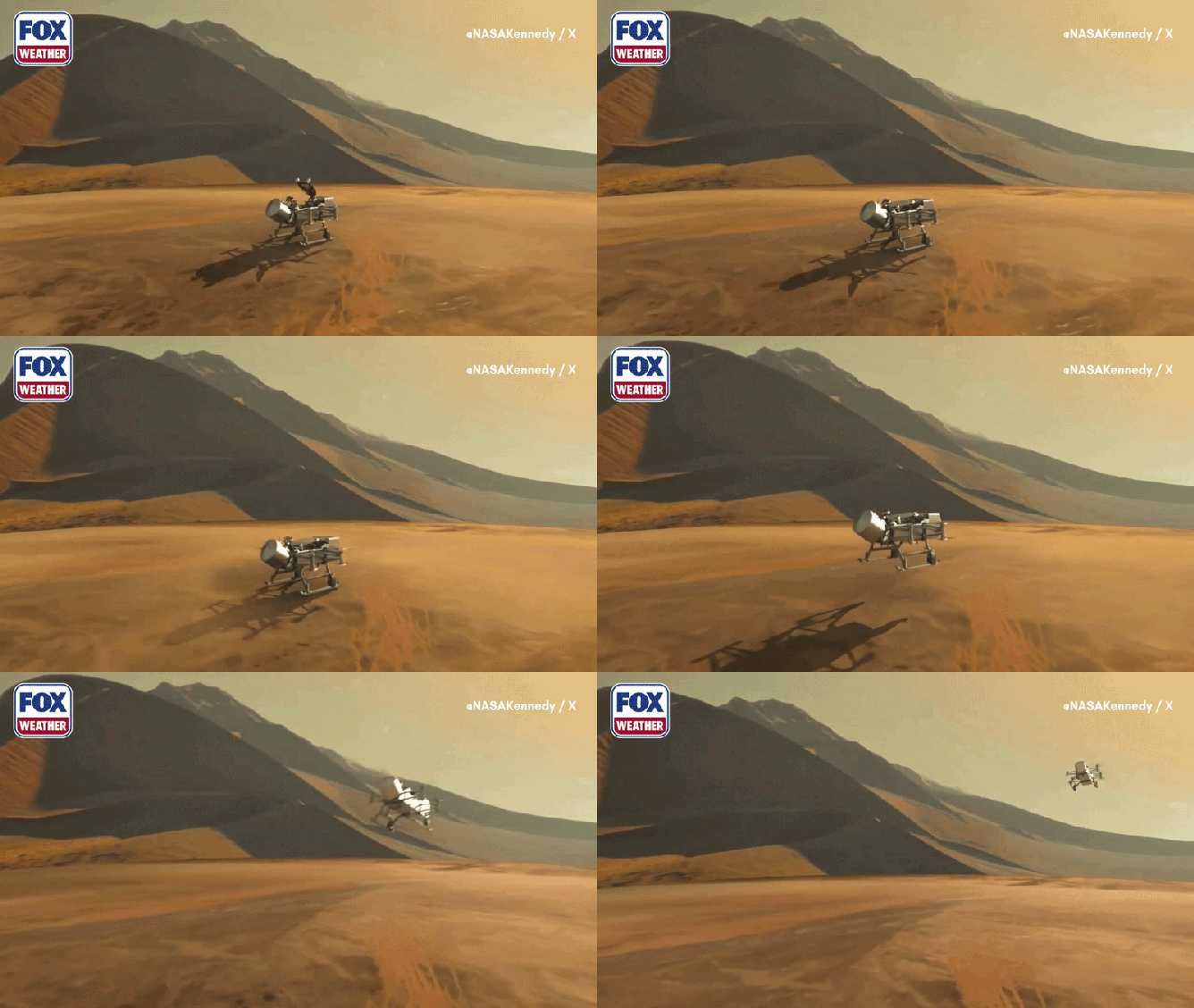
An artist's concept of Dragonfly lifting off from the surface of Titan during it's mission.
(NASA/Johns Hopkins APL)
This is the same kind of chemical equation that existed on Earth before life developed.
This allows scientists to understand the chemical steps that may have occurred here on Earth, leading to the leap in biology.
Could this be the early stages of what can lead to life? That is what experts are hoping to discover.
NASA ANNOUNCES CRITICAL CHANGES TO ARTEMIS MISSION'S RETURN TO THE MOON
"Flying several miles each flight through the yellowish, smoggy haze of Titan’s nitrogen-rich atmosphere, Dragonfly, will stop at a variety of geologic sites, where it will collect samples of surface material for analysis inside the rotorcraft by a suite of scientific instruments," read a statement from NASA, explaining the process of the rotorcraft.
The dragonfly will travel up to 70 miles across Titan during its planned 3.3-year-long mission. According to NASA, the rotorcraft is expected to make one flight every one to two Titan days, which is called a Tslo and lasts about 16 Earth days. A year on Titan is 29.5 years on Earth.
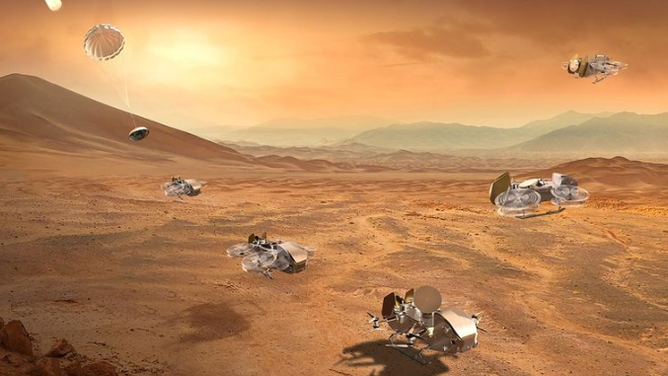
A concept of the dragonfly's entry, descent, and landing on the surface of Titan.
(NASA/Johns Hopkins APL)
The geology of Titan is surprisingly Earth-like, with the target landing area being full of organic dunes, very similar to what we are used to. Despite this geological feature, the temperature on this moon is 94 Kelvin, which is negative 290 degrees Fahrenheit.
Luckily, the rotorcraft is built to withstand this environment, as it is a very well-insulated vehicle that keeps the lander’s interior at a good temperature for the equipment, electronics and other instruments.
THE BEST CELESTIAL EVENTS IN 2026 YOU WON'T WANT TO MISS
This mission has the opportunity for scientists to learn unprecedented information dating back thousands of years, and could teach us what Earth looked like before the emergence of biology.
The launch date for the rotorcraft is in July 2028 and will arrive at Titan in December 2034.