

Crystal Ball Nebula seen in stunning new space image 1,500 light-years away
The Crystal Ball Nebula was first discovered by astronomer William Herschel in 1790 and is located in the constellation Taurus.
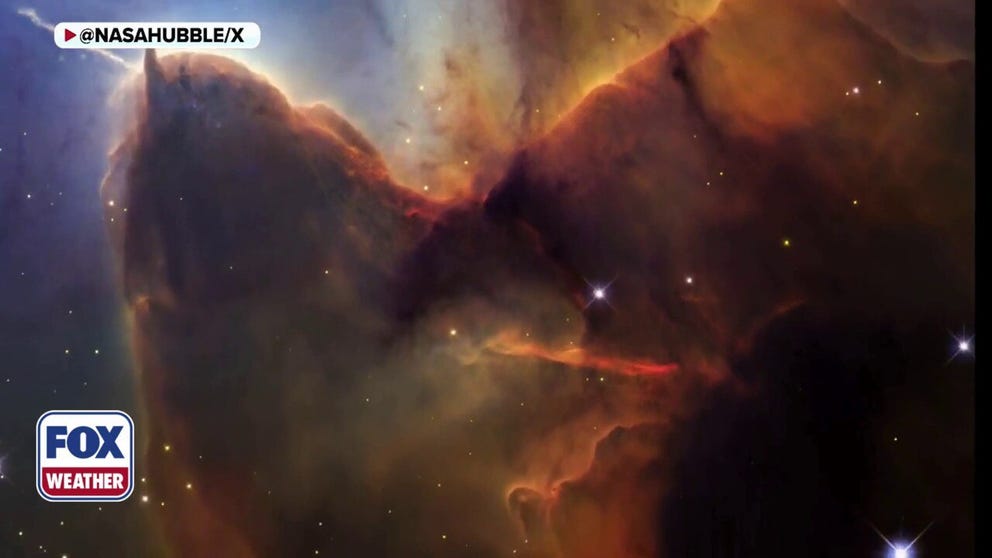
FILE: NASA’s Hubble Telescope captures stunning images of Trifid Nebula
NASA’s Hubble Telescope captures stunning images of the Trifid Nebula in deep space, nearly 5,000 light-years away from Earth.
An interstellar discovery that resembles a crystal ball is captivating space enthusiasts around the world.
New images of the floating nebula NGC 1514, nicknamed the Crystal Ball Nebula, were captured by the Gemini Multi-Object Spectrograph (GMOS) on the Gemini North telescope in Hawaii.
The Crystal Ball Nebula was first discovered by astronomer William Herschel in 1790 and is located in the constellation Taurus.
BREATHTAKING VIEWS: NASA RELEASES 12,000 NEW PHOTOS FROM ARTEMIS II MISSION
A nebula is a giant cloud of dust and gas in space, some of which comes from the explosions of dying stars, such as supernovae, according to NASA.
Other nebulae in the universe are regions where new stars are beginning to form, and for this reason, some nebulae are called "star nurseries."
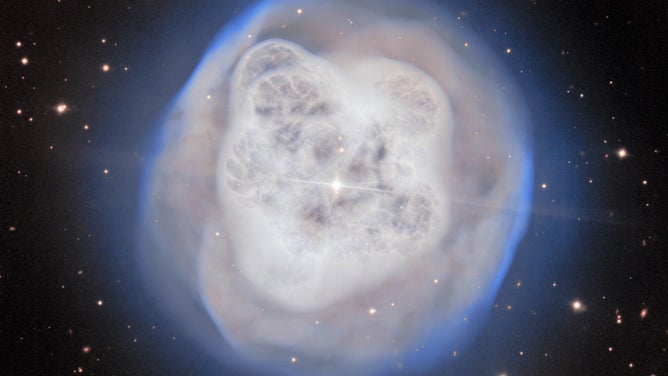
The Crystal Ball Nebula first captured by German-British Astronomer William Herschel in 1790.
(@GeminiObs/NOIRLab/NSF/AURA Via X)
According to experts at the International Gemini Observatory, the most recent image captures the final stages of a star’s life from around 1,500 years ago.
The Crystal Ball Nebula was classified as a planetary nebula after Herschel observed its spherical features, which reminded him of planets.
JUNE SKYWATCHING GUIDE: FROM PLANET CONJUNCTIONS TO NEW MOONS, HERE IS WHAT TO LOOK UP FOR
A planetary nebula represents the final and brief stage in the life of a medium-sized star like our sun, according to NASA.
Experts say that at the heart of the Crystal Ball Nebula lie two actual stars that orbit each other every nine years.
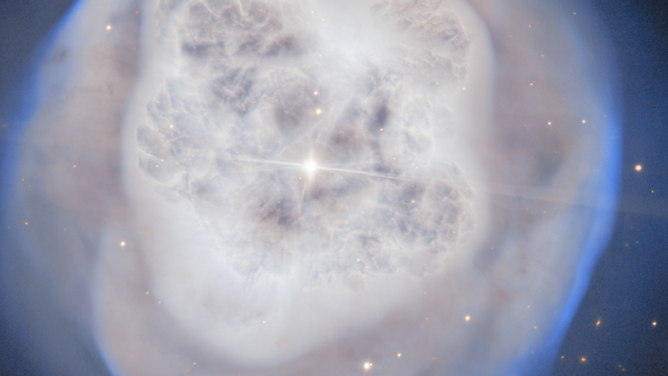
Zoomed in image of the Crystal Ball Nebula captured by the Gemini Multi-Object Spectrograph.
(@GeminiObs/NOIRLab/NSF/AURA)
As the two stars orbit each other, they mold an expanding shell of gas and winds, forming the lumpy outer layers observed in the image.
LOOK UP: RARE BLUE MOON AND 4 PLANETS WILL SHINE ACROSS THE SKY AT THE END OF MAY
As we continue to monitor this luminating phenomenon, we often receive new observations and insights into the lives of these celestial wonders.