

Pan American plane found 2,000 feet under Atlantic Ocean after crash 74 years ago
Pan Am’s Flight 526A is one of the worst air disasters in Puerto Rican history, after 52 people lost their lives in a plane crash on April 11, 1952.
FILE: Man rescues a woman from plane crash in Texas
The hero who helped rescue a woman from a plane crash in Galveston, Texas, Sky Decker, joins FOX Weather to share the intense story about how he rescued the victim from the aircraft.
PUERTO RICO – A 74-year-long mystery has finally come to a close in Puerto Rico, as officials have discovered a lost Pan Am airliner that crashed, known as the Good Friday Tragedy.
Pan Am’s Flight 526A is one of the worst air disasters in Puerto Rican history, after 52 people lost their lives in a plane crash on April 11, 1952.
According to the Air Sea Heritage Foundation, the Douglas DC-4 aircraft was found using high-resolution sonar on June 2, located almost 2,000 feet under the Atlantic Ocean, broken into two parts.
The plane took off from Puerto Rico bound for New York’s Idlewild Airport (later John F. Kennedy International Airport), carrying 64 passengers and five crew members.
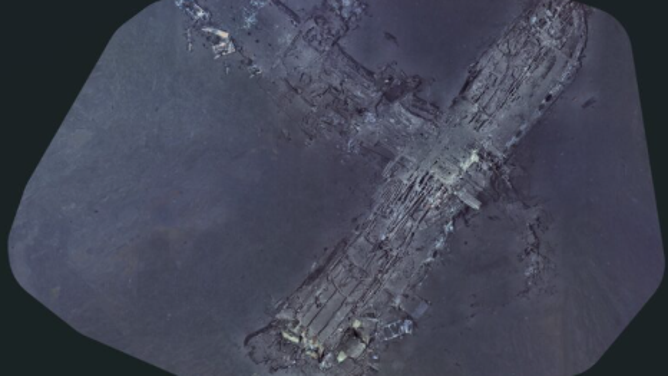
Wreckage of Pan Am’s Flight 526A that crashed in 1952.
(Air/Sea Heritage Foundation )
According to the Air Sea Heritage Foundation, the plane experienced multiple engine failures shortly after takeoff, which forced the pilot, Captain John C. Burn, to conduct a water landing.
"The conditions below were not optimal for a water landing," the Pan Am Historical Foundation said. "What had been a gentle breeze had freshened to a 15-knot wind, which whipped up the sea surface."
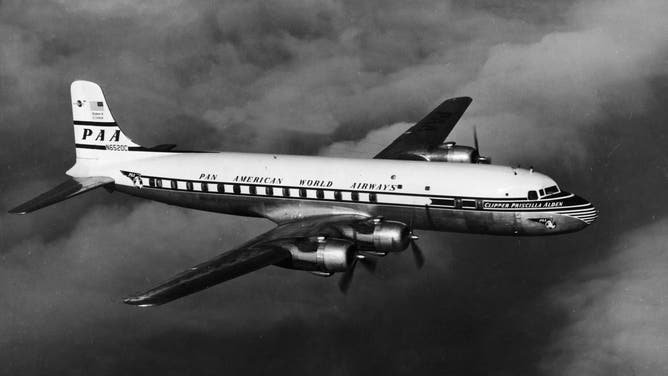
Pan American World Airways Super-6 plane the Clipper Priscilla Alden (registration number N6520C) flies over the Atlantic Ocean during one of its earliest runs between hemispheres, 1952.
(Pictorial Parade / Getty Images)
All aboard the plane initially survived the impact, but the tail section broke off, and the aircraft began flooding and sinking within three minutes.
According to the historical foundation, the aircraft was equipped with life rafts and personal floatation devices for everyone on board.
Still, most of the passengers remained glued to their seats in the plane's cabin rather than springing into action, resulting in the death of 52 people.
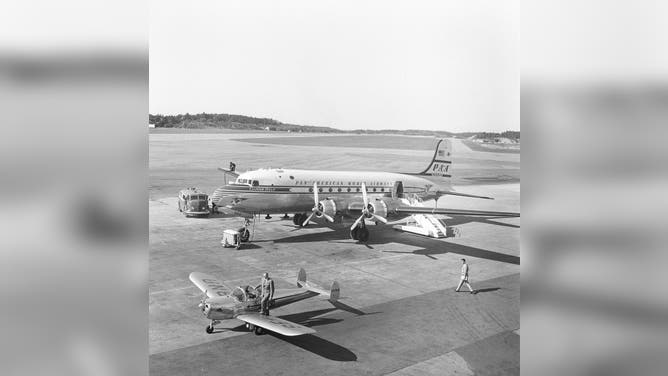
1950s airport. A Douglas DC-4 of Pan American World Airways "Clipper Oslo" PA-A N88944 being prepared and fueld before takeoff. A man is seen on the wing at the end of the gas pipe from the truck. The smaller propeller aircraft is a Ercoupe 415 SE-BNA with a man with a briefcase about to step into the aircraft. Sweden 1953. Kristoffersson ref BM42-3.
(Sjöberg Bildbyrå/ullstein bild / Getty Images)
Despite the action taken by Capt. Burn and crew members, most people refused to leave the rapidly sinking airplane and went down with it.
This disaster shed light on the rules and safety regulations for commercial flights over water, becoming a turning point in aviation history and prompting new reforms, including now-mandatory preflight safety and emergency procedure demonstrations.
CELEBRATING WEATHER HISTORY: HOW FOG HELPED GEORGE WASHINGTON SAVE AMERICAN INDEPENDENCE
Only 17 people aboard the aircraft survived the crash, including all five crew members, after rescue teams from the Coast Guard and Air Force responded within six minutes of the initial distress call.