

Golden Gate Bridge gets major seismic makeover to withstand powerful earthquakes
More than three decades after the 1989 Loma Prieta earthquake prompted vulnerability studies, the Golden Gate Bridge’s phased seismic retrofit is entering its final major construction phase.

FILE: Earthquake swarm beneath Hawaii volcano raises new questions
An earthquake swarm under Hawaii's Mount Kīlauea have geologists looking deeper for what's going on under the Earth's surface. Geologist and CEO Earth Evolution Stefan Burns joins FOX Weather to provide analysis on earthquake activity and what could lead to the next mega quake.
THE TAKEAWAY
- The Golden Gate Bridge is undergoing its final major seismic retrofit phase.
- The billion-dollar project is designed to limit earthquake damage and help keep the bridge operational for emergency response.
- The retrofit is being designed to withstand a magnitude 8.3 earthquake centered on the San Andreas Fault.
GOLDEN GATE, Calif. – The Golden Gate Bridge is preparing for the "Big One" as crews begin a billion-dollar seismic upgrade designed to limit damage and help keep the iconic crossing operational in the aftermath of a major earthquake.
One of the world's most iconic bridges, the Golden Gate Bridge, connects San Francisco with Marin County and serves as a critical transportation link to the North Bay, carrying up to 40 million vehicles annually.
Amid the Golden Gate’s breathtaking scenery and architectural brilliance, a powerful threat looms in California beneath the bridge and surrounding Bay Area.
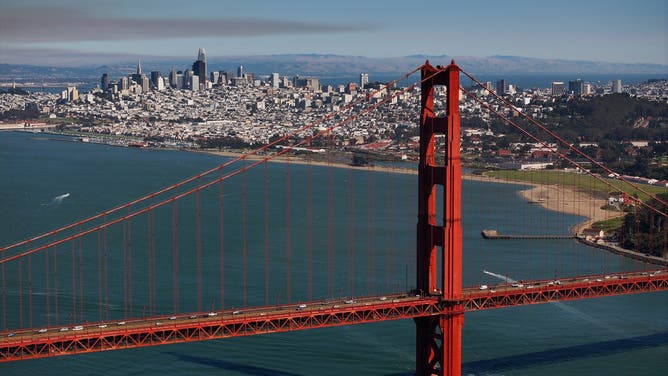
A view of Golden Gate Bridge during warm weather in San Francisco, California, United States on August 26, 2026.
(Photo by Tayfun Coskun/Anadolu via Getty Images / Getty Images)
The Golden Gate Bridge sits between two major earthquake faults: the San Andreas Fault about seven miles to the west and the Hayward Fault roughly 10 miles to the east, with several other active faults crossing the wider Bay Area.
The U.S. Geological Survey (USGS) estimated in 2014 that a 72% probability of at least one magnitude 6.7 or greater earthquake striking the San Francisco Bay region before 2043 — a quake capable of causing widespread damage, and the Golden Gate Bridge is preparing accordingly.
HURRICANE SWELLS REVEAL FORGOTTEN HISTORY BENEATH ICONIC CALIFORNIA BEACH
In such an earthquake-prone area, the Golden Gate Bridge District began studying the bridge’s seismic vulnerabilities in response to a devastating earthquake and established a phased retrofit plan in 1996.
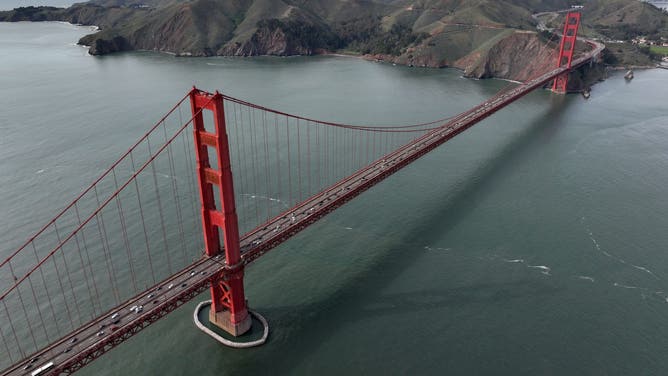
A view of Golden Gate Bridge in San Francisco, California, United States on February 20, 2026.
(Tayfun Coskun/Anadolu via Getty Images / Getty Images)
Now, more than three decades after the retrofit program began, the bridge is entering its final seismic upgrade worth over one billion dollars, designed to reduce earthquake damage and help keep the structure operational for emergency response in the event of a disaster.
Construction began this year with crews installing temporary platforms beneath the roadway and reinforcing the bridge’s towers and side spans.
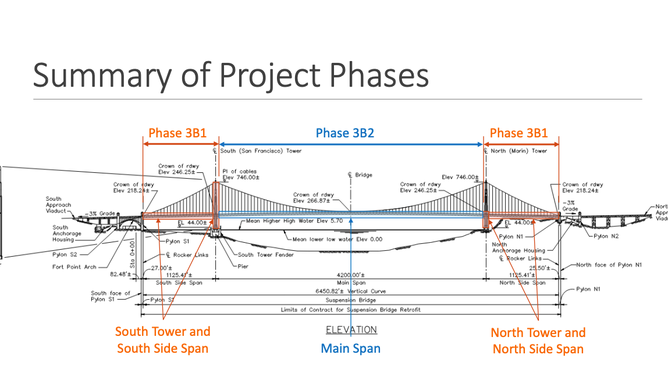
This graphic shows the broader seismic retrofit, including completed upgrades to the bridge’s approach structures, Fort Point Arch and north anchorage, along with remaining work on the suspension bridge. The current Phase 3B1 construction covers the north and south towers and side spans, while a future Phase 3B2 will address the 4,200-foot main span.
(Golden Gate Bridge Highway and Transportation District. )
Overnight lane closures began Oct. 5, but the bridge remains open in both directions, with at least one lane available each way during construction.
CAN CONCERTS AND SPORTING EVENTS CAUSE EARTHQUAKES?
The bridge district said the final retrofit is being designed to withstand a magnitude 8.3 earthquake centered on the San Andreas Fault, considered the maximum credible earthquake for the region.
According to the Golden Gate Bridge District, the retrofit is designed to limit structural damage and help keep the bridge operational for emergency response after a major earthquake.
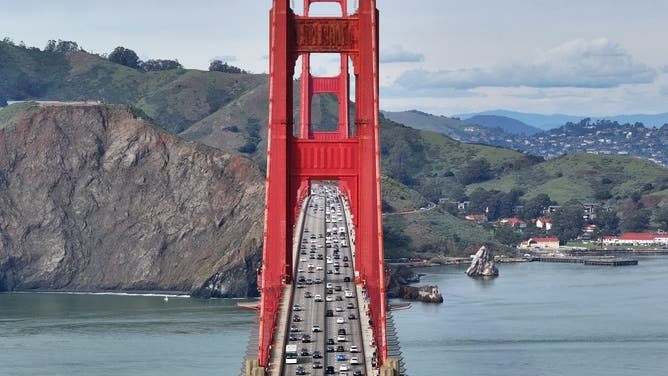
A view of Golden Gate Bridge in San Francisco, California, United States on February 20, 2026.
(Tayfun Coskun/Anadolu via Getty Images / Getty Images)
Before the retrofit program began, district studies found that a magnitude 7.0 or greater earthquake near the bridge could cause severe damage and force an extended closure.
According to the Golden Gate Seismic Retrofit Program, the final phase will strengthen the bridge’s main suspension span, two side spans, both towers and the south tower pier, while reinforcing roadway floor beams, trusses and lateral bracing and installing energy-dissipation devices.
ONE OF THE MOST DANGEROUS FAULT LINES IN THE US IS OVERDUE AND THE IMPACTS COULD BE CATASTROPHIC
According to the official seismic retrofit timeline, the first three phases were completed between 1997 and 2014, strengthening the approach structures, Fort Point Arch and north anchorage.

An aerial view shows the Golden Gate Bridge from Sausalito, California on May 19, 2026. (Photo by JOSH EDELSON / AFP via Getty Images)
Construction on the final phase began this year with work on the towers and side spans, while the full retrofit, including the main suspension span, is expected to be completed around 2036.
Major quakes can and have devastated the region before.
THESE ARE THE WORLD'S MOST POWERFUL EARTHQUAKES ON RECORD
On Oct. 17, 1989, a major magnitude 6.9 earthquake struck Loma Prieta, and would go on to cause 68 deaths, at least 3,700 injuries and an estimated loss of $6 billion to $7 billion, underscoring how vulnerable the San Francisco region was to a dangerous, devastating earthquake.
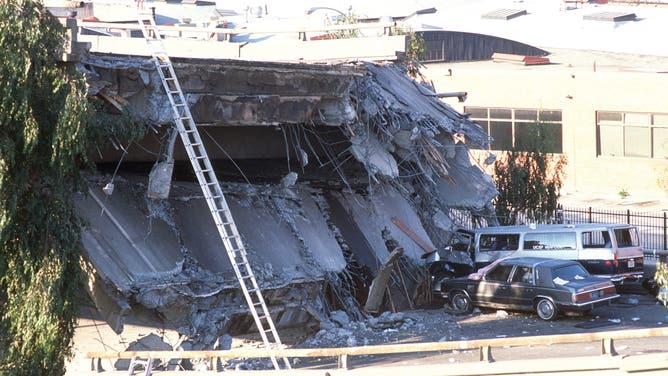
Damaged cars stopped in time in front of a collapsed freeway October 18, 1989 San Francisco, California, one day after the earthquake.
(Paul Harris/Getty Images / Getty Images)
Although the Golden Gate Bridge wasn't impacted by the deadly earthquake, it became a catalyst for an extensive seismic retrofit of the vital roadway.
More than 30 years later, the bridge is entering the final phase of its seismic retrofit, designed to protect the iconic and vital roadway during a major earthquake and help keep it operational in the aftermath of a devastating disaster.
If a powerful quake strikes along the nearby fault system, the Golden Gate Bridge’s upgrades will be critical to maintaining a lifeline connection for emergency responders, commuters and freight.