

How extreme heat is forcing school systems to adapt for better quality learning
Researchers at the American Psychological Association are getting to the root of the issue and trying to develop a plan to help protect students' health, safety and learning as extreme heat unfortunately becomes more common.
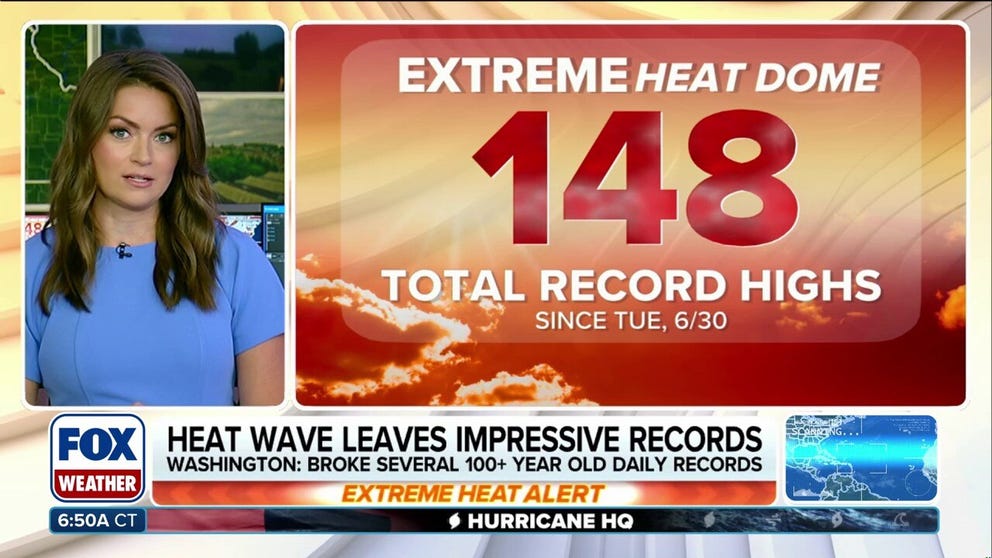
FILE: July 4 heat wave shatters more than 148 records across the eastern US
The historic heat dome that broiled the eastern U.S. over the July 4 holiday weekend shattered records across the eastern U.S. At least 148 daily high-temperature records were set between June 30 and Sunday, July 5. Notably, Washington, D.C., broke the record for the warmest July 4 with a high temperature of 103 degrees. Philadelphia recorded three consecutive days above 101 degrees for the first time in its history. Atlantic City, New Jersey tied its all-time hottest temperature of 106 degrees on Saturday.
THE TAKEAWAY
- Extreme heat affects the quality of learning for students.
- Recent studies have shown lower test scores on hot days.
- Extreme heat exposure can impact students’ attention, memory and ability to learn.
As school slowly starts for thousands of kids across the country, experts worry about the never-ending heat students endure during the school year and how it threatens quality learning.
The sweltering heat students experience at the start of the school year and in the spring can be a major distraction when trying to keep kids focused from elementary school through high school.
Researchers at the American Psychological Association (APA) are getting to the root of the issue and trying to develop a plan to help protect students' health, safety and learning as extreme heat unfortunately becomes more common.
EXTREME HEAT SAFETY: RECOGNIZING SIGNS OF HEAT ILLNESS AND HOW TO TREAT IT
"Psychological science demonstrates that extreme heat exposure can impact students’ attention, memory and ability to learn, underscoring why schools need to plan now to safeguard learning and promote student health and academic outcomes," APA CEO Arthur C. Evans Jr. said.

LAGUNA BEACH, CALIFORNIA - SEPTEMBER 7: People watch the sunset during a record heat wave on September 7, 2024 in Laguna Beach, California. The week-long record-breaking heat wave blanketed Southern California with triple-digit highs throughout the region.
(Photo by Kevin Carter/Getty Images / Getty Images)
When it is extremely hot outside, our bodies have a more difficult time staying cool and adapting to the weather.
There are three types of heat illness: heat cramps, heat exhaustion and heat stroke.
SCORCHING SUMMER TEMPERATURES LEAD TO CONSECUTIVE DAYS OF EXTREME HEAT ALONG THE WEST COAST
Beyond the physical effects of extreme heat, it also harms students' learning, as recent studies have shown lower test scores on hot days.
According to studies, extreme heat has also been linked to mental health effects such as mood disorders.

A monitor reads the current temperature as 100 degrees Fahrenheit outside a building during a heatwave in Dallas, Texas, US, on Tuesday, June 21, 2022.
(Shelby Tauber / Bloomberg / Getty Images)
As a result of the never-ending heat, schools must adapt and find ways to help children stay as cool as possible during the day and avoid harmful heat.
One example is New York, where lawmakers have created temperature regulations for school systems, requiring officials to take action when temperatures hit 82 degrees and relocate students and staff out of rooms that reach 88 degrees.
RECORD HEAT TAKES AIM AT SOUTHERN PLAINS WITH TEXAS, OKLAHOMA IN THE BULL'S-EYE
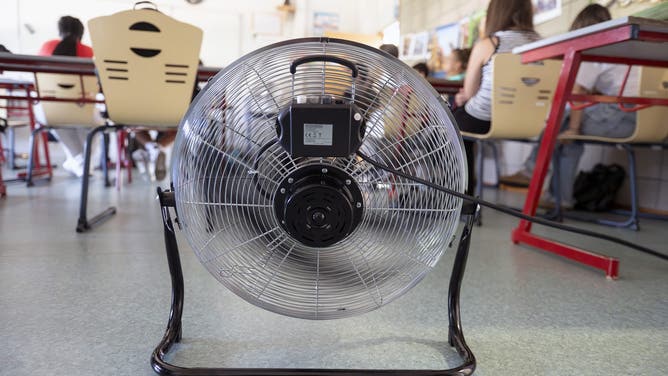
Close-up of a fan cooling pupils revising for the brevet exam during an intense heatwave in a classroom at College Pierre de Ronsard in Poitiers, Nouvelle Aquitaine, France, June 24, 2026. The blurred students and classroom setting show school revision work, digital devices and adaptation to high temperatures before a national exam.
(Jean-François FORT / Hans Lucas / AFP / Getty Images)
Experts at the APA suggest these actions by school districts
- Designate district-level heat leadership and accountability structures.
- Develop and implement heat thresholds and monitoring procedures, integrated into emergency and safety planning.
- Prioritize mitigation in the locations where heat causes the greatest harm.
- Ensure automatic protection for students and staff who are more vulnerable to extreme heat.
- Implement heat-specific policies for athletics, extracurriculars, after-school programs and transportation.
- Treat heat like a "snow day for cognition," for example, postponing assessments and adjusting instructional time.
- Coordinate heat response with families and caregivers and ensure that individual actions — like hydration or light clothing — are treated as the last layer of protection rather than the primary defense against extreme heat.
SEE IT: CREWS RACE TO CONTAIN WILDFIRES BURNING ACROSS TEXAS AND NEVADA AMID DANGEROUS FIRE WEATHER
Over time, with better regulations, school officials can better monitor and keep students safe from extreme heat and avoid heat-related illnesses.