

Strengthening El Niño suppresses tropical activity in Atlantic forecasting a quiet July
The first named storm of the Atlantic season, Arthur, formed on June 17, a week after the average first named storm typically forms. Since then, it's been quiet in the Atlantic, with no other tropical systems strong enough to have names.
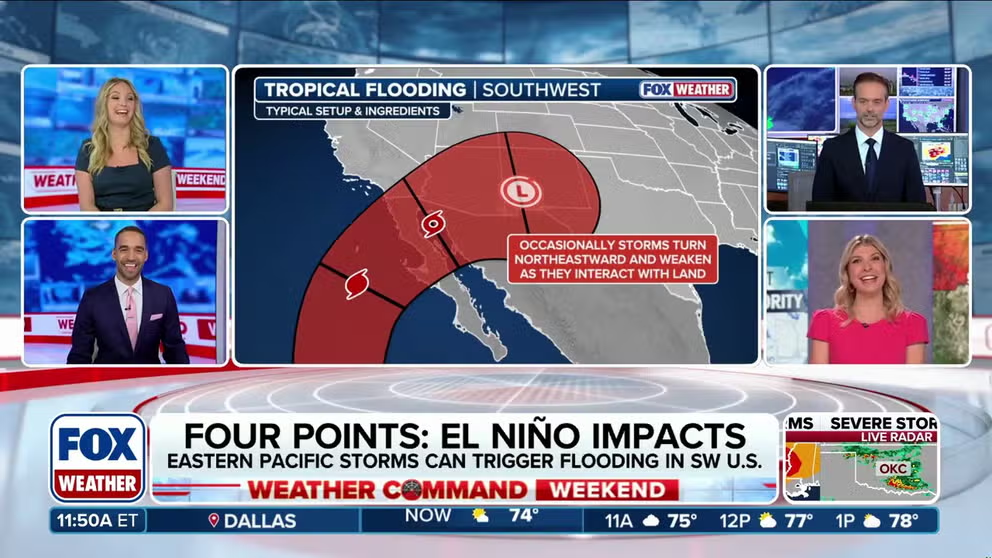
FILE: Tracking potential super El Niño: How could it shape weather patterns across the US?
Experts are suggesting that a super El Niño is likely this year, which could bring major impacts to weather patterns across the U.S. FOX Weather Meteorologists Nick Kosir, Haley Meier, Michael Estime and FOX 26 Meteorologist Allison Gargaro are breaking down what people might see if the super El Niño develops.
We're one month into the Atlantic hurricane season, and only one tropical storm has formed. A strengthening El Niño is to blame as we inch closer to falling behind schedule for the season.
The first named storm of the Atlantic season, Arthur, formed on June 17, right on time for the average first named storm of the season, which typically forms on June 20. Since then, it's been quiet in the Atlantic, with no other tropical systems strong enough to have names.
BRYAN NORCROSS: THE ATLANTIC GOES QUIET TO KICK OFF JULY
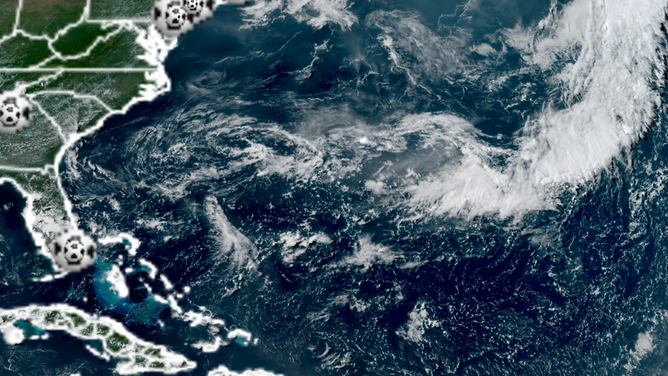
A look at the quiet Atlantic via GOES-19 satellite on July 1, 2026.
(CIRA/CSU / NOAA)
The most recent hurricane forecasts by NOAA and Colorado State University (CSU) call for eight to 14 named storms, three to six hurricanes and one to three major hurricanes; and 11 named storms, five hurricanes and two major hurricanes, respectively, this season.
Things are looking to stay inactive for at least the next week, with the National Hurricane Center forecasting no tropical activity in the next seven days.
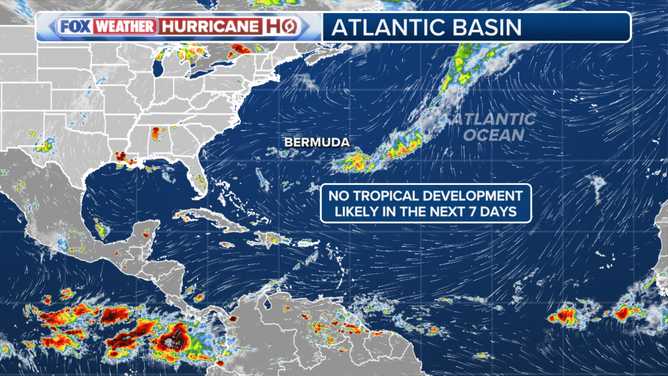
Atlantic tropical overview current on Wednesday, July 1, 2026.
(FOX Weather)
Taking a look at the latest long-range tropical outlook from the Climate Prediction Center, it shows an 80% chance of below-average precipitation in the Main Development Region of the Caribbean.
NOT JUST HURRICANES: TROPICAL STORMS IN HISTORY THAT PACKED A PUNCH WITH HISTORIC, DEADLY FLOODING
While it is usually too early to track large disturbances in the deep tropics, the FOX Forecast Center said this suppressed activity could be a precursor of things to come, driven by the onset of El Niño.
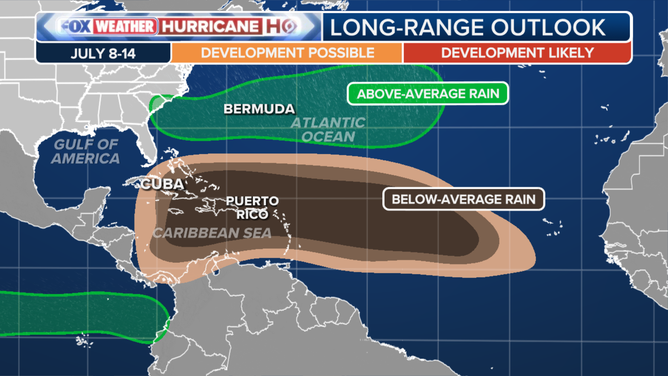
July 8-14 tropical long-range outlook for Atlantic
(FOX Weather)
El Niño itself is no surprise to anyone, but its intensity at this point in the year is already stronger than initially predicted, the FOX Forecast Center said.
If things continue as forecast, the CPC said this could be one of the most powerful El Niño events dating back to 1950.
SAHARAN DUST SETTLES OVER HURRICANE BREEDING GROUNDS. HERE'S WHAT IT MEANS FOR HURRICANE SEASON
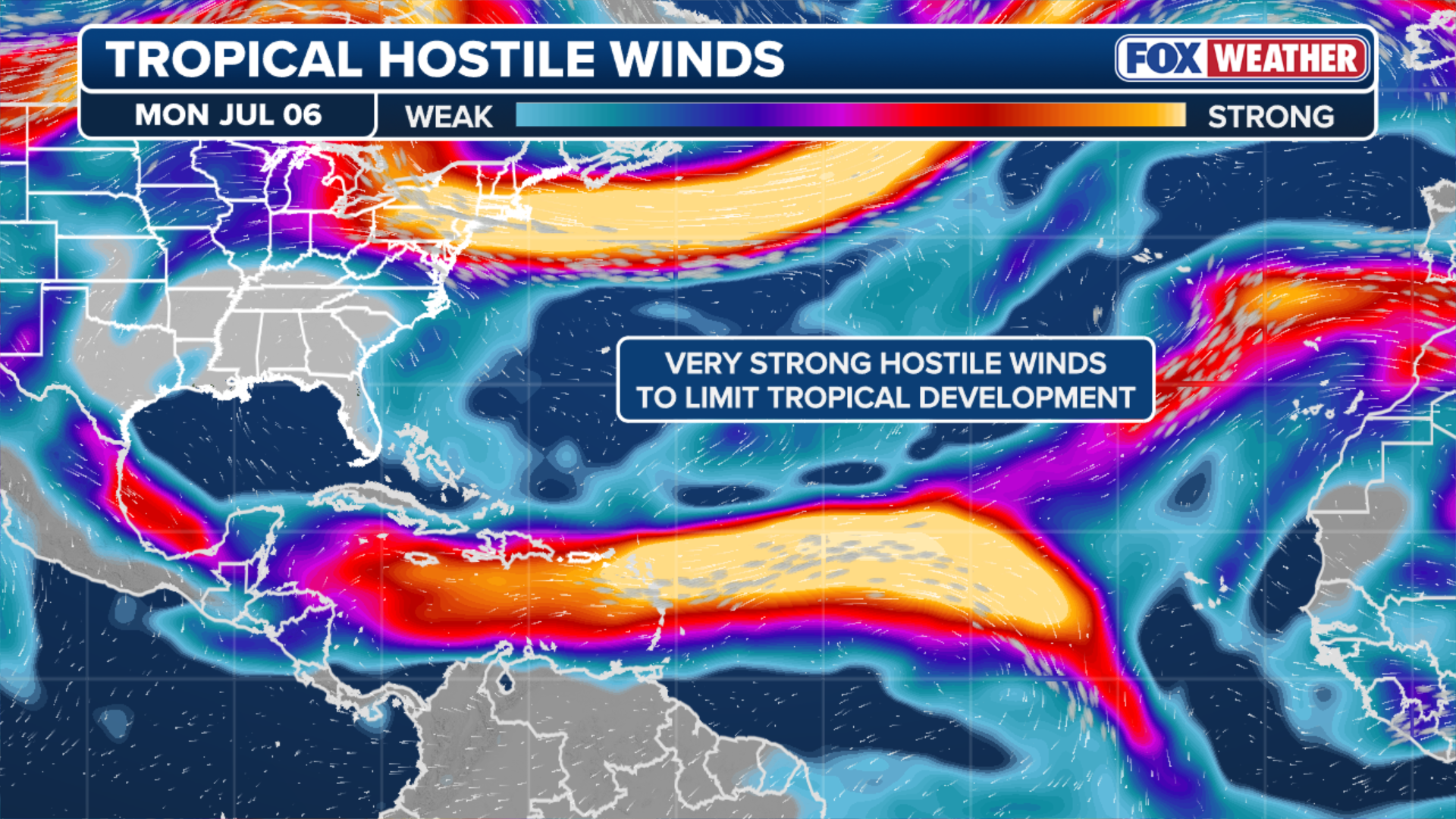
The FOX Forecast Center said El Niño is going to continue to intensify as hurricane season progresses, with the most significant impact on the Atlantic hurricane season becoming the increase in hostile upper-level winds.
(FOX Weather)
Whether the belt of hostile winds is a direct product of El Niño is too big of an open-ended question at this point in the game, the FOX Forecast Center said.
Regardless of that, the Atlantic is likely not going to see any significant tropical activity for the next few weeks.
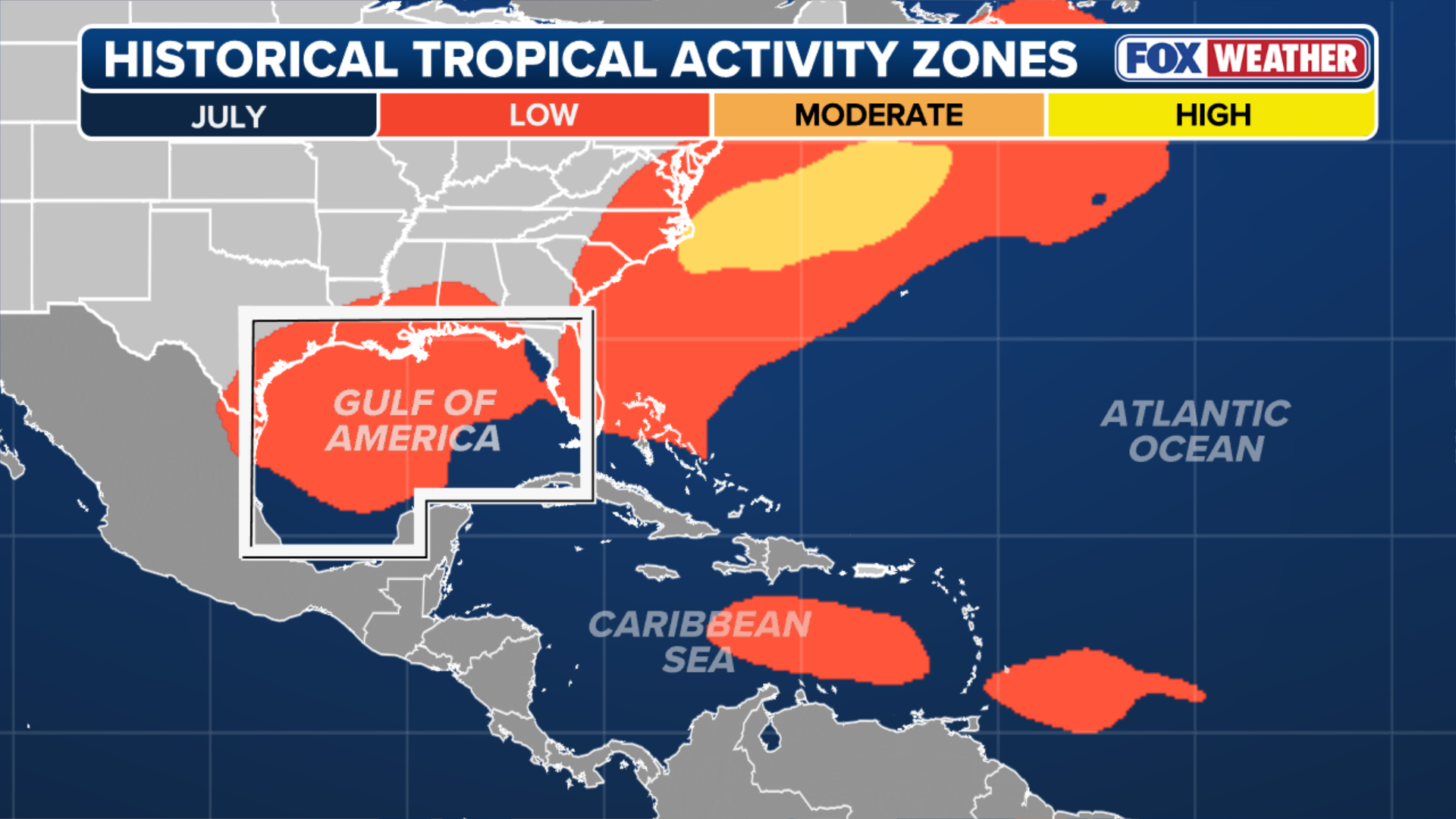
If it does see tropical activity, it will most likely occur north of the tropical hurricane belt.
(FOX Weather)
The FOX Forecast Center said that waters in the Northern Gulf and off the Southeast Coast are not facing quite as hostile conditions as the Caribbean, so those will be the areas to watch out for any possible tropical activity in July.
In the Atlantic, the B named storm typically forms by July 17, and the C named storm follows by Aug. 3, on average.
Overall, the big picture is that El Niño is successfully keeping the Atlantic hurricane season at bay for now.
Editor's note: This story was updated to provide revised average dates of the A, B and C named storms in the Atlantic hurricane season.