

Army blasts in Iowa spark toxic lead dust concerns as winds could spread plume to communities downwind
The U.S. Army plans to detonate 68 drums of degraded lead azide in Iowa Friday, potentially releasing a plume of lead-containing dust.

FILE: WWII-era military structure falls onto beach in California
A portion of the concrete ruins at Fort Funston in San Francisco slid down a rain-soaked bluff onto the beach below, authorities said Monday.
THE TAKEAWAY
- The U.S. Army plans to detonate unstable, degraded explosives in southeast Iowa, sending a plume of lead-containing dust into the air.
- Wind speed and direction will play a key role in determining where the plume travels and which communities face potential exposure.
- The operation has prompted public health concerns and precautionary advisories for communities up to 100 miles away.
MIDDLETOWN, Iowa – The U.S. Army plans to detonate unstable explosives at an ammunition plant in southeastern Iowa Friday, potentially sending a plume of lead-containing dust into surrounding communities.
Two controlled detonations are scheduled for approximately noon CST Friday at the Iowa Army Ammunition Plant in Middletown, with the wind and weather conditions set to play a key role in determining where the lead-containing dust travels after the blast.
RESIDENTS GIVEN ALL CLEAR IN OKLAHOMA AFTER LACK OF WIND TRAPS AMMONIA PLUME FROM TANKER TRUCK
According to the FOX Forecast Center, southerly winds of 10 to 15 mph, with gusts up to 25 mph, are expected in Middletown on Friday, pushing the dust plume northward from the ammunition plant.
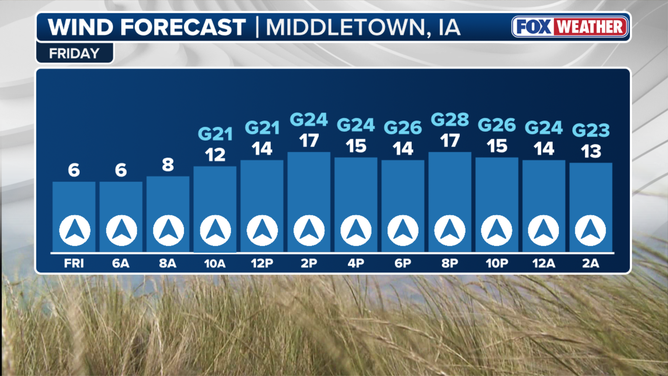
Middletown wind forecast.
(FOX Weather)
"While safety measures will be fully enforced, the controlled detonation will cause temporary noise, ground vibrations and a dust plume that will contain some lead," according to the Army.
"Residents in Middletown will hear a loud noise; feel vibrations from two consecutive, rapid detonations; and see a plume of dust which is expected to linger for no more than one hour after the detonation, depending on wind speed."
CAN CONCERTS AND SPORTING EVENTS CAUSE EARTHQUAKES?
On Nov. 15, the Environmental Protection Agency (EPA) issued an emergency permit for the Army to detonate 68 drums of degraded lead azide, citing an imminent explosion threat to both human health and the environment, with the permit requiring environmental monitoring and cleanup of any contaminated areas.

Depending on wind conditions, the lead-containing dust plume from the Iowa Army Ammunition Plant in Middletown is projected to drift north potentially extending up to 100 miles.
( Scott Olson/Getty Images / Getty Images)
The operation has prompted exposure concerns and precautionary guidance for communities as far as 100 miles away, with residents downwind from the Southeastern Iowa community keeping a close watch on the weather forecast.
The Army said the resulting plume could carry lead particles beyond the installation and deposit them on the ground, with its projected path subject to changing weather conditions.
WHAT IS YOUR STATE ANIMAL? SEE THE OFFICIAL LIST FEATURING ALL 50 STATES
What locations will be exposed to toxic lead dust?
Exposure maps project that lead-containing dust could settle along a corridor extending north toward Morning Sun and Wapello, though the affected areas could shift with changing weather conditions.
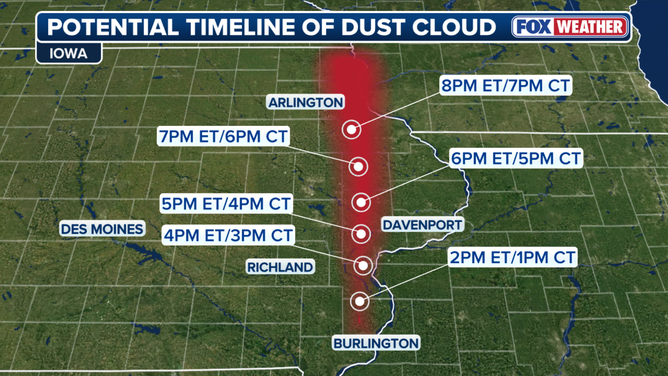
A FOX Weather map shows the potential northward path and hourly timeline of a dust cloud across eastern Iowa, tracking from near Burlington at 1 p.m. CT (2 p.m. ET) toward Arlington by 7 p.m. CT (8 p.m. ET).
(FOX Weather)
Depending on wind conditions, the lead-containing dust plume from the Iowa Army Ammunition Plant is projected to drift north and north-east, potentially extending up to 100 miles across southeast Iowa, and potentially across state lines into Illinois, before settling on the ground within about an hour.
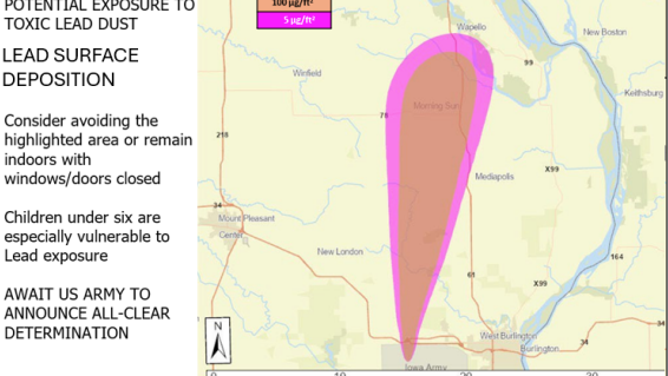
The Army’s maps identify areas where people could potentially breathe in lead-containing particles or encounter contaminated dust on surfaces after Friday’s detonations. Officials advise those in the highlighted areas to avoid exposure by staying indoors with windows and doors closed during the potential exposure period. An updated map will be released on Friday morning ahead of the detonation.
(U.S. Army)
The surface map shows higher projected deposits within a narrower central area, surrounded by a broader zone of lower deposits.
The Army said its modeling predicts airborne lead levels could rise after the detonations, but remain well below the level at which the EPA would require protective actions.
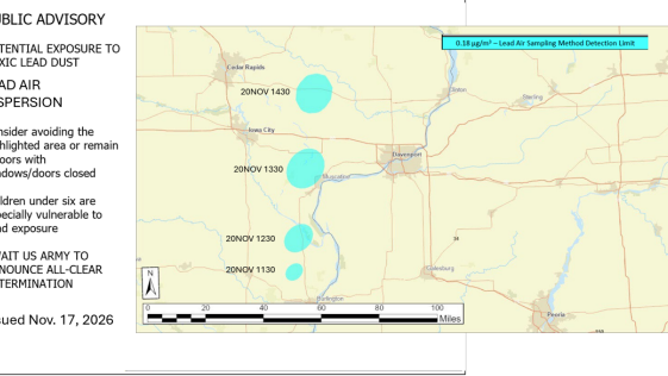
This map shows projected areas of potential airborne lead dust exposure following planned detonations at the Iowa Army Ammunition Plant.
(U.S. Army)
Lead is a toxic metal that can damage the brain and nervous system, slow children’s growth and development and cause learning and behavioral problems, according to the CDC.
Lead exposure can damage the brain, nervous system and kidneys, and at high levels can cause seizures, coma and death.
THESE 6 AIR POLLUTANTS CAN CAUSE PROBLEMS FOR YOUR HEALTH
Human impact
The Army issued its public exposure advisory Sunday, Nov. 15, giving potentially affected communities five days’ notice before Friday’s planned detonations.
Residents in Middletown and communities downwind are preparing for the blast as the Army outlines precautions to reduce potential exposure to lead-containing dust.
The Army is asking residents near Middletown’s City Park and Butterfly Park to temporarily leave their homes from 8 a.m. to 2 p.m. CST Friday because the detonations could damage nearby windows.
Johnson County Public Health is monitoring the planned detonations and sharing exposure precautions with residents, while noting the county was outside the plume’s projected path as of Nov. 18.
Linn County emergency management and public health officials are coordinating with state agencies and reviewing plume forecasts to assess potential local impacts.
THE MOST PATRIOTIC FRONT LAWN IN AMERICA CELEBRATES THE NATION'S 250TH WITH A BALD EAGLE MURAL
Mediapolis, downwind of the ammunition plant and near the Army’s projected lead dust deposition area, is among several school districts canceling Friday classes over potential exposure concerns.
Concerns extend beyond the initial plume, as lead-containing dust could settle on playgrounds, outdoor furniture and other surfaces, creating potential exposure risks after the cloud passes.
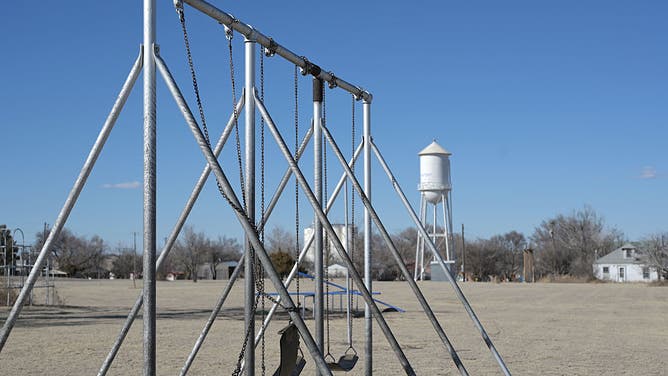
Lead-containing dust can settle on playground equipment, toys and other outdoor surfaces, creating potential exposure risks after the plume passes.
(Photo by Hyoung Chang/The Denver Post / Getty Images)
Preparing for the impacts
The Army warns that children, pregnant women and older adults are especially vulnerable to lead exposure and should avoid outdoor activities in affected areas during the potential exposure period.
People who live or work in affected areas to remain indoors during the potential exposure period if they cannot evacuate beforehand, keeping windows, exterior doors and other openings closed.
Heating and cooling systems should be turned off or set to recirculate to limit outdoor air intake.
IDPH is monitoring a planned detonation in Middletown, Iowa that could impact parts of Mercer County, Illinois and surrounding areas. Here’s what you need to know👇
— IDPH | Illinois Department of Public Health (@IDPH) November 19, 2026
After the Army determines the airborne exposure period has ended, residents should wet-clean surfaces children may touch, including outdoor play equipment, toys, tables, chairs, handrails and windowsills, to reduce potential exposure to deposited lead dust.
With weather conditions shaping the plume’s potential path, residents should check the Army’s updated exposure maps six hours before Friday’s planned detonations and hourly thereafter until the blasts.

The U.S. Army plans to detonate 68 drums of unstable lead azide at an Iowa ammunition plant Friday, potentially sending lead-containing dust into communities downwind.
(Beata Zawrzel/NurPhoto via Getty Images / Getty Images)
The Army will issue a final estimate of the affected area after the operation.
Updated plume models will be released Friday morning, Nov. 20, according to the Army.