

Top five winter storms to hit Central Park in New York City
Over 20 inches of snow fell on numerous occasions in Central Park in New York City over the years.
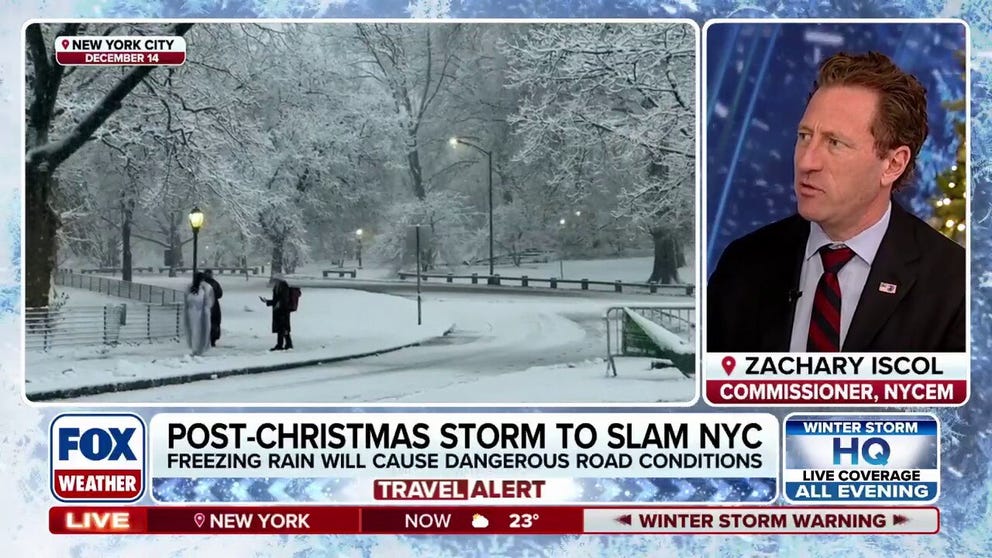
Strong winter storm to slam New York City
A powerful winter storm is taking aim at New York City this weekend, with up to 8 inches of snow expected to be dumped on the Big Apple. New York City Emergency Management Commissioner Zachary Iscol joins FOX Weather to discuss how the city is preparing:
CENTRAL PARK, NY – It’s no secret that New York City can be the most magical place on Earth during the winter season.
Areas such as Central Park become a picturesque scene as snow falls in the big city.
In its history, Central Park has been transformed into a winter wonderland on several occasions, enduring numerous heavy snow events.
So what are the five biggest snowstorms to hit Central Park?
Feb. 25-26, 2010
Starting at number five, we have the intense nor'easter in February 2010, where Central Park recorded 20.9 inches of snow over two days.
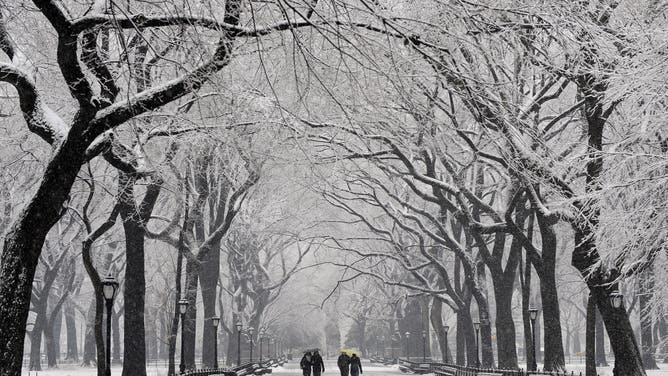
People stroll through Central Park in New York, February 25, 2010 as the the region is hit with another storm which could drop as much as a foot of snow in New York City and parts of the metropolitan region.
(TIMOTHY A. CLARY/AFP / Getty Images)
Bands of heavy snow just would not stop coming down, as snowfall rates of 1 to 3 inches an hour occurred across the Northeast. According to the National Weather Service, wind gusts of up to 50 to 70 mph were reported across southeastern New York.
Heavy and wet snow fell across much of the region. The combination of gusty winds and accumulating snow led to scattered power outages and downed trees across parts of the Northeast.
March 12–14, 1888
Coming in fourth place is the March 1888 snowstorm, which brought 21 inches of snow to the area.
Otherwise known as the Great Blizzard of 1888, it is widely regarded as the most severe of its kind in American history.
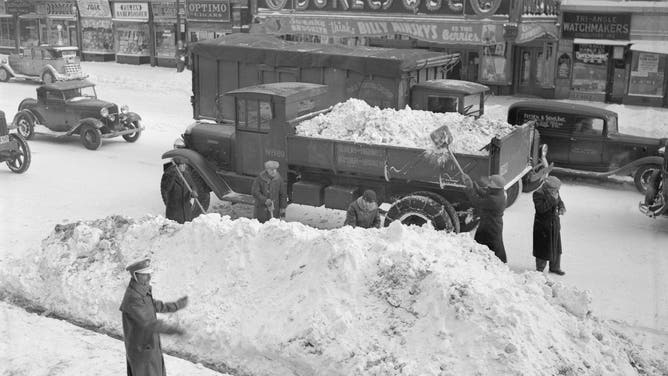
(Original Caption) Department of Sanitation workers clearing Flatbush Avenue in Brooklyn, the morning following New York's worst snow storm since the famed Blizzard of 1888.
According to the National Oceanic and Atmospheric Administration (NOAA), as much as 58 inches of snow fell in some regions, and over 400 people died as a result of the storm. That includes around 200 people in New York City, according to History.com.
Notably, many forms of transportation, such as the subway system, shut down. Power and telegraph line outages helped encourage moving them underground to avoid disasters during such weather events, according to NOAA.
December 26–27, 1947
In third place is the blizzard of December 1947, which brought 26.4 inches of snow to Central Park.
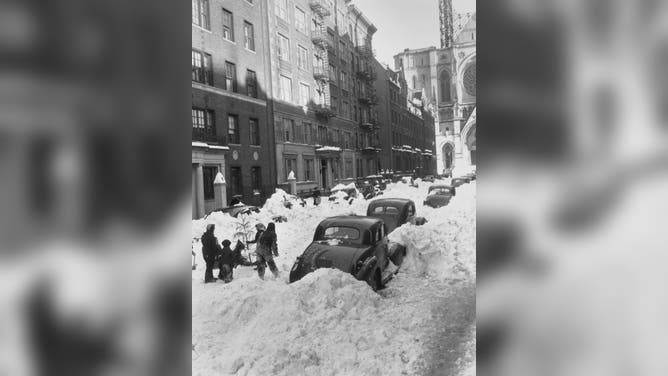
People clearing snow following a snowstorm in New York City, New York, 29th December 1947. The North American blizzard of 1947 brought the northeast of the United States to a standstill, with over 26 inches falling on New York City.
(Bettmann Archive / Getty Images)
Heavy snow like this completely paralyzes a city at this time, forcing people to dig themselves out of the piles.
February 11–12, 2006
Coming in second place is the snowstorm of February 2006, with 26.9 inches of snow.
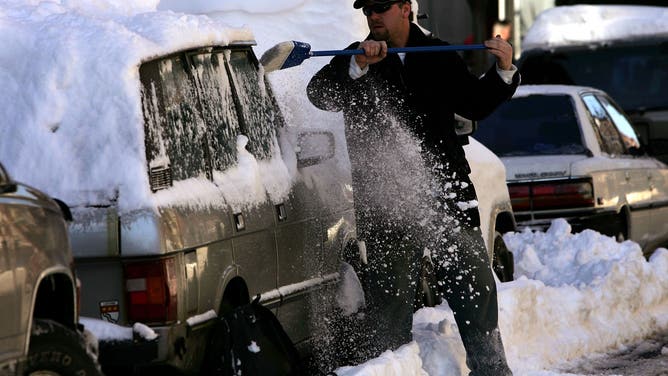
NEW YORK - FEBRUARY 13: A man clears snow from his vehicle the morning after a Northeast storm dropped more than two-feet of snow February 13, 2006 in New York City. The storm hit New York City on the night of February 11, 2006 resulting in blizzard conditions and setting a new snowfall record. The storm shut down airports in the Northeast and caused power outages.
(Spencer Platt / Getty Images)
New York City officials deployed 2,500 workers to handle the cleanup efforts of the considerable accumulation.
Hundreds of flights were canceled, and numerous roads were closed due to intense winter weather.
ROUNDS OF SNOW TO STRETCH FROM FOUR CORNERS TO THE GREAT LAKES, TRIGGERING WINTER WEATHER ALERTS
January 22-24, 2016
In first place with the most snow to hit Central Park was in January 2016, when New Yorkers experienced 27.5 inches of snow.
This is the most significant snowstorm to hit Central Park since records began in 1869.
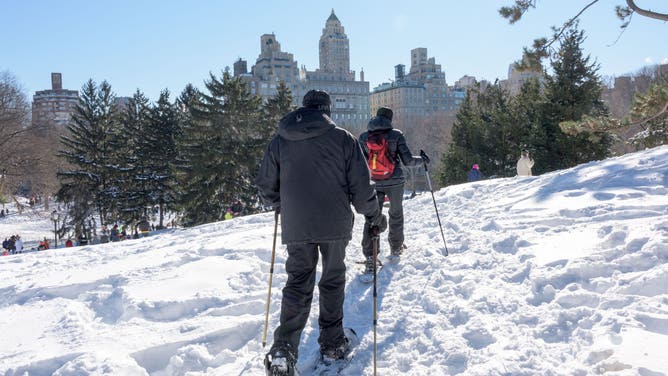
![TOPSHOT - Two men walk in snow shoes in Central Park on January 24, 2016 in New York. - A massive blizzard that claimed at least 16 lives in the eastern United States finally appeared to be winding down Sunday, giving snowbound residents the chance to begin digging out.]() Image 1 of 3
Image 1 of 3TOPSHOT - Two men walk in snow shoes in Central Park on January 24, 2016 in New York. - A massive blizzard that claimed at least 16 lives in the eastern United States finally appeared to be winding down Sunday, giving snowbound residents the chance to begin digging out. (FRANCOIS XAVIER MARIT/AFP)
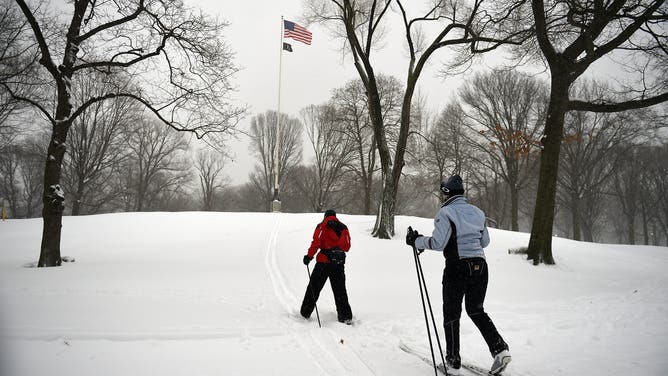
![NEW YORK, NY - JANUARY 23: Cross country skiers exercise through Central Park on January 23, 2016 in New York City. A major Nor'easter is hitting much of the East Coast and parts of the South as forecasts warn of up to two feet of snow in some areas.]() Image 2 of 3
Image 2 of 3NEW YORK, NY - JANUARY 23: Cross country skiers exercise through Central Park on January 23, 2016 in New York City. A major Nor'easter is hitting much of the East Coast and parts of the South as forecasts warn of up to two feet of snow in some areas. (Astrid Riecken)
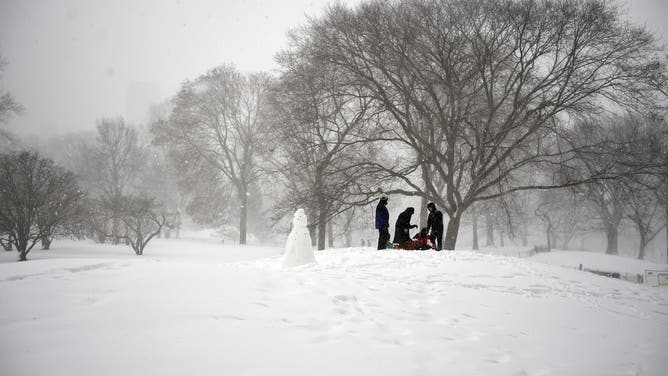
![NEW YORK, NY - JANUARY 23: People stand under a tree in Central Park on January 23, 2016 in New York City. A major Nor'easter is hitting much of the East Coast and parts of the South as forecasts warn of up to two feet of snow in some areas.]() Image 3 of 3
Image 3 of 3NEW YORK, NY - JANUARY 23: People stand under a tree in Central Park on January 23, 2016 in New York City. A major Nor'easter is hitting much of the East Coast and parts of the South as forecasts warn of up to two feet of snow in some areas. (Astrid Riecken)
Blizzard conditions were observed in New York City, Long Island and other portions of the Northeast.
Be sure to stay updated with the latest winter weather alerts all season long with FOX Weather.