

How do hurricanes and tropical storms influence sharks?
Sharks have inner ears, which allow them to sense the drop in pressure from an incoming tropical system, Dr. Bob Hueter, senior advisor for science and academics at OCEARCH, said.
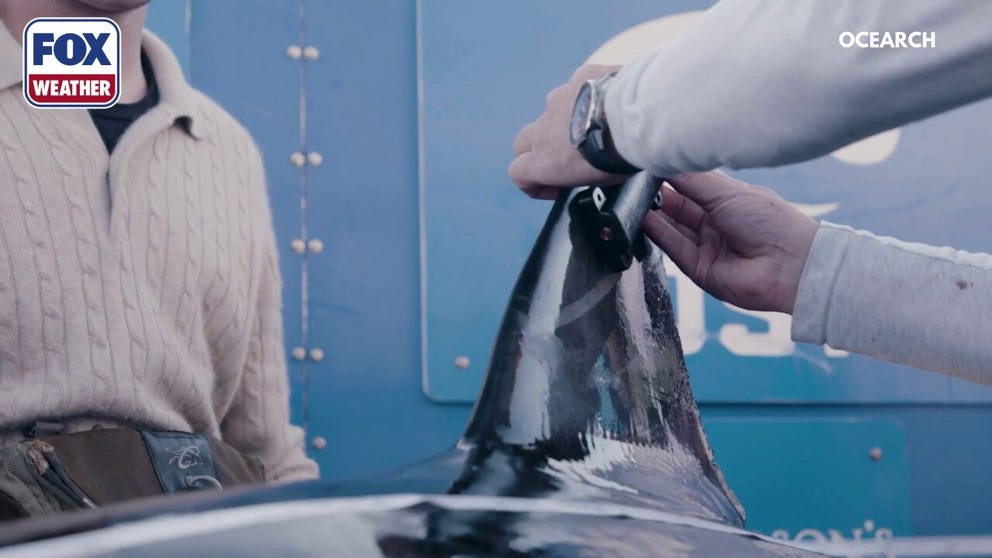
OCEARCH tags a shark for their shark tracker program in Nova Scotia
Video from an OCEARCH expedition in Nova Scotia back in 2021 shows the shark tagging process, including measuring the shark, taking blood and tissue samples and attaching a tracker to the shark's fin.
Sharks, like many animals, can sense when something is amiss in their home environment: the ocean.
So, when a hurricane or tropical storm is brewing, sharks in the area have been reported to flee.
WHAT IS BAROMETRIC PRESSURE AND WHAT DOES IT MEAN FOR HURRICANES?
Barometric pressure is the pressure of the atmosphere, as measured by a barometer.
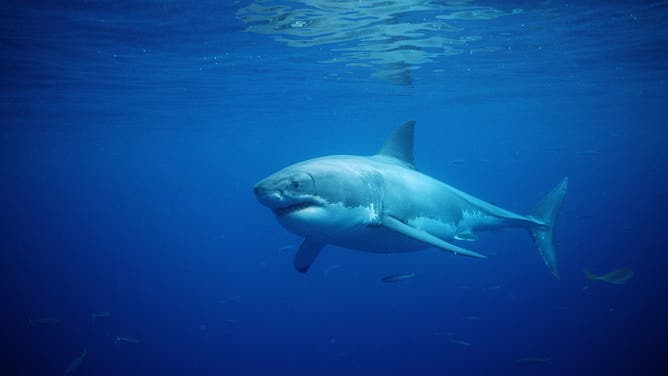
A great white shark patrols the waters near Dangerous Reef off Neptune Island in South Australia, one of the world's premier habitats for the apex predator.
(Photo by Reinhard Dirscherl/ullstein bild via Getty Images / Getty Images)
1013 millibars is a standard atmospheric pressure at sea level, representing a normal weight of air above the Earth, according to the National Weather Service.
Barometric pressure drops at the center of a tropical system, and scientists measure it to determine how strong a hurricane could be.
RARE, ELUSIVE PANCAKE-LIKE OCTOPUS SPOTTED IN UNCHARTERED DEEP WATERS OFF CARIBBEAN ISLAND
Sharks have inner ears, which allow them to sense the drop in pressure from an incoming tropical system, Dr. Bob Hueter, senior advisor for science and academics at OCEARCH, said.
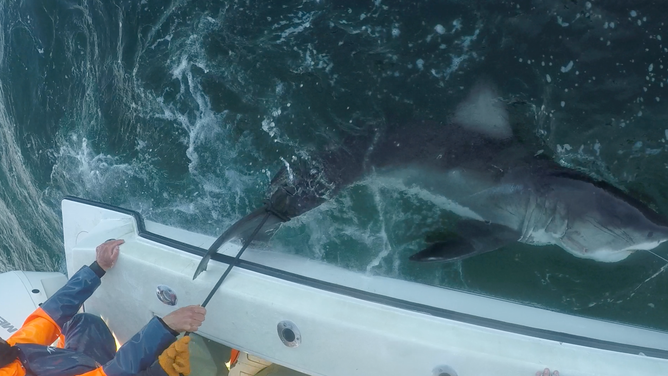
An OCEARCH and Tancook Islands Marine Field team tagging Nori, a young white shark, off Mahone Bay in Nova Scotia in Oct. 2025.
(OCEARCH / FOX Weather)
A study published by Hueter, Dr. Michelle Huepel and Colin Simpfendorfer back in 2003 showed that a group of young blacktip sharks that normally lived in bays and protected areas off Florida's Gulf Coast, were leaving in unprecedented numbers out into dangerous, deeper waters during the approach of Tropical Storm Gabrielle back in September 2001.
After the storm passed, Heupel collected the acoustic data obtained from these young sharks, which showed that they fled when the storm approached and returned a week or two afterward, Hueter said.
SEE IT: RARE GREAT WHITE SHARK CAUGHT ON CAMERA IN THIS STATE'S WATERS FOR EXPECTED FIRST TIME
"As far as what the trigger was, Dr. Heupel could see that it wasn't the wind, it wasn't the rainfall, it was the drop in barometric pressure as the storm approached," Hueter said.
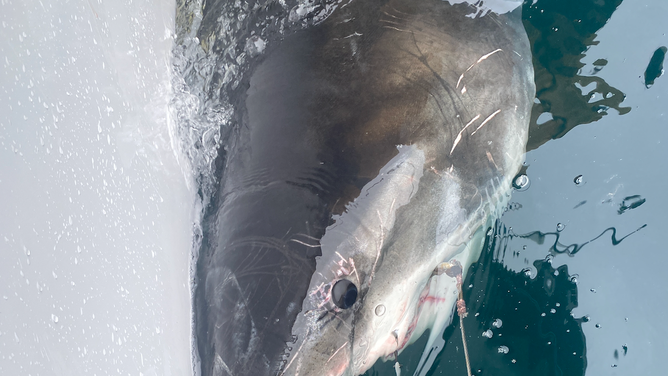
CAYO upon being tagged in Nova Scotia in July by OCEARCH.
(OCEARCH / FOX Weather)
He said that around the same time, scientists in Scotland found that through their inner ears, another species of shark was able to detect the barometric pressure dropped.
ATLANTIC SHARK INSTITUTE TAGS ITS FIRST-EVER HAMMERHEAD SHARK OFF COAST OF RHODE ISLAND
"That pressure can be transmitted down through the water column for marine animals," he said.
The animals are attuned to the normal atmospheric pressure combined with the pressure from the weight of the water, so when there's a change, they know something's up.
"Behaviorally, it was obvious to us that it's an innate behavior for them to take this information and basically say ‘Uh oh, something’s coming, I better get out of here quick,'" Hueter said.
BEACHGOERS ON ALERT AS UNPRECEDENTED SHARK SIGHTINGS PLAGUE THESE POPULAR BEACHES THIS SUMMER
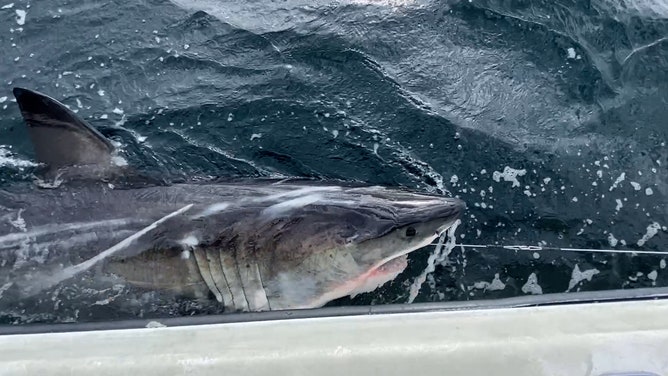
Ripple, a sub-adult male white shark was tagged on Sept. 30, in Mahone Bay off the coast of Nova Scotia.
(OCEARCH / FOX Weather)
The study has held up for the last 23 years, and further studies of marine animals have helped prove their theory, Hueter said.
He said that there's not enough data to prove if all species of shark exhibit this evacuation-like behavior, but for sharks of similar biology to the blacktop sharks, it's probably a general trait of many shark species, especially those in coastal areas.
MASSIVE 1,400-POUND GREAT WHITE SHARK BRETON RAISES QUESTIONS AFTER IT PINGS OFF FLORIDA COAST
OCEARCH tags and tracks many sharks to monitor their movement patterns for ocean research and to help people better understand the animals instead of being afraid of them.
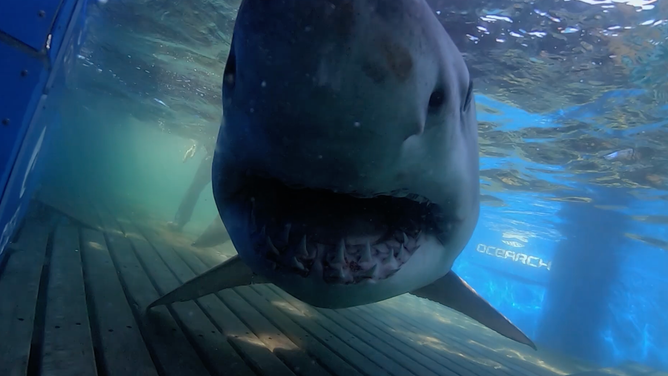
Breton the shark being released in 2020 after his evaluation and tagging.
(OCEARCH / FOX Weather)
Hueter said more than 100 white sharks have been tagged as part of their Global Shark Tracker program, and they have seen some sharks make adjustments in recent years due to oncoming tropical systems, but when sharks dive deep into the ocean like many do to escape the weather, their tags will not ping on satellites.
YOUNG GREAT WHITE SHARK PINGS OFF CANADA'S COAST AS HE HEADS TO SUMMER FEEDING GROUNDS
While searching for sharks with OCEARCH off the coast of Nova Scotia a few years ago, Hueter recalls having to seek shelter up near Prince Edward Island due to an incoming tropical system.
He said prior to leaving, they were having great luck finding sharks, but when they returned after the storm cleared, their luck had changed.
The OCEARCH logo on a boat during a shark tagging in 2020.
(OCEARCH / FOX Weather)
"The fishing was bad, the animals had left," Hueter said.
Hueter said that while understanding how sharks sense these changes in weather patterns is great and helpful for scientific research, they can't be used to track hurricanes or predict how bad they'll be, as he's been asked many times before.
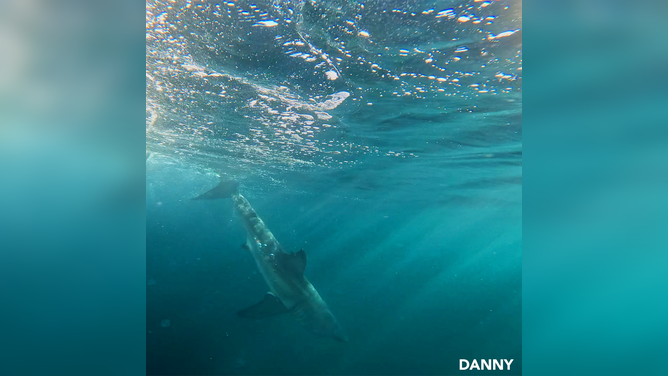
Danny, the white shark tagged by OCEARCH.
(OCEARCH / FOX Weather)
"I think the National Weather Service and the great folks at FOX Weather are pretty well-equipped to do it better than we can do it with the sharks," he said, chuckling. "But it is an interesting feature and another way that we can understand how these animals have survived for 400 million years a group in the world's oceans."
Keep up with OCEARCH and their research as well as their free Global Shark Tracker app here.