

Rare shark spotted by group of college students during nighttime dive off California coast
A prickly shark is identified by its large, thorn-like denticles on the body, and is categorized as a rare, near-threatened species that is typically only observed by submarine.
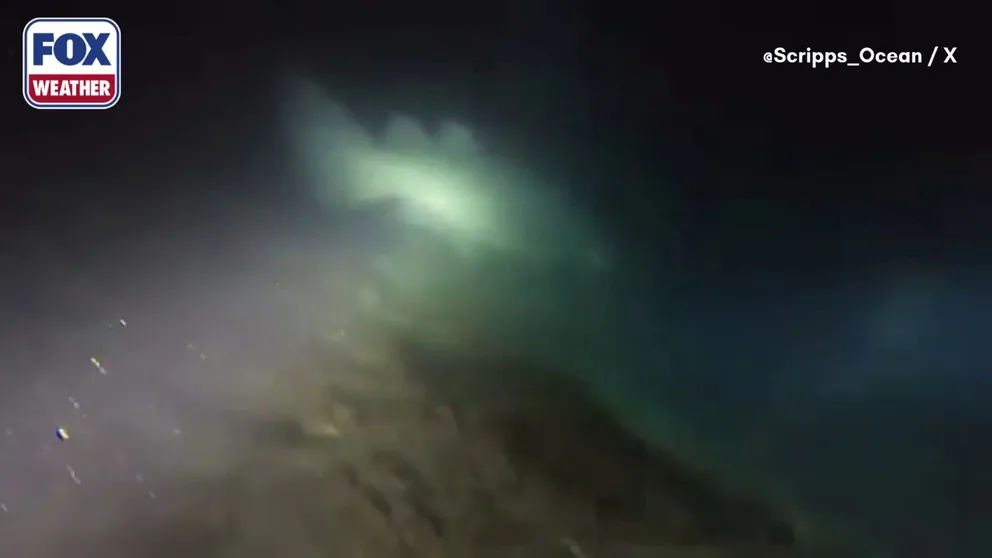
Rare shark observed in La Jolla Cove during night dive
Divers observed a Prickly Shark during a evening dive in La Jolla Cove in San Diego, California.
SAN DIEGO, Calif. – During a night dive in San Diego's La Jolla Cove, divers caught a glimpse of a rare shark under the light of their flashlights on the floor of the pitch-black Pacific Ocean.
What started out as an underwater, late-night adventure for Scripps Oceanography marine biology graduate student, scientific diver and anchovy bioenergetics expert Cali Lingle, her dive partner Liam Dougherty and two other friends became a dive she would never forget when she caught a glimpse of the Echinorhinus cookei, or prickly shark.
A prickly shark is identified by its large, thorn-like denticles on the body, and is categorized as a rare, near-threatened species that is typically only observed by submarine.
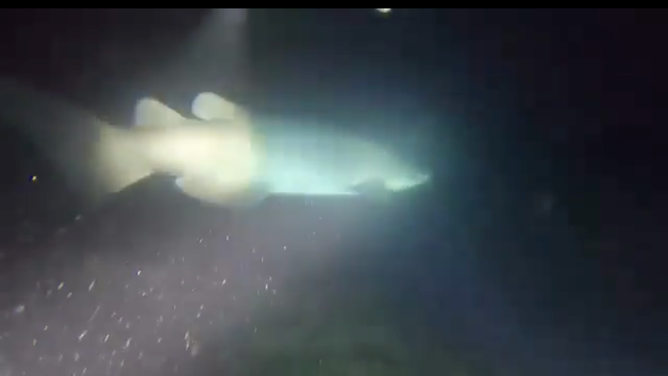
On a late-night adventure, divers in La Jolla Cove caught a glimpse of the Echinorhinus cookei, or the Prickly Shark.
(@Scripps_Ocean / X)
"I thought the shark was a sevengill at first, but I saw two dorsal fins and the shark looked at least seven feet long," Lingle said on Instagram. "Turns out this shark is extremely rare to see by divers because they commonly swim in deeper waters, closer to 300 to 2,000 feet down."
This deep-water shark is found from 11 to 1,100 meters deep in the Western Pacific Ocean off Japan, Taiwan, Palau, Australia and New Zealand, and in the Eastern Pacific off Hawaii, Gulf of California and from Costa Rica to Peru and Chile.
"This was by far the most amazing experience I’ve had," Lingle said. "It felt like discovering a new species at first, because none of us knew of the shark beforehand. It reminded me of how big the ocean really is and how little we know, and gave me motivation to keep protecting and caring for our mysterious and beautiful oceans."
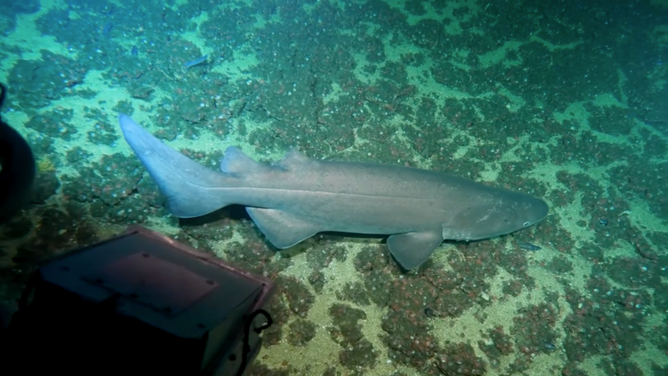
A prickly shark was documented in Panama's eastern Pacific region during a two-week-long research expedition to the Cordillera de Coiba seamount in May 2022.
(Smithsonian Tropical Research Institute)
"I've dived there so many times, and I've never seen this shark, and my friends didn't either," Lingle said, who was accompanied by three other marine biology students.
The La Jolla Shores Canyon dive site, a common diving spot in the area, is equipped with a submarine canyon.
The canyon, which has a depth of approximately 700 feet, invites wayward deep sea creatures to venture into the shallows, like the prickly shark.
While many on-lookers wonder why Lingle and the trio of marine biology students brave the sinister, dark waters of the Pacific Ocean at nighttime, she said, for unique moments that may only happen when the sun is down.
SEVERAL SKIERS REPORTED MISSING AFTER AVALANCHE IN SIERRA NEVADA DURING EXTREME WEATHER CONDITIONS
"Night dives are more exciting, not in the sense of being scary, but in the sense of the flashlight focusing the light on one area, and it kind of puts you into a zen-focus state," Lingle said.
While a flash flight guides the way, she said the nighttime also invites bioluminesces and unique marine life, like the prickly shark, that practice dial-vertical migration during the night.
An accomplished diver that has observed bull-sharks, whales and the nighttime dive turned into an experience that Lingle said was an underwater moment she will never forget.