

Rare solar phenomenon making shadows disappear lingers over Hawaiian islands
During a Lāhainā Noon, as the sun directly passes over the island, upright objects like flagpoles, utility poles and fire hydrants cast no shadow.
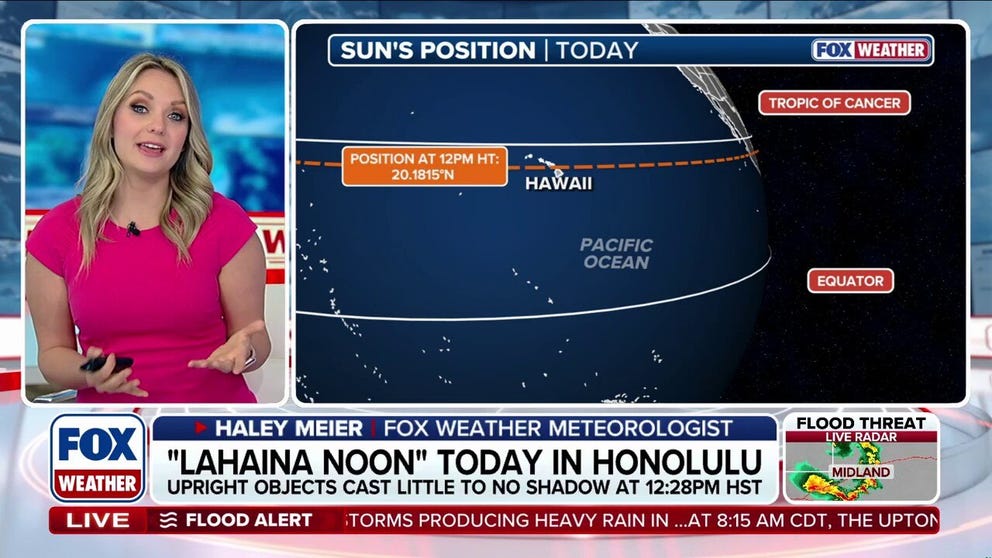
Shadows to vanish across Honolulu for rare 'Lāhainā Noon
It is Lāhainā Noon in Honolulu! Today, the sun will pass directly overhead at its absolute highest point, causing vertical objects- including people! - to cast little to no shadow at all. FOX Weather Meteorologist Haley Meier explains the precise timing and why this unique phenomenon can only be experienced in this part of the country:
Have you ever felt like the sun was directly overhead? In Hawaii, it's possible it actually is.
During a phenomenon known as Lāhainā Noon, the sun passes almost directly above the islands, causing upright objects to cast little to no shadow.
As an isolated archipelago located in the central Pacific Ocean roughly 2,400-miles from the closest U.S. mainland, Hawaii fosters phenomenons the rest of the U.S. can't relate to.
WASHINGTON MAN ARRESTED AFTER VIRAL VIDEO SHOWS HIM THROWING ROCK AT ENDANGERED HAWAIIAN SEAL
Lāhainā Noon is one such thing, and the astronomical phenomenon only occurs when the timing is perfect.
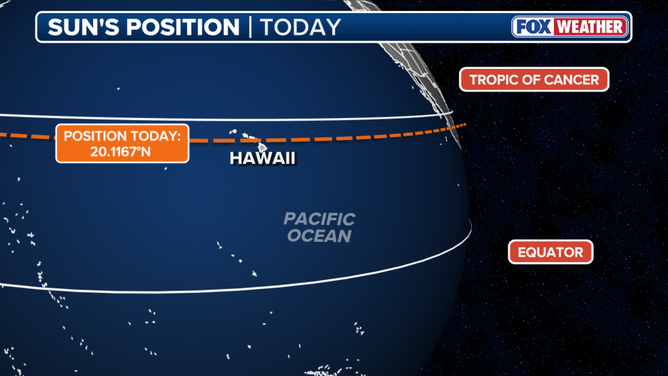
The sun was positioned directly over Hawaii on Wednesday, May 20.
(FOX Weather)
Twice a year, in May and July, the sun passes directly overhead parts of the Earth at a perfect 90-degree angle – a phenomenon the Bishop Museum, the State of Hawaiʻi Museum of Natural and Cultural History, coined Lāhainā Noon.
During a Lāhainā Noon, as the sun directly passes over the island, upright objects like flagpoles, utility poles and fire hydrants cast no shadow.
The unique phenomenon can only occur within the tropics, between the Tropic of Cancer and the Tropic of Capricorn, making Hawaii the only U.S. state where the "Zero-Shadow" can be observed.
ALASKA LANDSLIDE UNLEASHED ONE OF THE LARGEST TSUNAMIS EVER RECORDED, NEW STUDY SHOWS
The annual shade-taking phenomenon was a normal thing for islanders, but there wasn't an "official" name to describe the rare sun show. So, the Bishop Museum held a contest to award a name to the phenomenon, and the winner was Lāhainā Noon.
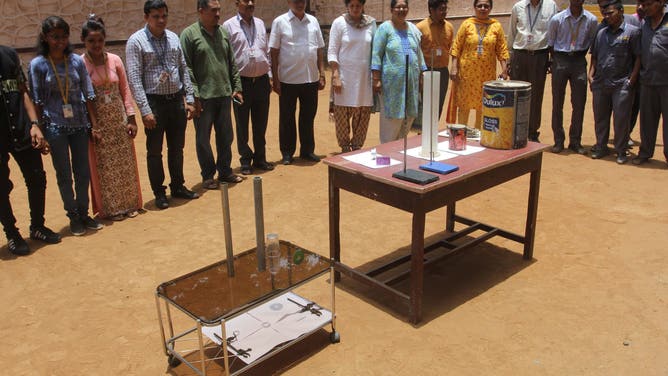
Students and staff observe "Zero Shadow Day" by placing 7 objects in varied sizes and shapes at Dnyanasadhana College, Thane, on May 16, 2018 in Navi Mumbai, India. In India, the phenomenon is referred to as "Zero Shadow Day"
(Praful Gangurde/Hindustan Times via Getty Images)
According to the Bishop Museum, the dates, times and locations in Hawaiʻi where Lāhainā Noon can be observed are listed below.
- In Līhuʻe, Kaua‘i, Lāhainā Noon occurs on May 30 at 12:35 p.m. and again on July 11 at 12:43 p.m.
- In Haleʻiwa, O‘ahu, the overhead sun happens on May 28 at 12:29 p.m. and July 14 at 12:38 p.m.
- In Kāne‘ohe, O‘ahu, Lāhainā Noon takes place on May 27 at 12:28 p.m. and July 15 at 12:37 p.m.
- In Honolulu, O‘ahu, the phenomenon occurs on May 26 at 12:28 p.m. and July 15 at 12:37 p.m.
- In Kaunakakai, Moloka‘i, Lāhainā Noon happens on May 25 at 12:25 p.m. and July 17 at 12:34 p.m.
- In Kahului, Maui, the sun is directly overhead on May 24 at 12:23 p.m. and July 18 at 12:32 p.m.
- In Lahaina, Maui, Lāhainā Noon occurs on May 24 at 12:23 p.m. and July 18 at 12:33 p.m.
- In Lāna‘i City, Lāna‘i, the event happens on May 24 at 12:24 p.m. and July 18 at 12:34 p.m.
- In Hāna, Maui, the overhead sun appears on May 23 at 12:20 p.m. and July 19 at 12:30 p.m.