

October skywatching guide: Hunter's Moon, meteor showers, Saturn at opposition and more you can't miss
From meteor showers and the Hunter's Moon to Saturn in opposition, find out when to look up:
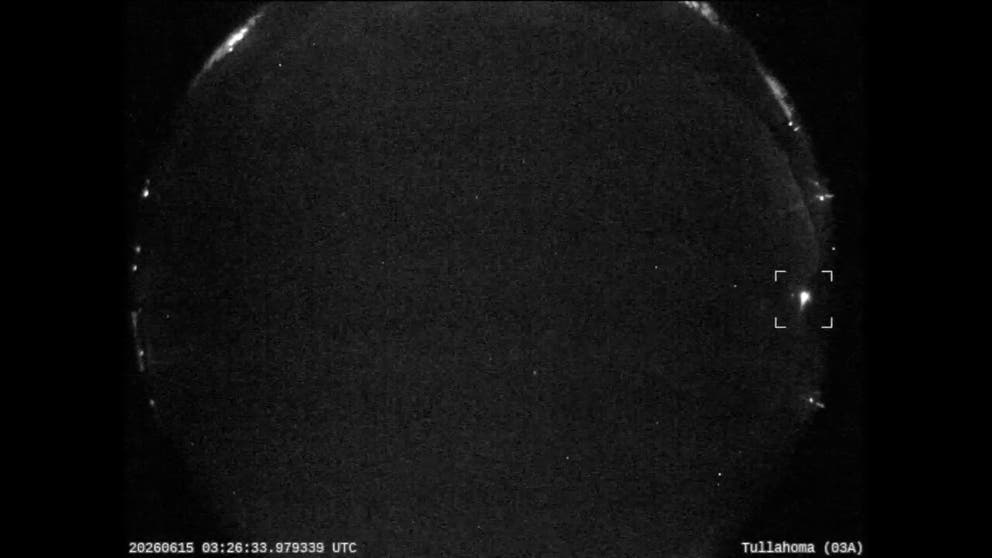
FILE: Meteor captured on NASA camera
The most recent fireball that lit up the night sky across several states in the U.S. was captured by one of NASA’s meteor cameras on Sunday.
THE TAKEAWAY
- The skywatching events kick off on Oct. 4 with Saturn in opposition.
- The Draconid and Orionid meteor showers will dominate the sky, too.
- The full Hunter's Moon happens on Oct. 25.
October is shaping up to be a great month for skywatchers, with several celestial events you won't want to miss for the first full month of fall.
From meteor showers and the Hunter's Moon to Saturn in opposition, find out when to look up:
Oct. 4: Saturn in opposition
On Oct. 4, Saturn will be in opposition, which means Earth comes between it and the Sun.
NASA LAUNCHES SPACEX’S CREW-13 ON A RECORD-BREAKING JOURNEY TO THE INTERNATIONAL SPACE STATION
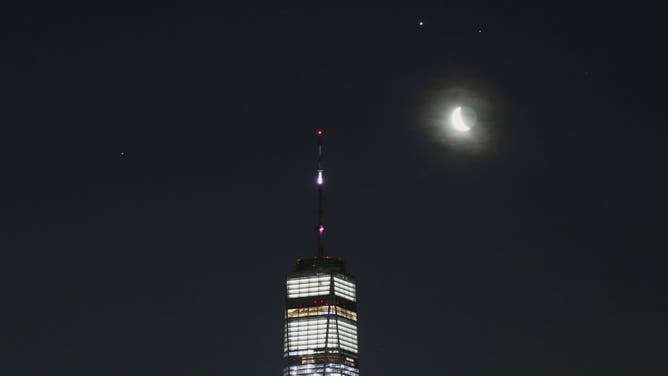
JERSEY CITY, NJ - MARCH 18: Saturn, Jupiter and Mars along with a crescent moon rise in the pre-dawn sky above One World Trade Center on March 18, 2020 as seen from Jersey City, New Jersey.
(Gary Hershorn / Getty Images)
What this means is Saturn will be opposite the Sun in the sky, rising around sunset and remaining visible for much of the night, NASA said.
Oct. 4 to 5: Moon and Mars close in the sky
On Oct. 4 and Oct. 5, the Moon will be near Mars in the predawn sky.
The waning crescent Moon will also be near Jupiter around this time.
THE SUN HAS GONE BLANK AS SUNSPOTS VANISH FOR THE FIRST TIME SINCE FEBRUARY
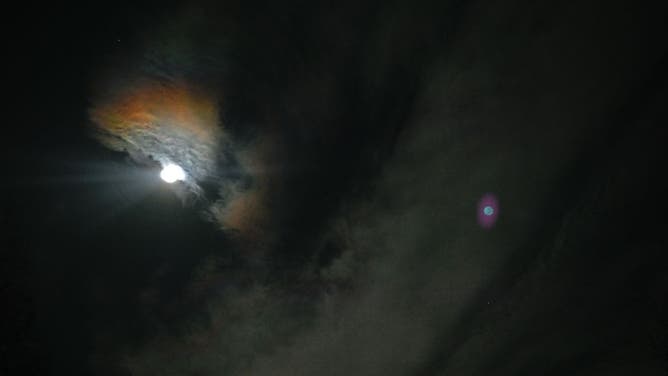
CHARLOTTE, UNITED STATES - JANUARY 13: The first full moon of the 2025 called 'Wolf Moon' that seen next to Mars rises over the sky during a lunar occultation of Mars in Charlotte, United States on January 13, 2025.
(Peter Zay/Anadolu / Getty Images)
You should be able to see these planets nicely without a visual aid, but pull out some binoculars to get a better look.
Oct. 8: Draconid meteor shower
On the evening of Oct. 8, the Draconid meteor shower will peak.
The waning crescent Moon won’t interfere with watching for Draconids meteors.
NASA SCIENTIST DISCOVERS LARGEST, NEWLY FORMED 'ONCE-IN-A-CENTURY' MOON CRATER AFTER ASTEROID IMPACT
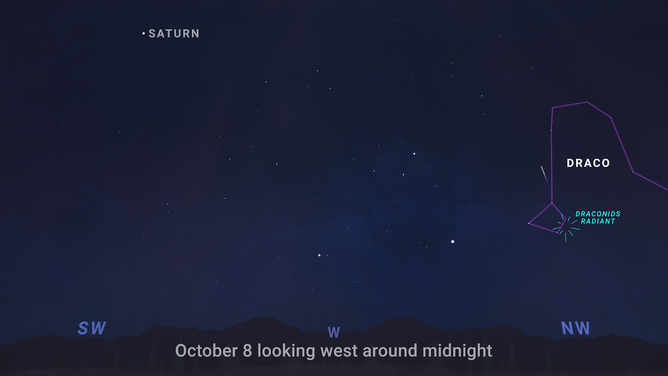
The Draconid meteor shower radiant point in the Draco constellation.
(NASA/JPL-Caltech / NASA)
The Draconids are likely to only produce a few meteors per hour, but some years offer more exciting shows than others, according to EarthSky.
Oct. 21: Orionid meteor shower
The Orionid meteor shower peaks on the night of Oct. 21 under a bright waxing gibbous Moon.
These meteors are known for their brightness and their speed, according to NASA.
ANCIENT MONUMENT WITH MYSTERIOUS CONNECTION TO SUN AND MOON FOUND AFTER 6,500 YEARS
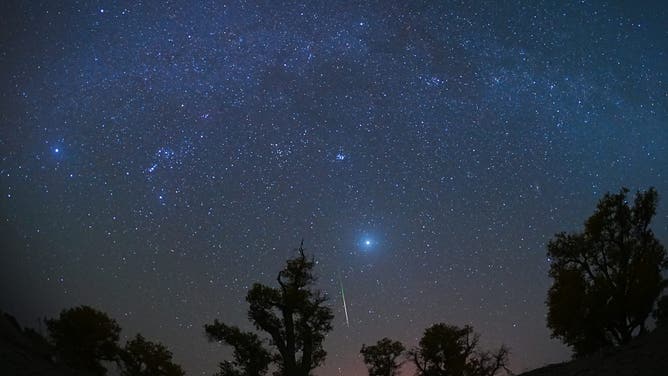
YULI, CHINA - OCTOBER 22: A meteor streaks across the sky over a desert during the Orionid meteor shower on October 22, 2023 in Yuli County, Bayingolin Mongol Autonomous Prefecture, Xinjiang Uygur Autonomous Region of China.
(VCG/VCG )
The best time to watch for meteors is in the dark hours before dawn. Under dark skies, you might see 10 to 20 meteors per hour, according to EarthSky.
Oct. 25 to 26: Full Hunter's Moon
The full Moon rises on the night of Oct. 25, and reaches its peak brightness at 12:12 a.m. ET.
The Hunter’s Moon is the full Moon that follows the Harvest Moon, traditionally associated with hunting and preparing meat for winter, according to the Old Farmer's Almanac.
SOLAR VS. LUNAR: WHICH ECLIPSE GIVES YOU THE BEST CHANCE OF SEEING IT?
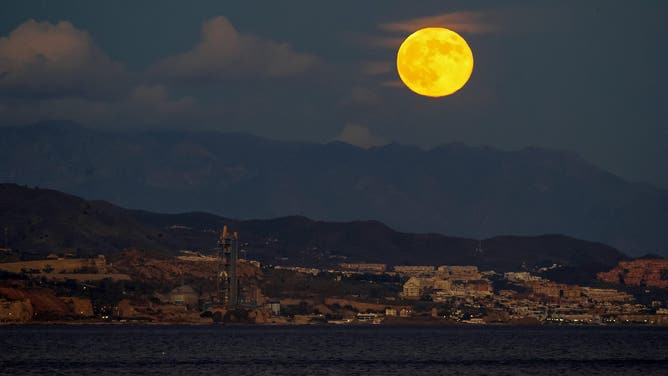
MALAGA, SPAIN - 2024/10/17: The full moon or 'Hunter's moon' is seen in the sky. During the Hunter's Moon, the first autumn full moon, is well-known as Hunter Moon because of its suitability during the hunting season. When the moon appears more large and orange than usual over the horizon.
(Jesus Merida/SOPA Images/LightRocket / Getty Images)
The Moon will be bright and high in the sky for most of the night, so find a clear viewing point away from light and look up.
Oct. 27: Moon near Pleiades
On the night of Oct. 27 into Oct. 28, look for the Moon passing close to a famous star cluster called the Pleiades, also known as the Seven Sisters.
"Many ancient cultures had stories associated with the Pleiades, due in part to the fact that the star cluster is visible from almost everywhere on the globe," said NASA.
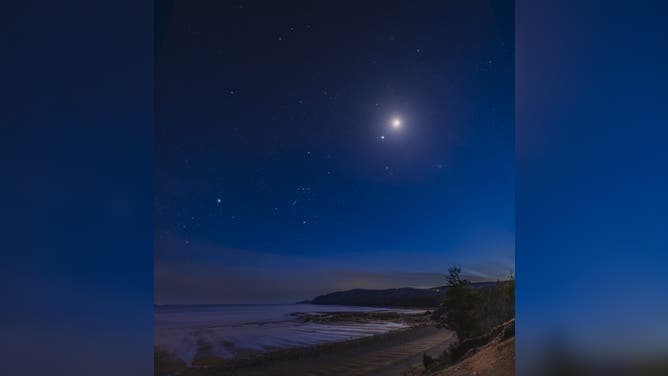
This vertical panorama frames the bright winter stars and constellations setting in the twilight over the Bay of Fundy on an early April evening. At centre is Orion with its distinctive trio of Belt stars, as well as reddish Betelgeuse above and bluish Rigel below. Taurus is to the right of Orion, with the Pleiades cluster, while Canis Major and its bright star Sirius is to the left.
(Alan Dyer/VWPics/Universal Images Group / Getty Images)
To find them, look east in the evening as the Moon and cluster climb higher into the night sky.
The Pleiades will appear as a slightly fuzzy grouping of 6 or 7 stars. They are visible to the unaided eye, but binoculars or a telescope help show more detail.