

NASA’s Pandora mission aims to uncover atmospheric secrets of more than 20 alien worlds
NASA will use the small Pandora satellite to study the atmospheres of exoplanets and learn more about the stars they orbit.
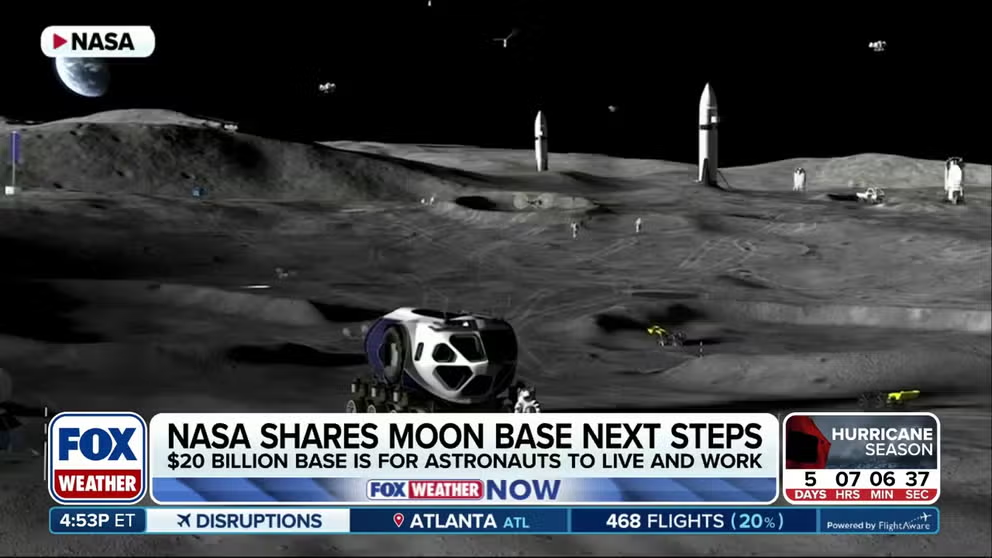
FILE: NASA reveals next steps in Moon Base strategy for long-term lunar presence
NASA shared new details about its Moon Base strategy, outlining plans to establish a long-term human presence near the Moon’s south pole. The agency unveiled new lunar rover contracts, upcoming cargo missions, and future infrastructure projects designed to support sustained operations on the lunar surface. NASA officials said the initiative represents a shift from simply visiting the Moon to building permanent systems for long-term lunar exploration.
NASA officials have announced that new observations of 20 exoplanets beyond our solar system will help unlock the secrets of these worlds' atmospheric makeup.
NASA will use the small Pandora satellite to study the atmospheres of exoplanets and learn more about the stars they orbit.
The goal of the Pandora mission is to determine the makeup of these exoplanets, including the presence of hazes, clouds and water.
SEE IT: NASA SATELLITE REVEALS HUMMINGBIRD-SHAPED SECRET BENEATH ANTARCTICA'S ICE
"Pandora’s data will help close a major gap in our knowledge about planets and their host stars because, right now, we can’t be entirely sure how the star’s light affects measurements of what makes up exoplanet atmospheres," Elisa Quintana, Pandora’s principal investigator at NASA’s Goddard Space Flight Center, said.
Hopefully, this will lay the foundation for interpreting exoplanet measurements and finding a habitable world for humans to colonize.
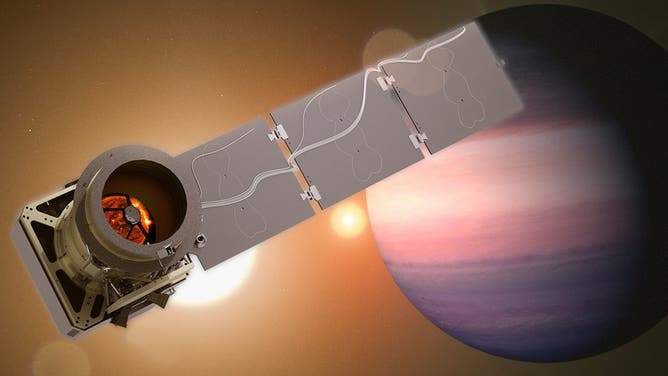
Pandora is a small satellite designed to characterize exoplanets.
(NASA's Goddard Space Flight Center/Conceptual Image Lab)
In particular, this will help the James Webb Telescope better determine measurements.
The Pandora satellite was launched in January, equipped with a telescope that can detect a star's brightness in visible light and its near-infrared spectrum at the same time.
Often, when conducting observations of these distant planets, the signals between water and light can distort what scientists are searching for.
SEPTEMBER SKYWATCHING GUIDE: HARVEST MOON, BRIGHT VENUS, FALL EQUINOX AND MORE AHEAD
Pandora helps detangle these signals from the planet, and its star, helping us understand the planets more accurately.
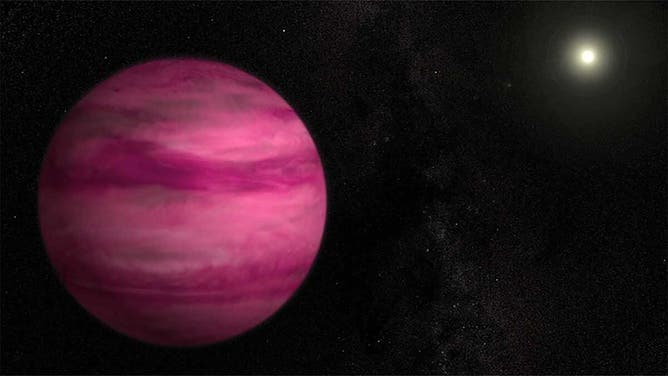
The "Pink Planet," or GJ504b, is either a giant exoplanet or small brown dwarf orbiting a star.
(NASA/Goddard Space Flight Center)
Over the course of the year-long mission, Pandora will observe 20 exoplanets 10 times with a long-duration stare for 24 hours each.
"Pandora’s advantage is its ability to observe targets for extended periods at multiple wavelengths, something high-demand flagship missions like Webb cannot regularly do," Knicole Colón, the mission’s project scientist at NASA Goddard, said.
By combining Pandora's data with observations from the James Webb Space Telescope, scientists can better determine the properties of interstellar surfaces and clearly separate star and planetary signals.
NASA CAPTURES STUNNING NEW VIEW OF TARANTULA NEBULA REVEALING DETAILS ABOUT HOW STARS ARE FORMING
In time, this could be the next big step in discovering habitable planets faster and collecting more data than ever before.