

September skywatching guide: Harvest Moon, bright Venus, fall equinox and more ahead
Ring in the first taste of autumn with some of the top celestial events to catch in September.
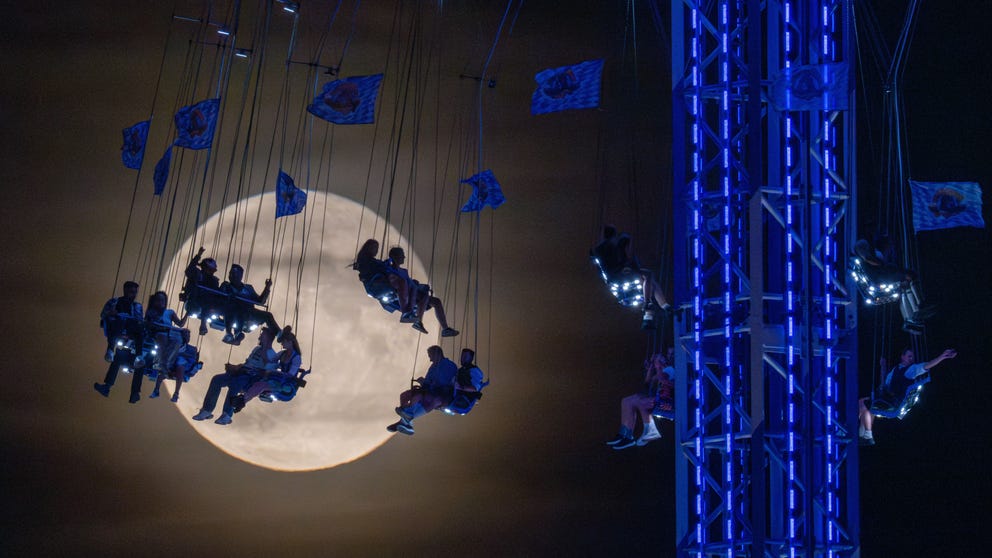
FILE: Harvest 'Supermoon' scenes from around the world
Sept. 29 was not only the full "Harvest" Moon but also the year's last "Supermoon" when the moon is full at its nearest point in its elliptical orbit around the Earth. (Photos courtesy: Getty Images)
September brings plenty of reasons to look to the skies. From a meteor shower and bright Venus to the official change of seasons and the year's Harvest Moon, an impressive lineup awaits stargazers this month.
THE BEST CELESTIAL EVENTS IN 2026 YOU WON'T WANT TO MISS
Ring in the first taste of autumn with some of the top celestial events to catch in September.
Sept. 1 — Aurigid meteor shower
This month begins with the Aurigid meteor shower, which is expected to peak Sept. 1, shooting off up to six meteors per hour. However, according to Star Walk, this year's display might be more limited due to a waning gibbous moon.
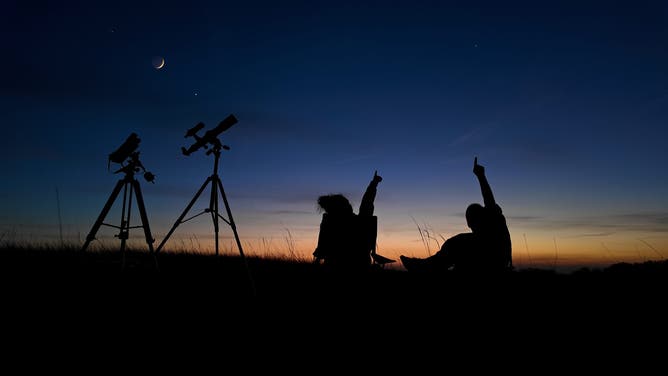
People enjoying watching and stargazing with astronomy telescopes outdoors in nature, observing planets, Moon and other celestial objects.
(m-gucci / Getty Images / Getty Images)
Sept. 6 and 8 — Moon meets Mars and Jupiter
Early September will also feature close encounters between the moon and planets.
On Sept. 6, a waning crescent moon will appear in close conjunction with Mars, followed by a close pairing to Jupiter around Sept. 8.
Sept. 10-11 — New Moon creates darker skies
The new moon arrives on Sept. 10 or 11 depending on your time zone, providing the darkest skies of the month.
In the U.S., it will fall on Sept. 10, while for Europe, Africa and Asia, it will be early on Sept. 11.
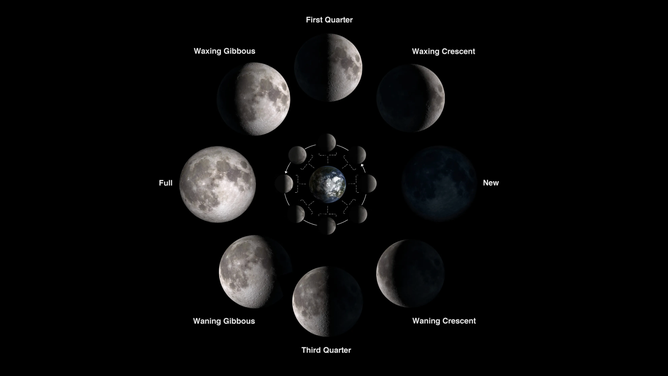
As the bright parts of the Moon appear to change shape during the month, each stage of the change is called a phase, and each phase carries its own name. (Image: NASA/Bill Dunford)
(NASA)
With little to no moonlight, it could create ideal viewing conditions for targets like the Milky Way.
Sept. 14 — Moon and Venus conjunction
On Sept. 14, another lunar and planetary conjunction will grace the skies.
A crescent moon will appear in close proximity to Venus, even though they are nowhere near each other in space.
WATCH: VENUS DISAPPEARS BEHIND THE MOON IN STUNNING TIMELAPSE OF RARE, DAYTIME LUNAR OCCULTATION
Sept. 18 — Venus shines at its brightest
Venus will remain a dazzling sight in the evening sky throughout most of September, with its peak brightness expected on Sept. 18.
"So it’s now nearing greatest brilliancy, when we’ll see it at its brightest in our evening sky for all of 2026. Venus will reach peak brilliancy on September 18. But start watching now!" EarthSky said.
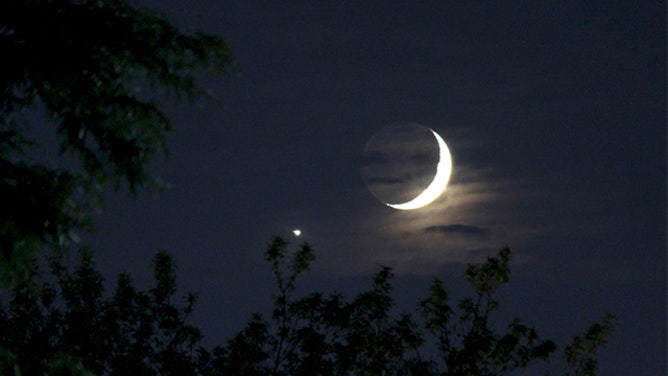
FILE: A waxing crescent moon setting in the early evening with bright Venus visible nearby. Credit: NASA/Bill Dunford
(NASA)
After its peak, it will slowly start to lose ultimate brightness at the end of the month.
Sept. 22-23 — September equinox welcomes fall
The September equinox arrives Sept. 22 to 23, depending on your time zone, and marks the official astronomical start to fall in the Northern Hemisphere.
NASA SET TO LAUNCH NEXT-GENERATION TELESCOPE TO UNLOCK UNIVERSE’S DEEPEST MYSTERIES
On the flip side, it will welcome astronomical spring in the Southern Hemisphere.
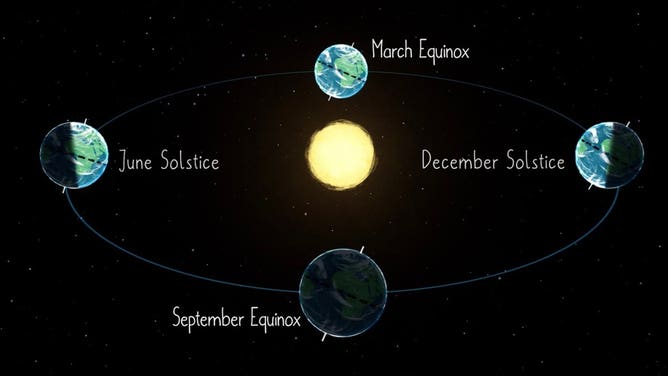
Diagram demonstrating how the tilt of Earth's axis causes variations in sunlight between the Northern and Southern Hemispheres throughout the year. During the equinoxes, the axis is not tilted toward or away from the Sun, resulting in roughly equal sunlight for both hemispheres.
(NASA/JPL-Caltech / NASA)
The September equinox occurs at the exact moment the sun crosses Earth's equator from north to south.
In the U.S., it will occur on Sept. 22, while for Europe, Africa and Asia, it will occur on Sept. 23.
FALL FOLIAGE FORECAST: WHY SOME AREAS MIGHT EXPERIENCE A SPOTTY SEASON
Sept. 25 to 26 — Neptune reaches opposition
Neptune will reach opposition on Sept. 25 and 26, again depending on your time zone.
This means the planet will be roughly opposite the sun in the sky.
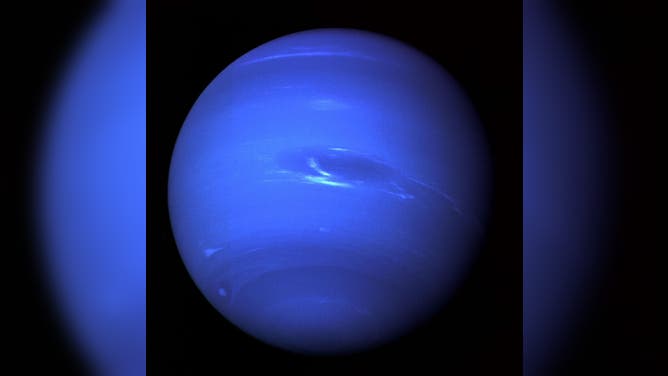
FILE: Image of Neptune
(NASA)
According to EarthSky, "Opposition marks the middle of the best time of the year to see an outer planet. Neptune reaches a yearly maximum in brightness at or near opposition."
Sept. 26 — Harvest Moon lights up night sky
Sept. 26 also brings a full Harvest Moon. September's full moon is known as the Harvest Moon when it occurs closest to the fall equinox.
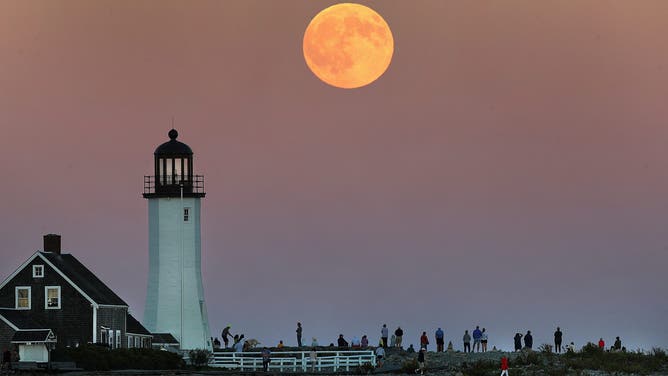
People gather at Scituate Lighthouse to view a full harvest moon on October 6, 2025.
(John Tlumacki/The Boston Globe via Getty Images / Getty Images)
While it will block out some visibility of other stars, it will offer plenty of light.