

NASA turns to AI to uncover new clues hidden across the moon’s surface
The overall goal is to understand the moon's geology and plan future research.
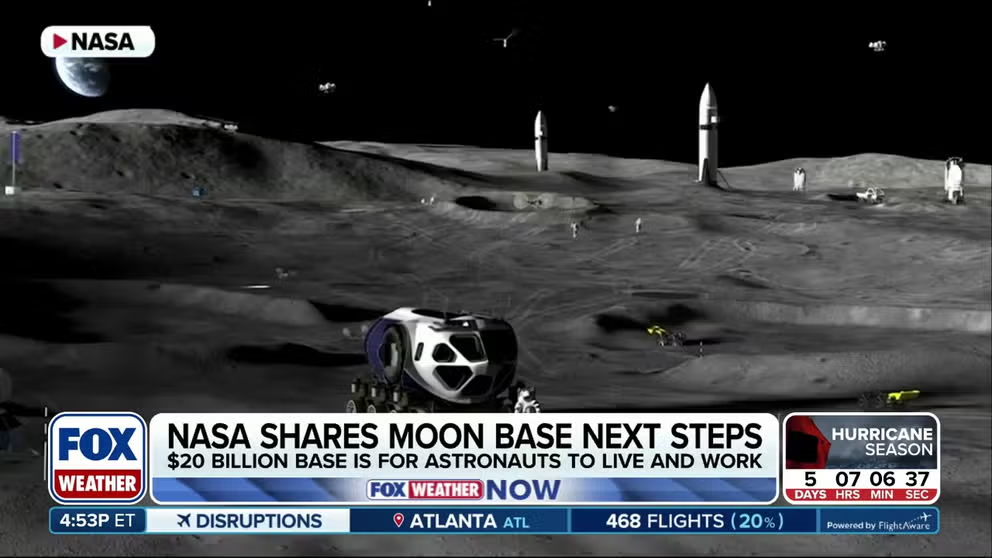
NASA reveals next steps in Moon Base strategy for long-term lunar presence
NASA shared new details about its Moon Base strategy, outlining plans to establish a long-term human presence near the Moon’s south pole. The agency unveiled new lunar rover contracts, upcoming cargo missions, and future infrastructure projects designed to support sustained operations on the lunar surface. NASA officials said the initiative represents a shift from simply visiting the Moon to building permanent systems for long-term lunar exploration.
THE TAKEAWAY
- NASA is using AI to help explore and research the moon's surface.
- The new AI model matched or exceeded the performance of previous methods.
- NASA and IBM plan to use these AI research methods in the future to advance our ability to explore our solar system.
The next step in space exploration is here, as NASA scientists plan to explore the darkest parts of the moon's surface using artificial intelligence.
AI is taking center stage in NASA's lunar research, using a mapping tool to analyze the moon's surface and develop strategies for evaluating its rugged terrain.
The overall goal is to understand the moon's geology and plan future research.
SCIENTISTS UNCOVER FIRST KNOWN ADULT T. REX TRACKWAY DATING BACK 66.5 MILLION YEARS
The AI models used to conduct research and map the moon's surface are pre-trained on vast unlabeled datasets.
"The broad knowledge they acquire through pre-training allows them to generalize across multiple scientific domains through quick fine-tuning, making foundation models both versatile and efficient in accelerating scientific research," NASA said.

NASA's lunar foundation model, a new open-source AI.
(@NASAScience_ / X)
Using data collected over the last 17 years by the AI model Lunar Reconnaissance Orbiter (LRO), scientists were able to analyze more information than all other NASA planetary missions combined, capturing seamless, high-resolution mosaics of the entire moon.
Because the AI model is already pre-trained on this data, scientists can adapt it to many lunar research tasks, such as mapping craters, spotting young volcanic features and estimating where ice may exist on the surface.
SEPTEMBER SKYWATCHING GUIDE: HARVEST MOON, BRIGHT VENUS, FALL EQUINOX AND MORE AHEAD
This will help researchers studying the moon's polar ice estimate where ice patches are likely to be stable, on or below the surface.
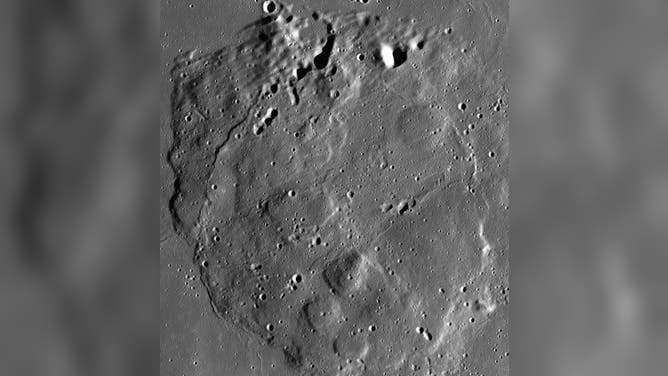
A 10-image mosaic captured by NASA’s Lunar Reconnaissance Orbiter's Narrow Angle Camera between June 2012 and April 2016 showing the volcanic feature Mons Rümker and its surrounding mare plains.
(NASA/GSFC/Arizona State University)
"Dark areas like the moon’s permanently shadowed regions remain cold enough to trap and preserve ice for up to billions of years," NASA said.
This research allows humans to map and potentially use the moon's resources for future space exploration.
NASA ANNOUNCES ARTEMIS III ASTRONAUTS IN NEXT PHASE OF MISSION TO RETURN HUMANS TO THE MOON
The AI model can also speed up crater identification and measurement, as well as analysis of unusual-looking volcanic features on the surface, to better understand the moon's thermal evolution.
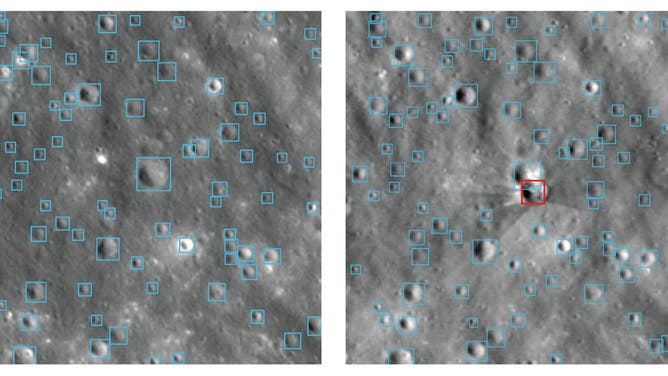
The NASA-IBM Lunar Foundation Model detected existing craters (blue outlines) and highlighted the newly formed impact crater (red box).
(NASA/IBM Research)
JAMES WEBB AND HUBBLE SPACE TELESCOPES DISCOVER TINY NEW WORLDS DEEP IN OUR SOLAR SYSTEM
After more testing with the new AI model, NASA experts determined that it matched or exceeded the performance of the previous method.
The research could help scientists better understand the moon and its features. Following these results, NASA and IBM plan to apply similar AI research methods to future efforts aimed at studying the moon and other parts of the solar system.