

Spring migration takes flight: 850 million birds fill the skies
On May 4, more than 858 million birds were migrating north in flight on a single night—setting a new record on BirdCast, a state-of-the-art tracking platform that uses weather radar to produce migration statistics.

Bird Songs of Spring
Day length, sunlight and instinct give the birds their seasonal cue.
Spring migration is hitting its peak, with hundreds of millions of birds taking to the skies in a massive seasonal journey toward warmer weather and breeding grounds this May.
On May 4 at 1:10 a.m., more than 858 million birds were migrating north in flight in the U.S.—setting a new record on BirdCast, a state-of-the-art tracking platform.
"That this number is closing on one billion in spring is staggering, and it represents the intersection of peak spring migration periods in many areas, with some rather intense, bird-concentrating weather en route, and of course the trusty sensing of our skies by the U.S. weather surveillance radar network," BirdCast said in a news release celebrating the milestone.
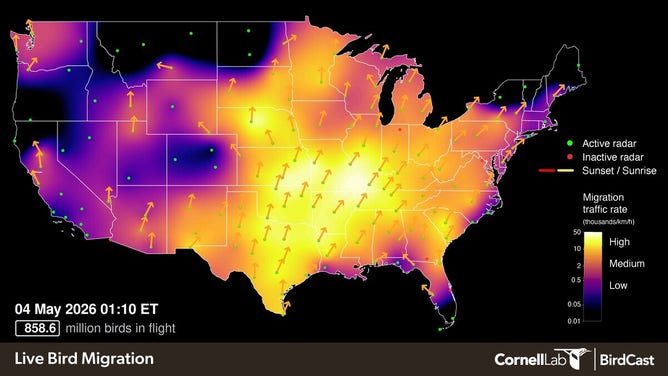
(BirdCast, Live Migration Map; May 4, 2026, 1:10 ET. Cornell Lab of Ornithology. https://birdcast.org/migration-tools/live-migration-maps.)
That’s nearly a billion birds moving overhead in just a few hours, one of the largest mass movements of life on Earth— that are tracked using the same radar technology meteorologists use to forecast storms and map future weather patterns.
FOR THE BIRDS: PROJECT TRACKS BIRD MIGRATION USING NWS DOPPLER RADAR
BirdCast, primarily run by the Cornell Lab of Ornithology in collaboration with the University of Massachusetts Amherst, Purdue University and the University of Illinois at Urbana–Champaign, tracks bird migration in real time using weather surveillance radar that picks up the energy of flocks of birds.
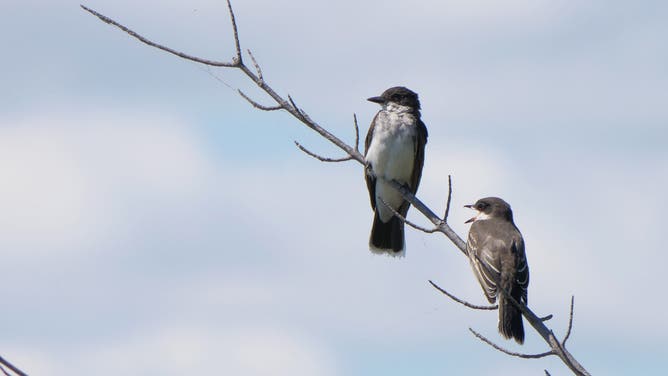
BirdCast’s migration dashboard estimates the species moving through a given area using weather radar data, historical migration patterns, and machine learning. On the record Spring migration day, an estimated 75 plus million birds moved through Missouri, including the Eastern Kingbird.
(Arrush Chopra/NurPhoto via Getty Images)
This groundbreaking platform tracks local bird movement through a migration dashboard, which provides estimates of the number and species of birds expected to pass through a given area each day. On the record-breaking spring migration day, more than 75 million birds crossed the state of Missouri.
Weather plays a pivotal role in Birdcast' mapping daily bird migration – with historic weather data like temperature, wind speed and direction setting the stage for daily migration conditions and the platform's migration forecasts.
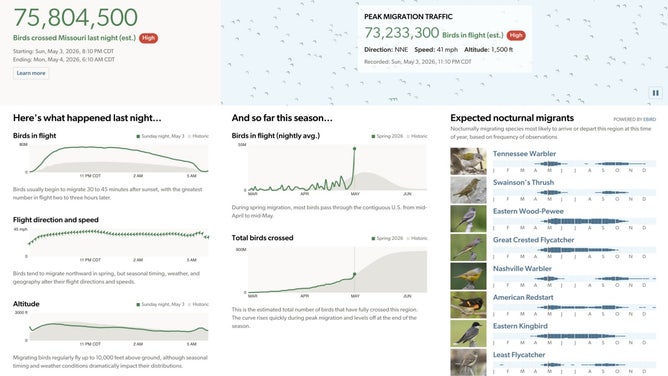
(BirdCast, Migration Dashboard; Missouri, May 3 to May 4. Cornell Lab of Ornithology. https://birdcast.org/migration-tools/migration-dashboard.)
The BirdCast model is updated every 6 hours and predicts bird migrations out to three days in advance for the 2 to 3 hours after local sunset, and gives an aggregate count of expected birds in motion.
When night falls, BirdCast tracks the movements of millions of birds traveling under the stars. They migrate at night to navigate more effectively, avoid predators, and take advantage of calmer, cooler air.
On the move
Every spring and fall, billions of birds across hundreds of species make a seasonal trek – and Birdcast predicts the massive movement of the migrating birds by combining live weather radar data on NEXRAD with over 20 years of historical data.
This new record isn’t the first time BirdCast has tracked a massive migration in real time. More birds migrate in the fall than in the spring—thanks to population growth after the breeding season—so while this spring peak doesn’t surpass the all-time high, it still ranks as the largest spring movement the platform has recorded.
2 HIKERS INJURED IN BEAR ATTACK IN YELLOWSTONE NATIONAL PARK
Each spring migration season, billions of birds embark on a journey northward after hunkering down for the winter in more favorable, warmer climates in the South.
As spring settles in with longer days and warmer weather, birds' seasonal return to the north is rooted in survival.

According to BirdCast, an estimated 208,000 birds moved through New York County between May 5 and May 6, including the Rose-breasted Grosbeak.
(Paolo Picciotto/REDA/Universal Images Group via Getty Images)
According to the U.S. Department of Fish and Wildlife, while factors vary, birds are motivated to migrate in search of a suitable nesting habitat and food – traveling extreme distances to continue their species.
While spring migration runs approximately from March 1 to June 15, peak bird migration occurs from late April to the middle of May – as birds embrace the warmer, summer weather conditions in ideal habitats fit for nesting and raising their youth.
How to keep migrating birds safe
On their annual migrations, birds face danger from every direction.
Most birds travel under cover of night, guided by the stars above. But the glow of city lights can confuse them—turning their journey into a deadly path of disorientation and collisions.

More than 6 million birds traveled through Tennessee between May 5 and May 6, including the Bay-breasted Warbler Perched.
(Education Images/Universal Images Group via Getty Images)
The National Audubon Society's Lights Out program, established in over 50 U.S. cities, is an effort to reduce bird facilities by convincing building owners and managers to turn off excess lighting during the months migrating birds are flying overhead.
Efforts to protect birds on their journey can be taken at home as well.

A sticker with a bird silhouette is attached to the windows of a building on the grounds of the visitor center in the Lower Oder Valley National Park. They are intended to prevent birds from flying into the windows.
(Jens Kalaene/dpa / Getty Images)
Experts argue that using bird-friendly glass to help birds avoid collisions with your windows and turning off your lights at night if you don't need them can make all the difference for the birds traveling on their annual migration journeys.