

Hubble Telescope captures stunning images of 'space slug' nearly 5,000 light-years away
The Hubble Telescope last observed the Trifid Nebula in 1997, allowing scientists to observe the phenomenon’s changes on a human timescale.
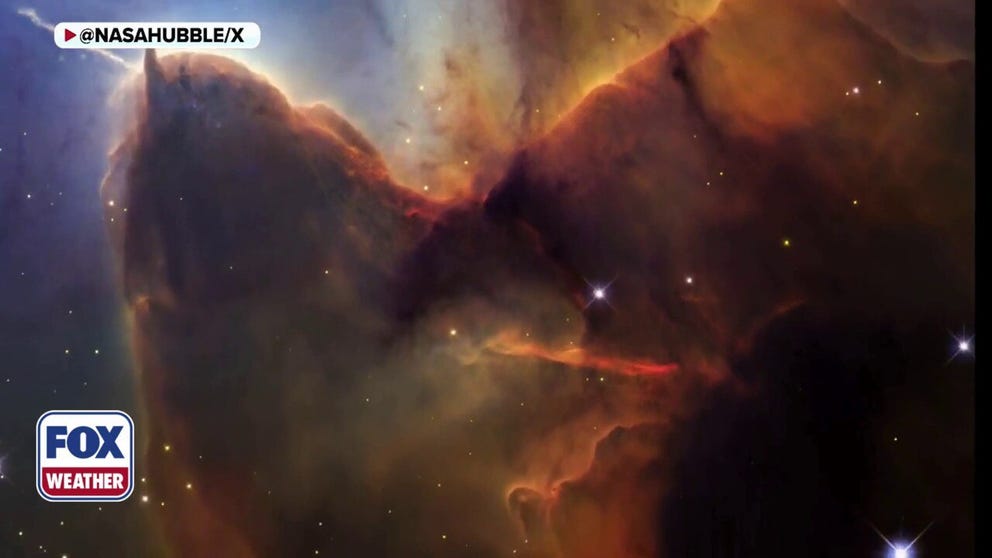
NASA’s Hubble Telescope captures stunning images of Trifid Nebula
NASA’s Hubble Telescope captures stunning images of the Trifid Nebula in deep space, nearly 5,000 light-years away from Earth.
NASA is celebrating the Hubble Telescope’s 36th birthday with stunning images of the Trifid Nebula, nearly 5,000 light-years away from Earth.
This stunning discovery is not the first time the Hubble Telescope has laid eyes on this cosmic scene.
The telescope last observed the Trifid Nebula in 1997, allowing scientists to observe the phenomenon’s changes on a human timescale.
PHOTOS: LARGE LUMINOUS SWIRL OF GALAXY CALLED IC 486 SEEN MILLIONS OF LIGHT-YEARS FROM EARTH
This giant space phenomenon is the result of several massive stars outside this field of view that have shaped this region for at least 300,000 years.
Experts at NASA say that the powerful winds from these stars continue to blow into the enormous bubble, a small portion of which is shown in the image, pushing and compressing the clouds, gas and dust, triggering new waves of star formation.
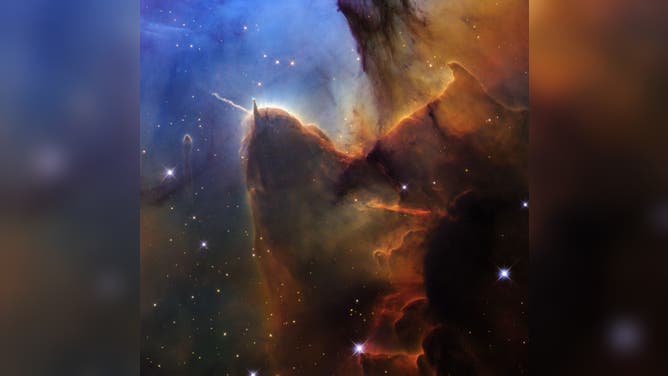
NASA's Hubble Telescope captures images of the Trifid Nebula.
According to NASA, a nebula is a giant cloud of dust and gas in space. Some of these come from the gas and dust thrown out by the explosion of a dying star, such as a supernova.
With a now-improved camera, the Hubble was able to capture a wider view with better detail than before.
THIS RARE INTERSTELLAR COMET IS SPEWING MASSIVE AMOUNTS OF WATER INTO SPACE
"Hubble’s view of the Trifid Nebula [also known as Messier 20 or M2] focuses on the head and undulating body of a rusty-colored cloud of gas and dust that resembles a marine sea lemon, or sea slug, that appears as if it is gliding through the cosmos," a statement from NASA said.
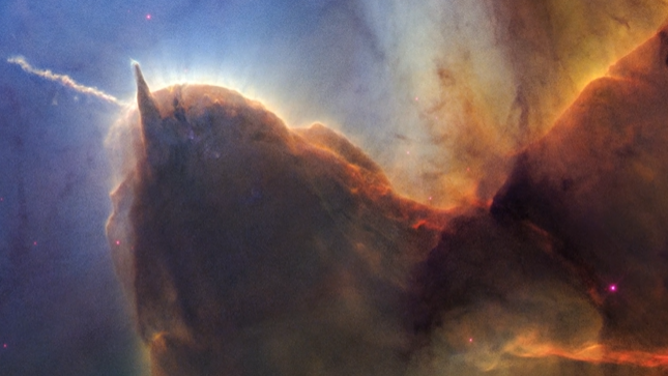
Stunning images released of the Trifid Nebula, taken by NASA's Hubble Telescope.
(NASA, ESA, STScI, Joseph DePasquale (STScI))
Stunning images from NASA show a variety of colors and cloud shapes floating in space, with shades of dark and light orange, and other luminous glowing light.
The "horn" of the giant cosmic sea slug is part of a jet of plasma periodically ejected over centuries by a young protostar called Herbig-Haro 399.
By comparing changes in photos from 1997 to now, researchers can determine how much energy from the protostar is injected into these regions of the cosmic slug and could provide new insights into how newly formed stars interact with their surroundings.
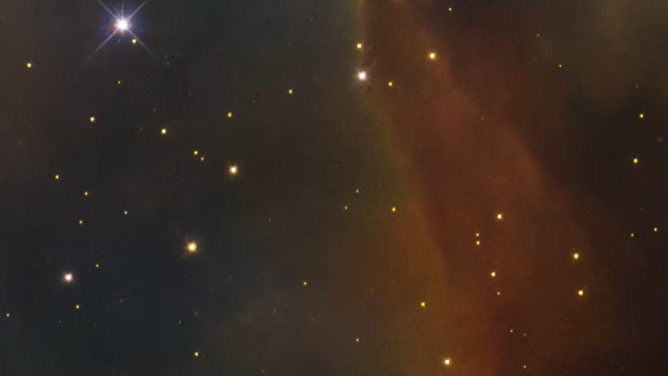
Old formation of stars within the Trifid Nebula.
(NASA, ESA, STScI, Joseph DePasquale (STScI))
Other observations, such as a darker, more triangular "horn" on the head, indicate that it hosts another young star, according to officials.
The plethora of orange orbs in the image are fully formed stars that have existed for millions of years.
NASA STARTS PREPARATIONS FOR ARTEMIS III MISSION WITH SPACE LAUNCH SYSTEM ROLLOUT
The Hubble Telescope continues to provide new opportunities to learn and advance our knowledge of deep space, having taken over 1.7 million observations, with many more on the way.