

Meet the gray wolf: How the apex predator, largest member of the dog family has evolved
The gray wolf is the largest wild member of the dog family, with a muscular build, long legs, and a narrow chest designed for long-distance running.

FILE: Pups of world’s most endangered wolf species born at Tennessee zoo
Six red wolf pups were recently born at Zoo Knoxville, a significant milestone as the species is critically endangered, according to zoo officials.
The grey wolf is one of the world's most fearsome apex predators, despite having a cute and cuddly appearance.
Gray wolves historically have ranged across the Northern Hemisphere in Europe, Asia and North America and once roamed across more than two-thirds of the U.S., according to the National Wildlife Federation.
Because wolves, dogs and coyotes are related, it can be difficult to distinguish them.
GRAY WOLF SPOTTED IN SEQUOIA NATIONAL PARK FOR FIRST TIME IN MORE THAN 100 YEARS
The gray wolf is the largest wild member of the dog family, with a muscular build, long legs and a narrow chest designed for long-distance running. It can weigh between 70 and 115 pounds, according to the National Park Service.
The gray wolf comes in various colors, such as black, white, all shades of gray and tan, and is never spotted.
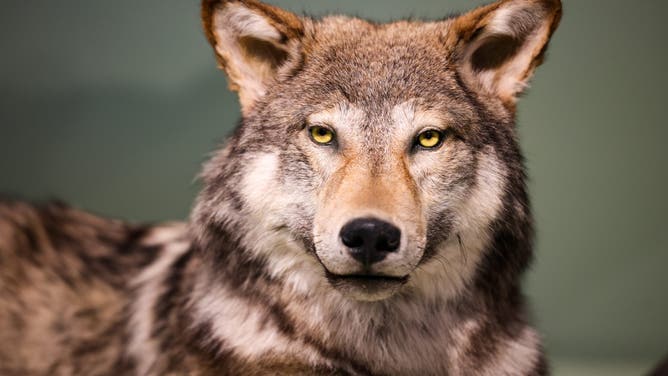
PRODUCTION - 17 April 2026, North Rhine-Westphalia, Essen: A dermoplastic of a wolf is on display in the exhibition "Survival in the Ice Age". The special exhibition, which can be seen until January 10, 2027, is part of the Palaeontological State Exhibition of North Rhine-Westphalia, which is a joint exhibition project of the Ruhr Museum, the LWL Museum of Natural History and the Lippisches Landesmuseum Detmold.
(Christoph Reichwein/picture alliance / Getty Images)
The difference from a coyote is size: they can weigh 20 to 30 pounds and come in all shades of gray and tan.
Dog breeds are related to wolves, but have evolved over the last one to two thousand years, breaking away from them as a result of association with human tribes, leading to distinct differences over time, according to Pet MD.
WATCH: PUPS OF WORLD’S MOST ENDANGERED WOLF SPECIES BORN AT TENNESSEE ZOO
Every dog in the world is descended from wolves that were tamed in the Middle East about 12,000 years ago.
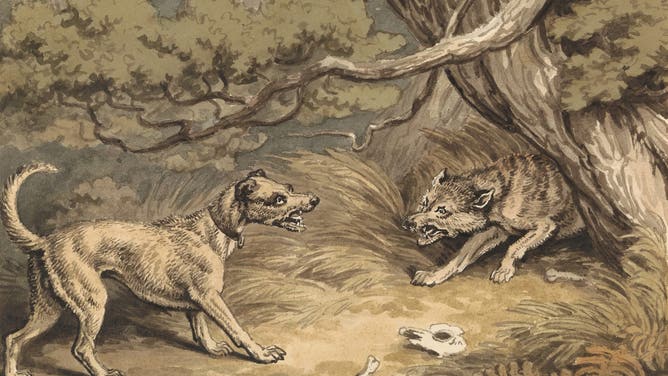
The Dog and the Wolf, Samuel Howitt, 1756–1822, British, undated, Watercolor and pen and brown ink over graphite on medium, slightly textured, cream wove paper, Sheet: 5 × 7 1/4 inches (12.7 × 18.4 cm), animal art, dog (animal), forest, wolf.
(Sepia Times/Universal Images Group / Getty Images)
As humans evolved, some wolves saw an opportunity to scavenge more easily, becoming less fearful of humans.
This trait would likely be passed on through generations via genes as dogs became domesticated and developed intimate relationships with humans.
RARE, ENDANGERED MEXICAN WOLF SPOTTED IN NEW MEXICO NATIONAL PARK
Despite this, wolves, including the dominant gray wolf, still rule the wild, often hunting in packs, employing coordinated strategies to isolate and bring down larger prey.
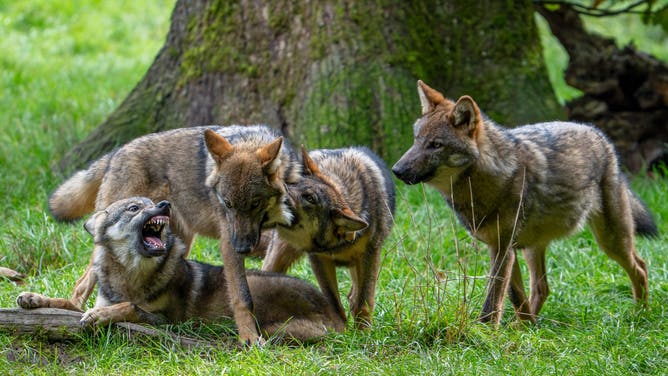
Wolf pack of Eurasian wolves / European grey wolves (Canis lupus lupus) with 5 months old pups play fighting in forest / woodland in autumn.
(Arterra/Philippe Clement/Universal Images Group / Getty Images)
An adult can consume up to 20 pounds of meat in a single meal after a successful hunt, but can also go several days without eating if prey isn't readily available.
SEE IT: RARE FOOTAGE CAPTURES ELUSIVE BLUE-RINGED OCTOPUS CARRYING HER EGGS OFF AUSTRALIAN COAST
Wolf packs are highly territorial, with an average home range of 140 to 400 miles, according to the Washington Department of Fish and Wildlife.
Wolves eat mostly mammals such as moose, elk, deer, beaver and marmot, and were likely the major predator for thousands of years until the late 19th century.
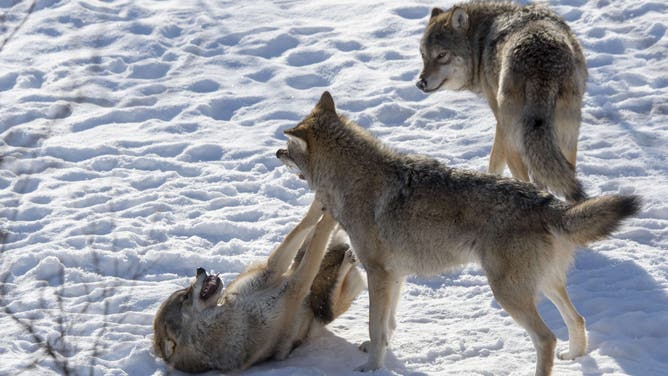
NORWAY - 2018/03/12: Gray wolves (Canis lupus) playing in the snow at a wildlife park in northern Norway.
(Wolfgang Kaehler/LightRocket / Getty Images)
Flash forward to now, and there are probably fewer than 2,500 wolves across the U.S. outside Alaska.
The wolf plays a significant role in the ecosystem. Like bears and cougars, these apex predators have few competitors and influence the dynamics of wildlife species across the spectrum.
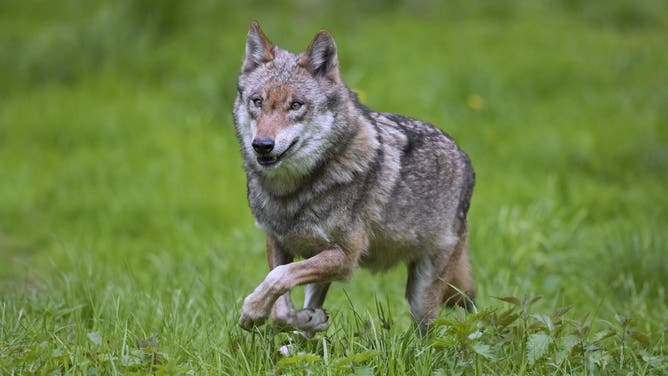
Solitary Eurasian wolf. European gray wolf. grey wolf (Canis lupus) running in meadow. grassland.
(Sven-Erik Arndt/Arterra/Universal Images Group)
Wolves in the wild are afraid of humans and generally avoid contact, as most places where these animals roam are free of people, who are completely unaware of their presence.
WATCH: FISHERMAN NARROWLY AVOIDS BISON ENCOUNTER IN YELLOWSTONE NATIONAL PARK
Places such as Yellowstone National Park use strategies to track wolf populations and learn how they live, interact with and affect other wildlife, using tools such as radio collars, remote cameras, sound recording and other observations.