

Northern lights dazzle across Lower 48 during G4 geomagnetic storm from strongest solar flare of 2025
Solar storms are ranked on a scale from G1 to G5, from minor to extreme characterization. If you missed Tuesday night's aurora you may have another opportunity Wednesday night.

Northern lights dazzle across Lower 48 during G4 geomagnetic storm from strongest solar flare of 2025
The northern lights were spotted Tuesday night as far south as Alabama during a G4 geomagnetic storm caused by the strongest solar flare of 2025. Dr. Steph Yardley, Vice Chancellor Fellow at Northumbria University joined FOX Weather Meteorologist Ari Sarsalari to discuss the rare celestial event.
The northern lights dazzled Americans across much of the Lower 48 on Tuesday night, caused by a geomagnetic storm that reached G4 intensity. According to NOAA's Space Weather Prediction Center, skywatchers will have another chance to see similar aurora conditions Wednesday night as far south as Alabama and Northern California.
![Northern lights seen over Budd Lake, New Jersey on Tuesday Nov. 11, 2025.]() Image 1 of 4
Image 1 of 4Northern lights seen over Budd Lake, New Jersey on Tuesday Nov. 11, 2025. (Matthew Mueller )
![Northern lights seen over Budd Lake, New Jersey on Tuesday Nov. 11, 2025.]() Image 2 of 4
Image 2 of 4Northern lights seen over Budd Lake, New Jersey on Tuesday Nov. 11, 2025. (Matthew Mueller )
![Northern lights visible through camera lens over Skiatook, OK on Nov. 11, 2025.]() Image 3 of 4
Image 3 of 4Northern lights visible through camera lens over Skiatook, OK on Nov. 11, 2025. (Tim Overton)
![Northern lights seen over Plymouth, MA on Nov. 11, 2025.]() Image 4 of 4
Image 4 of 4Northern lights seen over Plymouth, MA on Nov. 11, 2025. (Devin Debruyn)
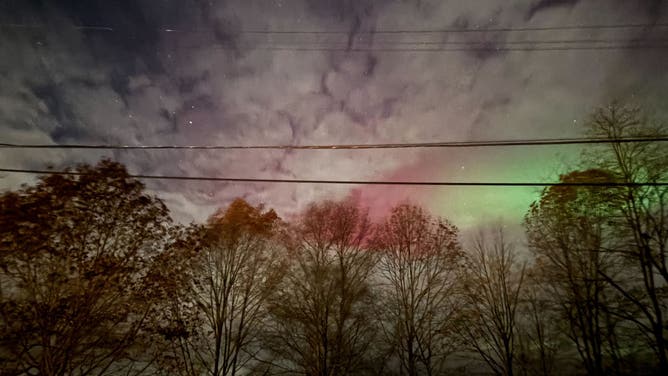
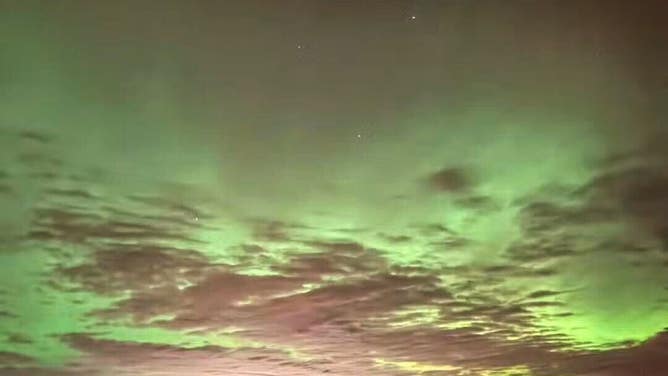
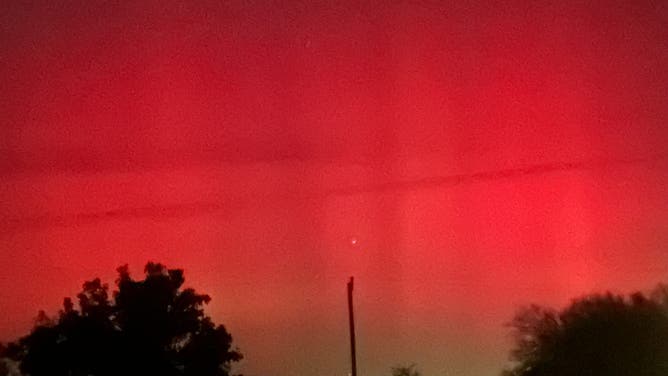
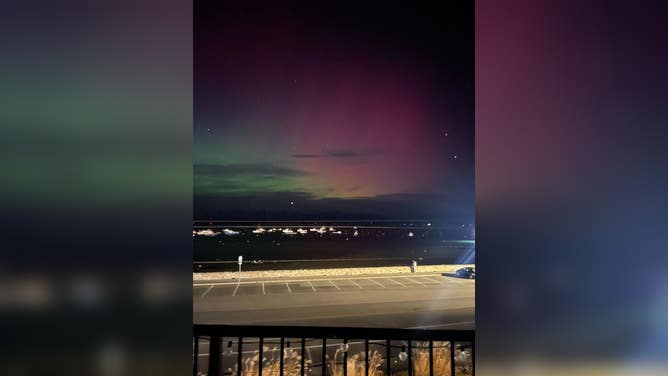
The aurora also lit up social media, with breathtaking pictures of the sky lit up in different shades of green, purple and red, posted from states across the Northern Tier.
The strength of the storm allowed states like North Carolina which normally don't see the aurora to enjoy the light show. The aurora was also visible with a camera lens as far south as Oklahoma on Tuesday night.
"It's an aurora-fest," exclaimed FOX Weather Meteorologist Ari Sarsalari as the event unfolded.

Northern lights dazzle over Johnston, Iowa
The northern lights dazzle over Johnston, Iowa Tuesday night.
WHAT DOES THE KP INDEX MEAN FOR SEEING THE NORTHERN LIGHTS?
Vivid Northern Lights displays usually follow a few days after solar events known as coronal mass ejections (CME). These are massive eruptions of plasma from the Sun’s corona.
Charged particles within that plasma interact with oxygen and nitrogen in Earth's atmosphere, during a disturbance known as a geomagnetic storm, and produce the beautiful colors of the northern lights, also known as the aurora borealis.
According to NOAA, a G4 category storm is characterized as severe, which could cause widespread voltage control issues for various regions.
Storms of this magnitude can also disrupt critical infrastructure, including cellular networks and radio communications.
7 THINGS TO KNOW ABOUT THE NORTHERN LIGHTS
A large CME, a massive eruption of plasma from the Sun’s corona, is expected to arrive at Earth by midday Wednesday and last into the evening.
Another strong geomagnetic storm is expected to occur on Wednesday, which could mean the northern lights may again become visible across much of the north half of the lower 48, according to the FOX Forecast Center.

(FOX Weather)
People in states as far south as Alabama and as far north as Northern California could have a chance to view the breathtaking light show.