

Deep-sea nightmare: The bone-chilling fish lurking along the ocean floor
The Stargazer fish, known for its creepy face and deadly ambush tactics, has electric organs capable of delivering up to 50 volts, venomous spines and bulging eyes that appear to migrate across its head.

FILE: 'Unprecedented' fish kill discovered in Georgia river following flooding
Flooding in the Atlanta region in late May led to stormwater flowing into Peachtree Creek and then Chattahoochee River in Georgia. The water was believed to be highly polluted, contributing to a large number of fish dying in the river.
In the depths beneath the ocean lives a terrifying species that will give you nightmares.
NEVER-BEFORE-SEEN FISH FOUND MORE THAN 3 MILES UNDER THE SEA
The stargazer fish, known for its creepy face and deadly ambush tactics, has electric organs capable of delivering up to 50 volts, venomous spines and bulging eyes that appear to migrate across its head.
According to BBC Wildlife, the species got its name from its grotesque upturned face, complete with upward-facing eyes and nostrils that allow it to burrow into the sandy seafloor while waiting for unsuspecting prey, such as fish or crustaceans, to swim overhead.
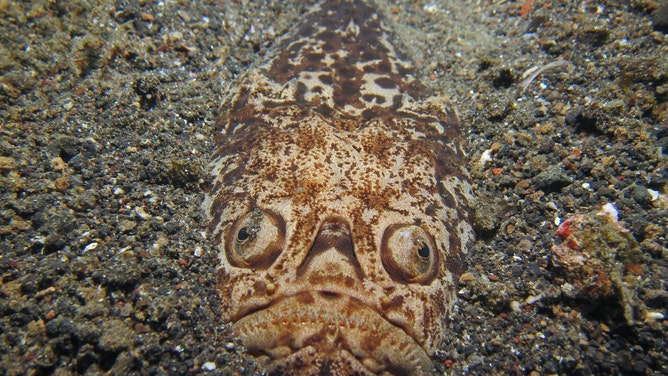
Trying to hide out in the sand
(Trueog / Getty Images)
If the poor prey makes the mistake of getting too close, the stargazer opens its large mouth and engulfs them whole.
In some cases, this terrifying fish lures its prey using a worm-like piece of skin that is growing out of its face. The wiggling appendage resembles a juicy worm, tricking nearby fish into coming in for a bite.
SPRING STING: PORTUGUESE MAN O' WAR RETURNS TO GULF COAST BEACHES
Once the fish realizes it's in danger, it’s too late— they are already the stargazer’s next meal.
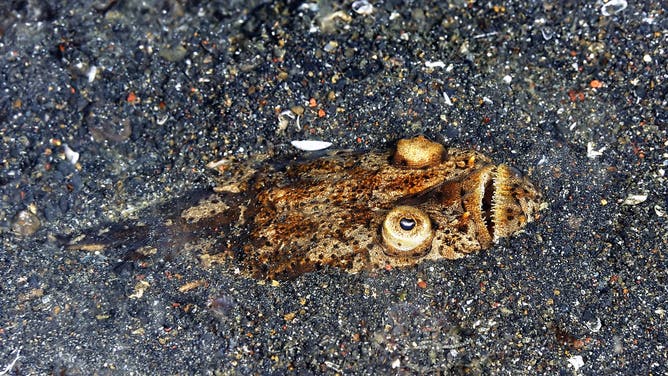
A picture of an scary stargazer hidden in the sand
(Luca Gialdini / Getty Images)
There are around 50 species of stargazers in the Uranoscopidae family found throughout the world, inhabiting the Atlantic and Pacific Oceans, as well as the Black, Mediterranean and Red Seas, per the American Museum of Natural History.
BRAIN-EATING AMOEBA DETECTED IN WATER AT ICONIC US NATIONAL PARKS, STUDY FINDS
This ambush predator can grow up to 17.7 inches long and have special organs behind its eyes capable of generating an electric charge to defend itself from threats.
Some species also have venomous spines located above their pectoral fins.
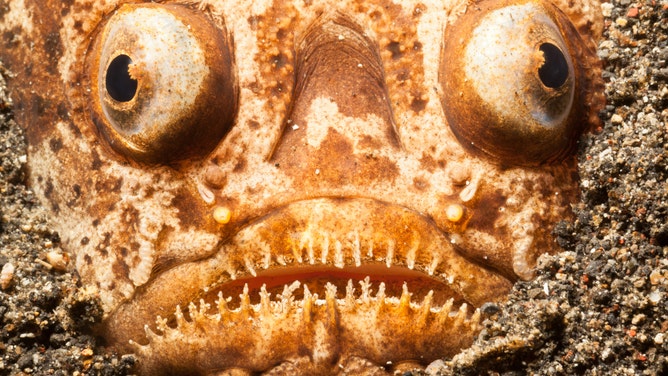
Whitemargin Stargazer Uranoscopus sulphureus inhabits reef flats and coastal bottoms but is rarely seen because it lies buried in sand or mud most of the time, with only the eyes showing.
(Getty Images / Getty Images)
Unlike most fish, stargazers can breathe through their nostrils rather than their gills.
To make them even creepier, they also have fleshy fringes around their mouths and nostrils that help keep sand out while buried beneath the ocean floor.
SEE IT: PREHISTORIC-LOOKING FISH WASHES ASHORE ON OREGON BEACH
On top of their spine-chilling features, this fish has large pectoral fins that help them dig deep holes into the sand, allowing them to bury their flat bodies almost completely out of sight.
Their brownish coloring and hidden positioning make them highly effective ambush predators while also helping them avoid predators of their own.
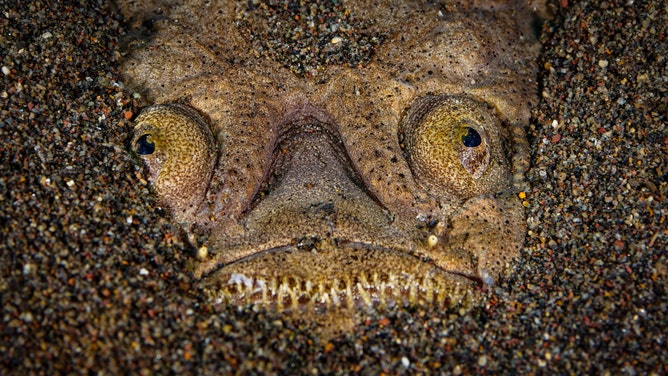
Marbled Stargazer (Uranoscopus bicinctus), head detail, partially hidden in the sand, focus on the eyes. Underwater shot taken in Pantai Melasti, Amed, Bali, Indonesia.
(RibeirodosSantos / Getty Images)
Although encounters with humans are rare, some stargazer species, including the whitemargin stargazer, can pose a threat to people who accidentally step on or touch them. However, according to Fishbase, in most cases, the stargazer’s venom will only cause a painful wound.
SEE IT: NIGHTMARISH DEEP-SEA FISH SPOTTED SWIMMING IN SHALLOWER WATERS
For now, the stargazer remains one of the ocean’s most terrifying and fascinating ambush predators.