

Rare, venomous 'visitors' wash ashore in Southern California as El Niño warms Pacific waters
Several of the stinging creatures recently washed up along the San Diego coast, becoming stranded near tidepools at Cabrillo National Monument, Del Mar and La Jolla beaches.

FILE VIDEO: Jellyfish swarm the Irish Sea, putting on a show for two kayakers
FILE VIDEO: Two kayakers were shocked after rowing into a jellyfish bloom off the coast of County Waterford on July 5.
THE TAKEAWAY
- Rare sightings of the venomous Portuguese man o' war have been reported along the Southern California coast.
- Warming Pacific Ocean waters fueled by a Super El Niño are pushing unusual marine life toward West Coast beaches.
- Beachgoers don't need to stay out of the water, though visitors are urged to watch out and avoid touching the stinging creatures.
LOS ANGELES – Southern California beaches are seeing a sudden spike in out-of-towners, though these unexpected visitors aren't your typical sunbathers.
Several sightings of the venomous, jellyfish-like Portuguese man o' war have been reported along the West Coast as a Super El Niño warms ocean waters and pushes unusual marine life toward the California coast.

Whether in the water or washed up on shore, venomous Portuguese Man O’ War pose a threat to humans.
(Elizabeth Condon, National Science Foundation / NOAA)
The Portuguese man o' war is a highly venomous species very closely related to a jellyfish that floats like a blue, violet or pink-colored balloon atop the ocean surface.
Though the dangerous sea creature might look inviting thanks to its intriguing color and innocuous shape, experts warn to keep your distance from a man o' war if you come across one.
LION TEETH, BEAR GALLBLADDERS AND COUGAR BONES: CALIFORNIA COUPLE SENTENCED IN WILD TRAFFICKING CASE
The non-threatening, balloon-like "pneumatophore" that identifies a man o' war from above the ocean's surface isn't what swimmers should fear – it's what lurks below the surface.

Portuguese Man of War, (Physalia physalis) photographed in the Atlantic Ocean.
(Photo by Reinhard Dirscherl/ullstein bild via Getty Images / Getty Images)
The drifting marine animal has specialized stinging cells called nematocysts that can deliver a painful sting to humans.
Several of the stinging creatures recently washed up along the San Diego coast, becoming stranded near tidepools at Cabrillo National Monument, Del Mar and La Jolla beaches, according to the Scripps Institution of Oceanography.
SEE IT: CALIFORNIA BEACHGOERS CAPTURE VIDEO OF MONSTER GREAT WHITE SHARK LEAPING OUT OF THE WATER
While man o' war sightings are rare in California, warming Pacific Ocean waters fueled by El Niño may be creating ideal conditions for these unusual visitors to drift onto the West Coast.
"This is an exciting occurrence for this region and we are grateful to the curious and careful naturalists who reported them," said Linsey Sala, manager of the Pelagic Invertebrate Collection at Scripps Oceanography.
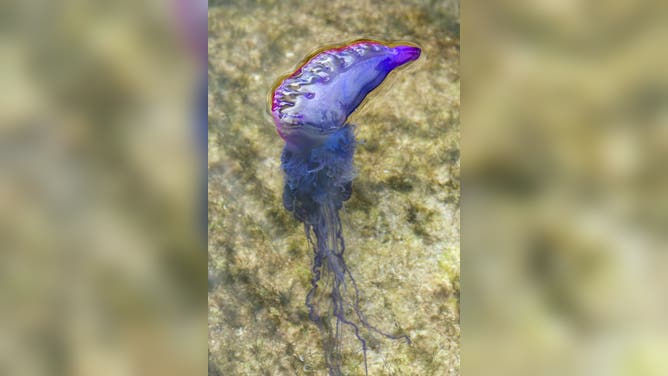
Portrait of a Portuguese man-of-war (Physalia physalis), Curacao, Netherlands Antilles.
(hoto by Wild Horizons/Universal Images Group via Getty Images / Getty Images)
The sightings don't mean beachgoers need to avoid the coast or stay out of the water altogether, just that Southern Californians have one more marine creature to keep an eye out for and stay wary of while enjoying the shoreline.
"Knowledge is power, and knowing that these gorgeous animals may periodically be here allows us to keep an eye out and aim to avoid touching them while on beach walks or swims," Sala said.