

House passes bill to make daylight saving time permanent, heads to Senate
The bill would make daylight saving time permanent nationwide, meaning that people would no longer have to change their clocks during the spring and fall.

The end of daylight saving time under the Sunshine Protection Act
🕛☀️ON BORROWED TIME?: FOX News Chief Congressional Correspondent Chad Pergram joins FOX Weather to discuss the passing of the Sunshine Protection Act, which aims to put an end to changing the clocks twice a year for daylight saving.
WASHINGTON — The House passed the Sunshine Protection Act of 2025 this week, which aims to make daylight saving time permanent nationwide, meaning people would no longer have to change their clocks in the spring and fall.
WHAT IS THE HISTORY OF DAYLIGHT SAVING TIME?
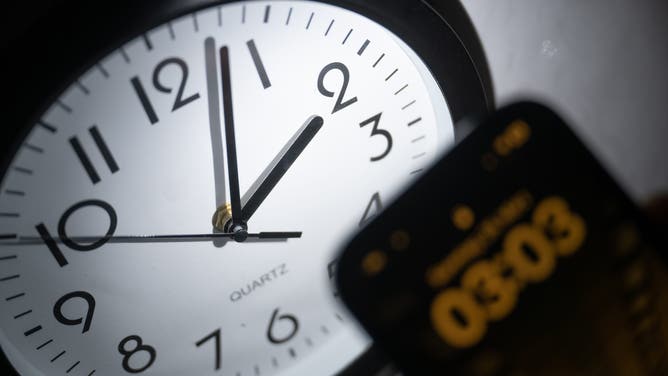
FILE- 21 March 2023, Hesse, Gießen: A smartphone displays the time "03:03", while on an analog clock it is still 02:03. On March 26, the clocks will be set forward at 02:00 to 03:00 and daylight saving time will begin.
(Sebastian Gollnow/picture alliance / Getty Images)
The bill does allow parts of Arizona and the state of Hawaii, which currently do not observe daylight saving time, to remain in standard time. Meaning, that when signed into law, most of Arizona would remain one hour behind neighboring Mountain Time states, like Colorado, year-round.

FILE - EDGEWATER, NJ - OCTOBER 28: People walk along a walkway covered in fall foliage in front of Hudson Yards and One World Trade Center in New York City as the sun rises on October 28, 2023, in Edgewater, New Jersey. (Photo by Gary Hershorn/Getty Images)
(Getty Images)
Daylight saving time had been adopted sporadically throughout U.S. history before the federal government created a consistent nationwide schedule for changing the clocks with the Uniform Time Act of 1966, while allowing states to opt out.
In the Northern Tier of the country, places like Washington, Idaho, Montana and Minnesota gain more than an hour and a half of daylight over the course of the month as the days grow longer. Daylight saving time shifts more of that daylight into the evening, leaving sunsets nearly two hours later by month's end than at the beginning.
For many people, the biggest impact of permanent daylight saving time would be brighter evenings throughout the winter. But those later sunsets would be accompanied by darker mornings, especially across the Northern Tier, where sunrise wouldn't occur until well after 8 a.m. in some places.
HOW DAYLIGHT SAVING TIME CAN IMPACT YOUR HEALTH

FILE - WASHINGTON, DC - JUNE 2: American flags are displayed on the lawn of the National Mall with the U.S. Capitol Building in the background at sunset on June 2, 2025 in Washington, DC.
((Photo by Kevin Carter/Getty Images) / Getty Images)
President Trump urged the House to pass the bill and after a brief debate today, the U.S. House of Representatives passed the bill in a 308-117 bipartisan vote.
Once signed into law, the last clock change would happen in the fall of 2027, after which permanent daylight saving time would begin.