

Remembering the Edmund Fitzgerald 51 years after wreck in Lake Superior
The notorious “gales of November" battered Lake Superior with dangerous wind gusts and massive waves when the Edmund Fitzgerald sank on Nov. 10, 1975.
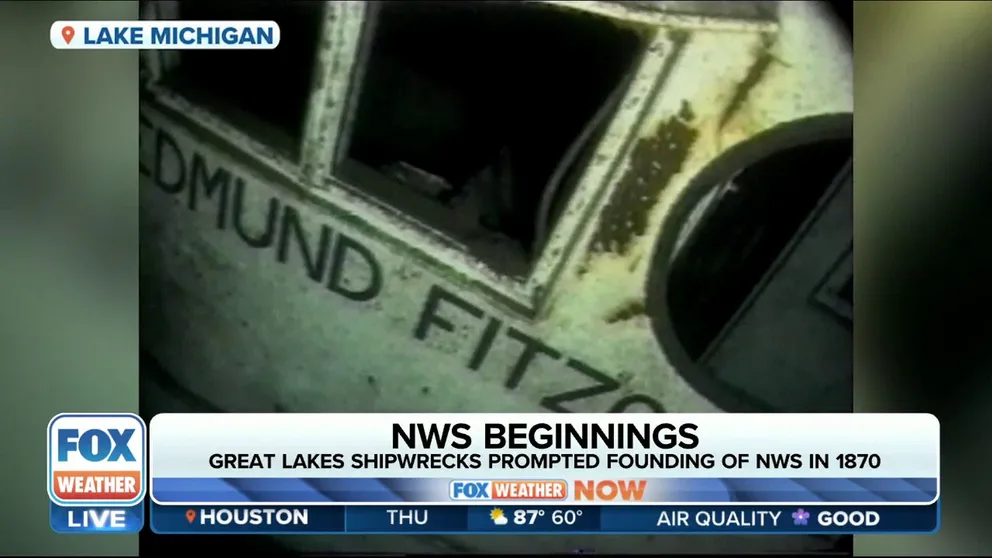
FILE: Great Lakes ship accidents was driver for NWS formation
FOX Weather's Winter Storm Specialist, Tom Niziol explains how deadly shipwrecks on the Great Lakes was the catalyst to forming the National Weather Service. He recalls some of the more preeminent accidents.
THE TAKEAWAY
- The Edmund Fitzgerald sank in Lake Superior during a fierce November storm 51 years ago, killing all 29 crew members.
- The freighter’s captain reported significant damage before the ship went down, but the exact cause of the sinking remains debated.
- Gordon Lightfoot’s 1976 ballad immortalized the tragedy, preserving the memory of the ship and its crew.
51 years ago today, the skies of November turned gloomy, and the S.S. Edmund Fitzgerald sunk in Lake Superior, claiming the lives of all 29 of its crew members.
The fabled ship, immortalized by Canadian singer-songwriter Gordon Lightfoot, that once championed The Great Lakes met a mysterious end that remains contented five decades after its ill-fated sinking.
HURRICANE SWELLS REVEAL FORGOTTEN HISTORY BENEATH ICONIC CALIFORNIA BEACH
The fateful journey began on Nov. 9, when the 729-foot freighter departed Burlington Northern Railroad Dock in Superior, Wisconsin, bound for Zug Island near Detroit, Michigan, hauling 26,000 tons of taconite pellets made of iron ore.
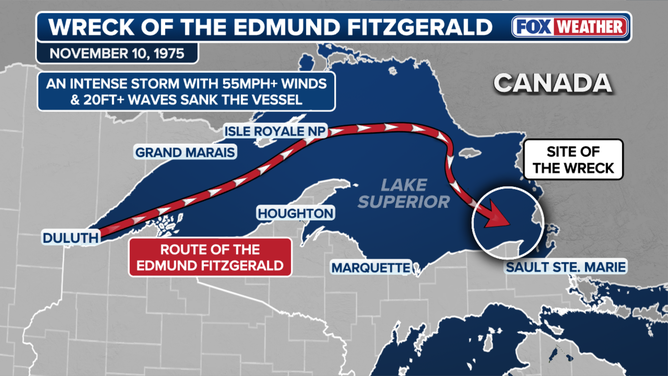
The notorious "gales of November" battered Lake Superior with dangerous wind gusts and waves around 25 feet high as the Edmund Fitzgerald sank on Nov. 10, 1975.
(FOX Weather / FOX Weather)
On the rough seas of the largest of The Great Lakes, the Fitzgerald was accompanied by the Arthur M. Anderson, a fellow Great Lakes freighter that departed Two Harbors, Minnesota the same afternoon.
The November sky turned gloomy and weather conditions deteriorated on the morning of Nov. 10, when a gale warning was upgraded into a storm warning, packing 50 knot wind gusts and seas of 12 to 16 feet, according to the Great Lakes Shipwreck Museum.
Throughout the afternoon and into the evening, the Fitzgerald was in contact with the Anderson as both freighters traversed through the monstrous storm, with Captain Ernest M. McSorley reporting that the vessel had sustained significant damage.
"That good ship and true was a bone to be chewed when the gales of November came early," Lightfoot sings in his folk anthem, "The Wreck of the Edmund Fitzgerald."

View of the 729-foot ore boat SS Edmund Fitzgerald, Sault Sainte Marie, Michigan, 1972. The ship sank, losing all hands, over the night of November 10, 1975. (Photo by Bettmann/Getty Images)
((Photo by Bettmann/Getty Images) / Getty Images)
Amid waves towering more than 20 feet and winds exceeding 55 mph, the ship sank, claiming the lives of all 29 crew members aboard.
HOW WEATHER TURNED THE GREAT LAKES INTO A SHIPWRECK GRAVEYARD
Exactly how the ship succumbed to Lake Superior is unknown to this day, although a report from the U.S. Coast Guard said, "the most probable cause of the sinking was the loss of buoyancy resulting from massive flooding of the cargo hold."
The wreck of the Edmund Fitzgerald was located by an underwater naval device 17 miles from Whitefish Point, over 500 feet below the surface of Lake Superior.
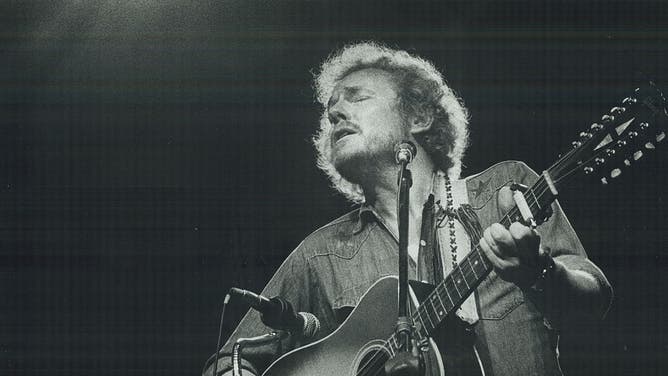
Gordon Lightfoot’s "The Wreck of the Edmund Fitzgerald" climbed to No. 2 on the Billboard Hot 100 in 1976, roughly a year after the disaster.
(Doug Griffin/Toronto Star via Getty Images / Getty Images)
Last year, in honor of the shipwreck's 50th anniversary, on Nov. 10, a number of organizations held memorials to remember and honor those lost on the Edmund Fitzgerald.
One year after the tragic sinking of the ship that was once the largest freighter on The Great Lakes, Lightfoot immortalized the story of the Edmund Fitzgerald in the 1976 song that artistically communicates the story of the doomed ship.