

Live updates: Artemis II lifts off from Kennedy Space Center, launching on mission around the moon
Live updates: Artemis II lifts off from Kennedy Space Center, launching on mission around the moon
Download the AppCatch the latest: Live updates move to April 2
View postCoverage for this event has ended.
Our live coverage of the Artemis II mission has moved. Follow along as the Orion crew completes their first maneuvers in orbit.
NASA’s Artemis II mission is well underway, marking humanity’s return to deep space for the first time in more than 50 years—and FOX Weather is tracking every milestone moment of the historic journey.
Building on the progress of Artemis I, this mission is aiming bring the crew of four astronauts for on a lunar flyby, with a roadmap that would take them further into space than any human has ever traveled.
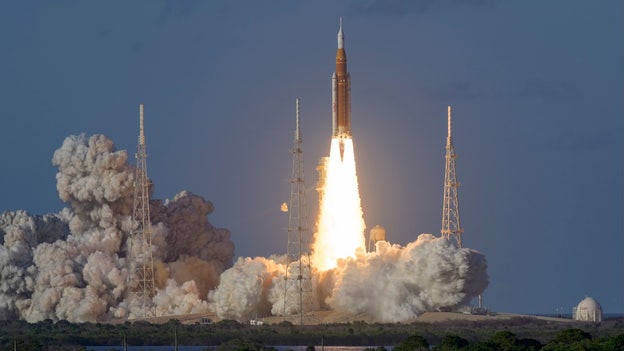
Artemis II launches from NASA's Kennedy Space Center in Florida on April 1, 2026. (Photo by Bill Ingalls/NASA via Getty Images)
Over the course of the 10-day mission, FOX Weather will follow each phase, delivering real-time reports as they unfold.
With global attention focused on the upcoming historic flyby of the moon, Artemis II is set to lay the foundation for the "Golden Age" of modern space exploration.
Stay with FOX Weather for continued coverage of the Artemis II mission.
Following the successful launch of NASA’s Artemis II mission on April 1, 2026, President Donald Trump praised the milestone as a major achievement for the United States and its space program.
"These are brave people...God bless those four unbelievable astronauts."
The launch marked the first crewed mission to the moon in over 50 years, sending four astronauts on a historic 10-day journey around the moon and back to Earth.
Just hours into NASA’s Artemis II mission, the crew reaches a key milestone in high-Earth orbit.
The Interim Cryogenic Propulsion Stage (ICPS-2) separated from the Orion spacecraft after completing two burns that placed Orion into its high Earth orbit.
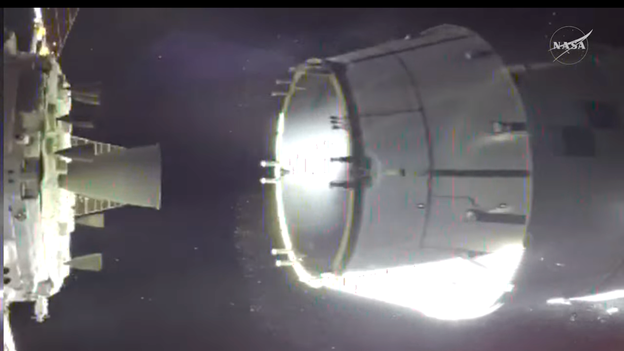
n, the Interim Cryogenic Propulsion Stage (ICPS-2) separates from the Orion spacecraft.
The astronauts are now performing a roughly 70-minute proximity operations demonstration, using the detached ICPS-2 as a target.
The exercise allows Artemis II Pilot Victor Glover to manually steer Orion, testing handling and navigation capabilities critical for future deep space missions in the Artemis III program.
After the demonstrations, the ICPS-2 is released for disposal as Orion prepares for the next phase of its journey toward the Moon.
Stay with FOX Weather for continuing coverage of the Artemis II mission.
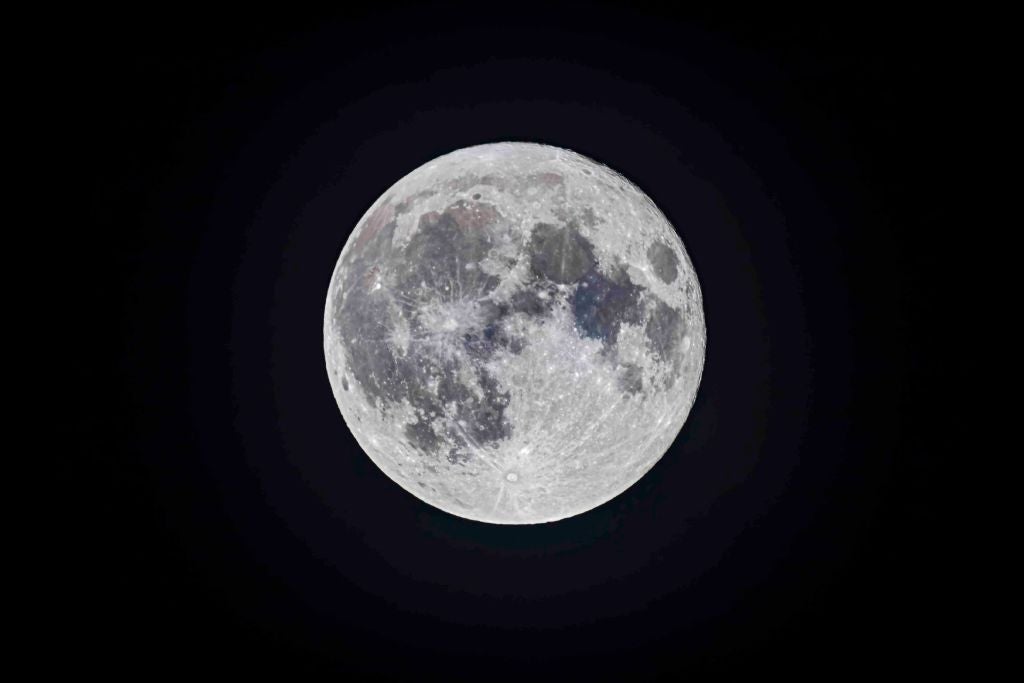
Aboard Integrity—the Orion spacecraft carrying NASA’s Artemis II crew—astronauts are settling into humanity’s next journey toward the Moon.
For the first time since launch, Artemis II Commander Reid Wiseman addressed the world, offering an early glimpse into life beyond Earth.
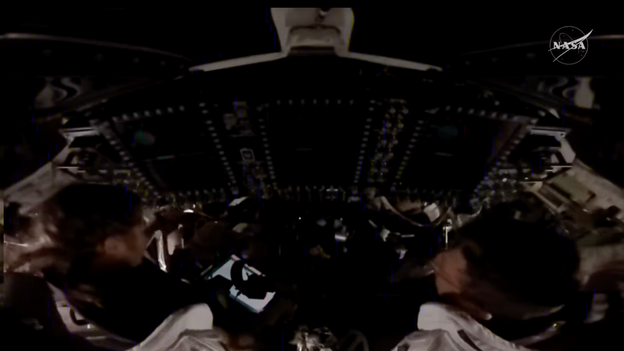
Inside Integrity Spacecraft for the first time in the Artemis II mission. Mission Specialist Christina Koch (left) and Commander Reid Wiseman (right) in seat 1 and 2 after launch into high Earth orbit.
"It was an amazing ride up hill," Commander Wiseman reported. "The views — we've got two moonrises that we've had so far... and the views of planet Earth, we've circled it completely, and we forget how beautiful it was to look back down on Earth,"
A still from NASA’s Artemis II live coverage captures the first images inside Integrity, where Mission Specialist Christina Koch and Commander Reid Wiseman appear as polished as ever while addressing the world from high Earth orbit.
From their vantage point in orbit, the crew is witnessing a perspective few humans have ever experienced, and they're hoping to go further than ever before.
As Artemis II continues its mission, stay with FOX Weather for ongoing coverage of the historic lunar flyby.
The Artemis II crew aboard Orion successfully executed an apogee-raise burn, placing the spacecraft into a stable high Earth orbit as it prepares for the next leg of its journey into deep space.
According to NASA, the maneuver raised the highest point of Orion’s orbit and aligned the spacecraft on the proper trajectory to remain in high Earth orbit through the rest of today’s flight day and into tomorrow.
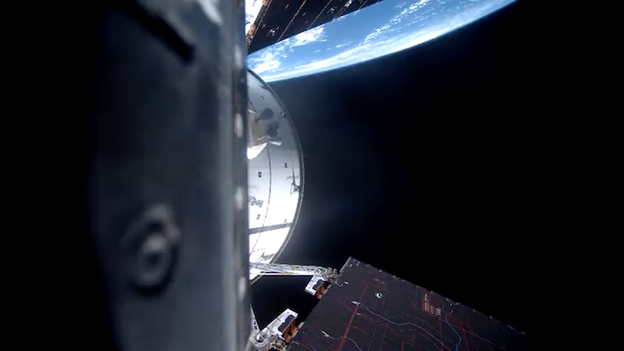
NASA's Artemis II live view from Orion
This milestone sets the stage for Orion’s approximately 23.5-hour "checkout phase."
During this period, the crew will carry out a series of critical activities and system preparations, ensuring both the spacecraft and team are ready for their 10-day journey into deep space.
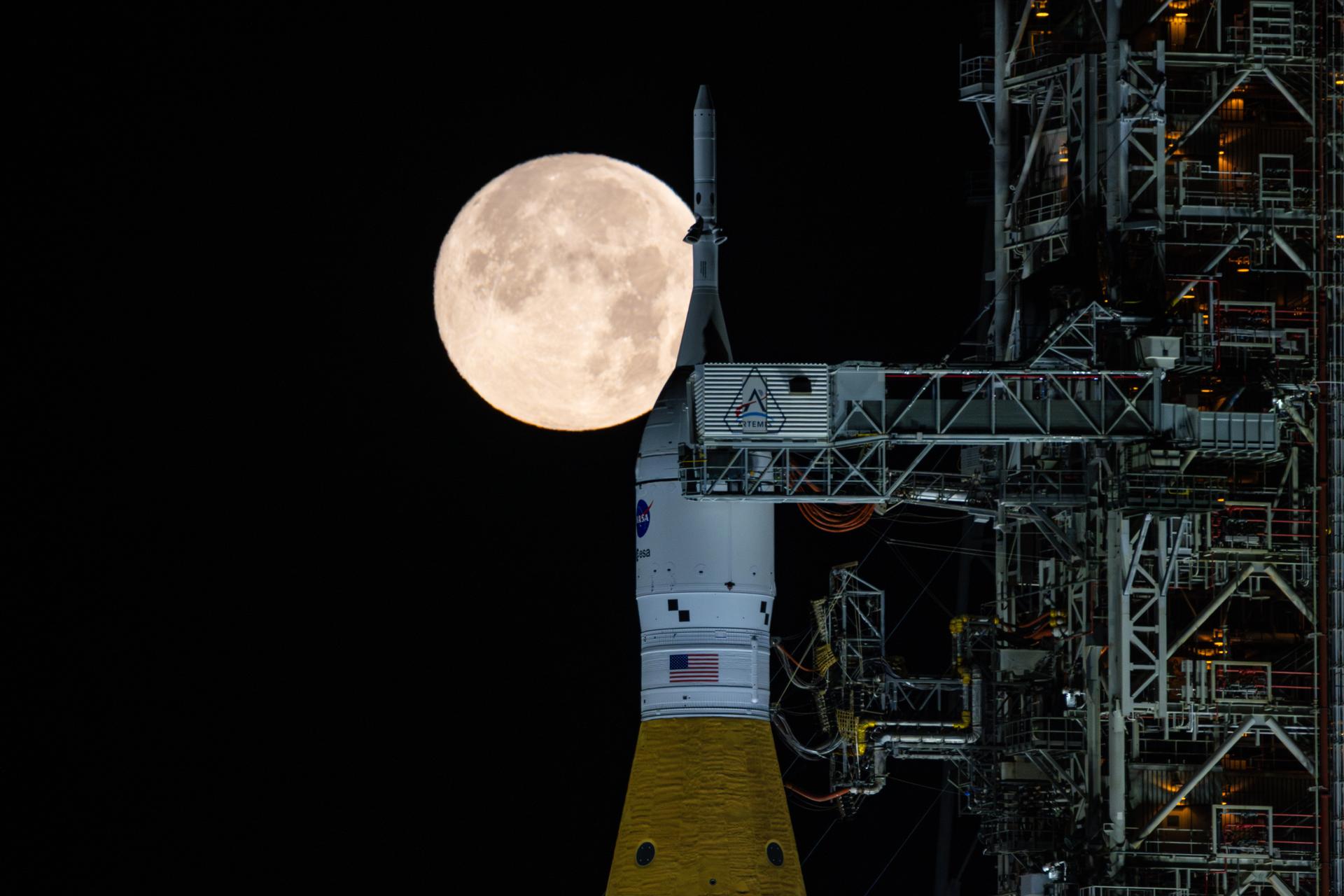
The Artemis II mission is officially in motion, marking a bold new chapter in humanity’s return to deep space. Following a successful launch, the crew has wasted no time diving into critical operations as they push forward on one of NASA’s most ambitious missions to date.
In a post-launch press conference, NASA Administrator Jared Isaacman confirmed the astronauts are in strong condition, noting that a brief communication hiccup was quickly identified and resolved.
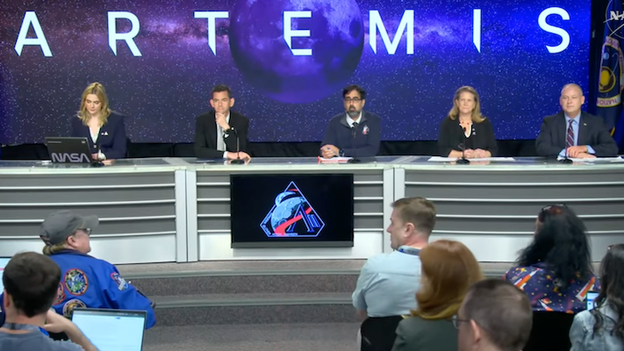
Artemis II post-launch press conference
"NASA astronauts Commander Reid Wiseman, Pilot Victor Glover, Mission Specialist Christina Koch and Canadian Space Agency Mission Specialist Jeremy Hansen are safe, they're secure and they are in great spirits," Isaacman said.
The Orion spacecraft has successfully separated from the core stage, and it's solar rays have been deployed. Soon, the crew will execute the apogee raise burn placing the craft into a stable high Earth orbit in preparation for it's journey into deep space.
"After a brief 54-year intermission, NASA is back in the business of sending astronauts to the moon," Isaacman said.
NASA Mission Control in Houston briefly lost communication with the Artemis II crews aboard Orion for about 10 minutes nearly an hour into the mission.
Mission Control reported not being able to hear the crew, but continued to speak to them "In the blind."
Commander Reid Wiseman confirmed once comms were re-established that the crew could hear Mission Control the entire time.
According to NASA, the ground teams are looking into what might have caused the drop out.
Artemis II made history on Thursday evening, lifting off from launchpad 39B at Kennedy Space Center.
Millions of people watched the Orion spacecraft and SLS rocket shoot into space, carrying four astronauts farther into space than humans have ventured in more than 50 years.
The next 24 hours will be crucial for the astronauts as they complete objectives imperative to their mission.
The ascent of Artemis II is progressing perfectly, with all systems on the Space Launch System (SLS) rocket and the Orion spacecraft operating nominally. As the vehicle climbs through the upper atmosphere and heads toward its initial elliptical orbit, telemetry shows that the core stage engines are performing as expected, maintaining the precise trajectory needed for the crew's 10-day mission.
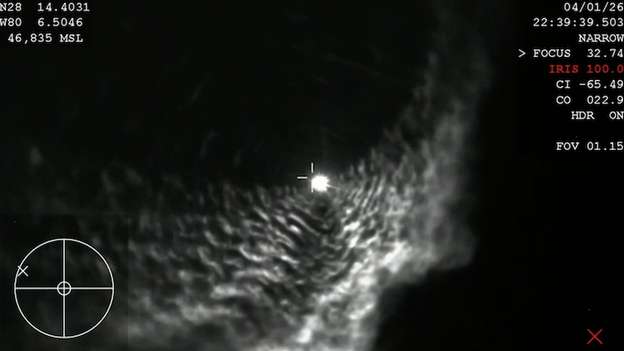
NASA
Inside the cabin, the crew—Wiseman, Glover, Koch, and Hansen—are reporting a smooth ride as they transition from the heavy G-loads of liftoff into the weightlessness of space.
Mission Control in Houston has taken full control of the flight, confirming that cabin pressure, power levels, and communication links are all in the "green."
With the rocket performing flawlessly, the focus now shifts to the critical "heartbeat" checks of the life-support systems that will sustain the astronauts on their journey to the lunar far side.
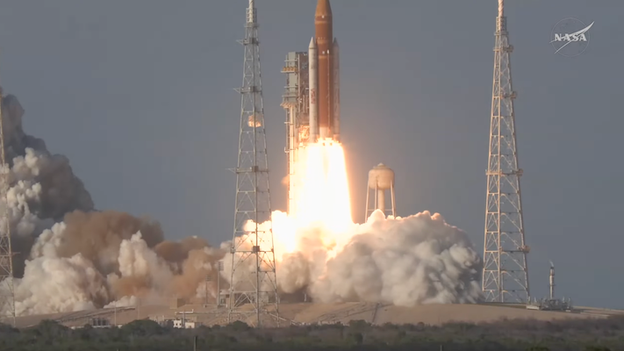
Artemis II lifts off from Kennedy Space Center in Florida on Wednesday, April 1, 2026.
History has been made at the Kennedy Space Center! At 6:35 p.m. ET, the Space Launch System (SLS) rocket—the most powerful in the world—roared to life, carrying the Orion spacecraft and its crew of four into the Florida twilight.
The successful liftoff marks the official start of the Artemis II mission, humanity’s first crewed journey to the lunar vicinity in over 50 years.
Commander Reid Wiseman, Pilot Victor Glover, and Mission Specialists Christina Koch and Jeremy Hansen are now beginning their 10-day mission.
The first 24 hours will be spent in high Earth orbit, where the crew will perform critical checkouts of Orion’s life-support and communication systems.
Once those heartbeat checks are complete, a Trans-Lunar Injection burn will send them on a free-return trajectory around the far side of the Moon, reaching a record-breaking distance of over 248,000 miles from Earth before heading home for a Pacific Ocean splashdown.
NASA
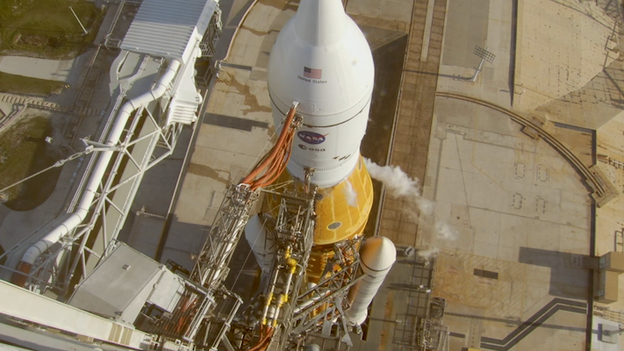
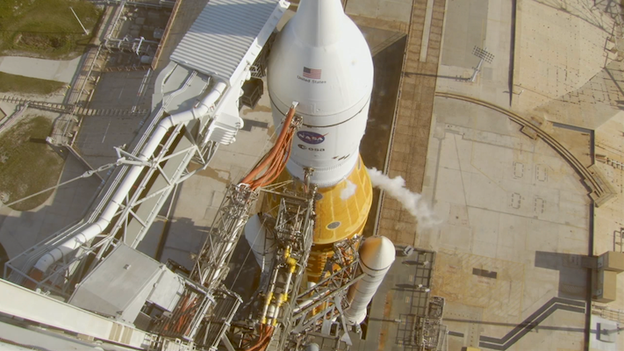
The Crew Access Arm has officially retracted from the Orion spacecraft, swinging away from the vehicle to its parked position for launch. This pivotal milestone leaves the Artemis II crew fully isolated within the capsule, marking the final physical disconnection between the SLS rocket and the mobile launcher as we approach the 6:35 p.m. ET liftoff.
The Artemis II launch time has been officially adjusted to 6:35 p.m. ET, moving slightly deeper into the two-hour window to allow teams to complete final configuration steps. This minor shift ensures that the SLS rocket and Orion spacecraft are in the optimal state for liftoff following the successful resolution of the earlier technical hurdles.
NASA
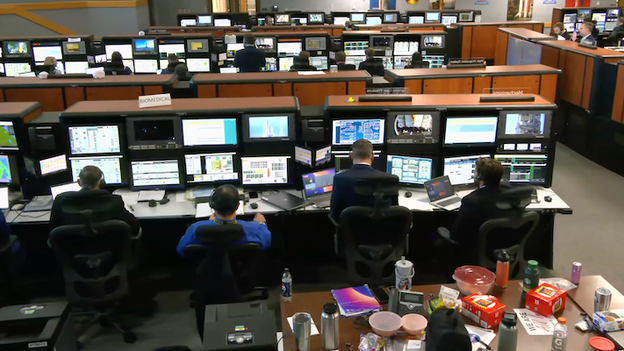
The final "Go/No-Go" poll is complete, and the word from the firing room is official: Artemis II is "GO" for launch.
Every major station, from the SLS rocket and Orion spacecraft teams to the Mission Control Center in Houston, has verified a "Green" status for our historic return to the Moon.
With the Flight Termination System and the Launch Abort System battery issues officially behind us, the Ground Launch Sequencer has been initiated. The countdown is now in the hands of the automated computers as we head toward a spectacular 6:24 p.m. ET liftoff from Pad 39B.
NASA
The moment of truth has arrived at the Kennedy Space Center. We are officially in the final Go/No-Go poll, the definitive roll call that determines if the Artemis II mission will leave Earth for the Moon.
One by one, Launch Director Charlie Blackwell-Thompson is polling every lead station in Firing Room 1—from the SLS rocket and Orion spacecraft teams to the weather officers and the U.S. Space Force Range.
This verbal handshake is the culmination of years of preparation and a morning of intense troubleshooting.
With the earlier Flight Termination System (FTS) and Launch Abort System (LAS) battery issues now confirmed as resolved, each station is reporting a "Green" status.
Once the poll is complete, the Launch Director will give the final authorization to the Ground Launch Sequencer, handing the mission over to the automated computers for the final 10-minute terminal count.
The 45th Weather Squadron has officially upgraded the launch forecast to a stunning 90% "Go" for this evening’s mission.
With the earlier afternoon showers now far away from the launch pad and the stubborn cloud layers dissipating, the skies over the Space Coast have opened up into a clear, high-visibility window for the SLS rocket.
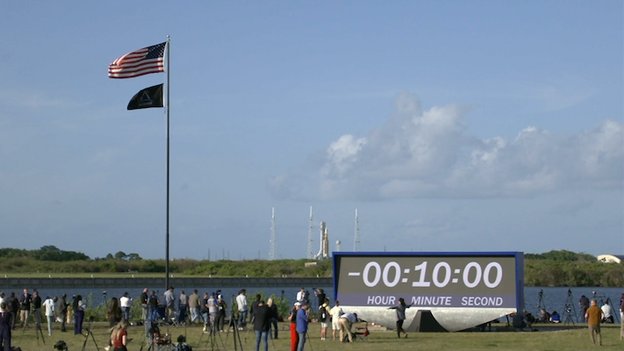
NASA
The countdown has entered its final scheduled "built-in" hold at the T-minus 10-minute mark. This planned 30-minute pause is a standard but vital part of the Artemis II launch sequence, acting as a final catch-up period that allows the launch team to ensure all technical data is perfectly aligned before the high-speed automated terminal count begins.
During this hold, engineers are performing final checks on the SLS rocket’s cryogenic systems and verifying that the earlier troubleshooting on the Launch Abort System is holding steady.
This is also the window where the 45th Weather Squadron provides its final weather briefing to Launch Director Charlie Blackwell-Thompson.
Once this hold is released, the clock will tick straight down to liftoff, signaling that the mission is officially in the hands of the ground launch sequencer.
The high-stakes technical hurdle involving the Launch Abort System (LAS) battery has been successfully resolved. After engineers conducted a deep-dive into the thermal data, it was determined that the out of range reading was the result of a faulty sensor rather than a hardware failure.
The engineering team at the Launch Control Center is making significant headway on the Launch Abort System (LAS) battery temperature anomaly. Specialists have spent the last several minutes analyzing the thermal data and are now nearing a definitive solution that would confirm the system is safe for flight.
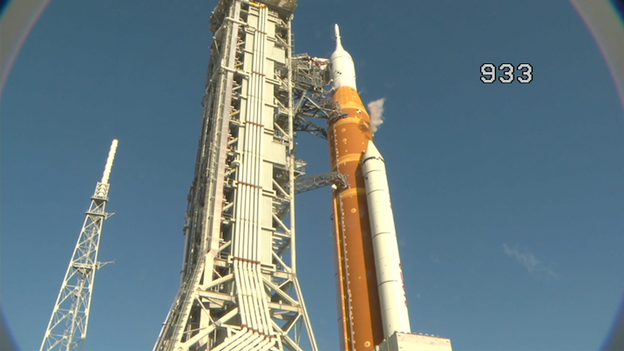
NASA
The countdown has reached the T-minus 30-minute mark, and the energy at Kennedy Space Center is reaching a fever pitch. We are now just a half-hour away from the opening of the launch window at 6:24 p.m. ET.
The SLS rocket is fully vented and pressurized, standing as a pillar of frost and power on Pad 39B, while the crew of four sits poised for their 10-day journey around the Moon.
While all technical systems are currently "Green," the 45th Weather Squadron and the launch team are staying vigilant during these final minutes. Although the forecast has been upgraded to a fantastic 90% favorable, meteorologists are still closely monitoring the flight path for any stray clouds or shifting winds that could interfere with the Thick Cloud or User Range safety rules.
At this stage, the atmosphere is as ready as the hardware, and the world is holding its breath for the final terminal count.
As the countdown enters its final minutes, the atmosphere in Firing Room 1 is one of intense, disciplined focus.
Launch Director Charlie Blackwell-Thompson and her team are currently stepping through the final pre-planned milestones, verifying that every "technical duck" is in a row before the high-stakes roll call.
This preparation involves a final sweep of all data consoles to ensure the earlier Flight Termination System and battery temperature issues remain firmly in the resolved column.
Once the Launch Director is satisfied that the vehicle, the crew, and the weather are all perfectly aligned, she will initiate the formal Go/No-Go poll, a verbal confirmation from every mission lead that authorizes the Ground Launch Sequencer to take the Artemis II mission into its final terminal count.
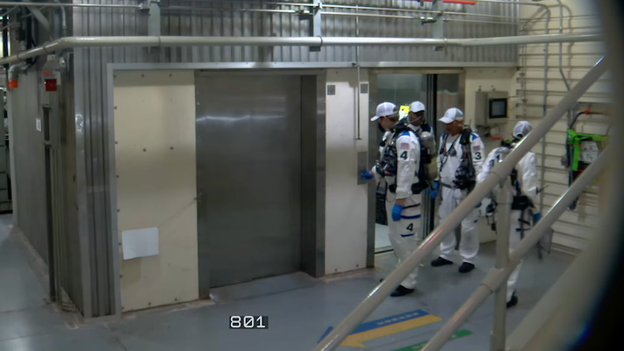
NASA
The White Room on the mobile launcher is now silent as the closeout team has officially completed their final tasks. After meticulously securing the Orion spacecraft's hatches and performing a last sweep of the area to ensure no tools or debris were left behind, the team is now preparing to evacuate the pad.
A new technical challenge has emerged in the final hour of the countdown as engineers are now monitoring a temperature anomaly within the Launch Abort System (LAS).
Specifically, one of the critical batteries that powers the LAS is currently running out of range, prompting immediate troubleshooting from the team in the Launch Control Center.
The Launch Abort System is the lifeboat of the Orion spacecraft, designed to pull the crew to safety in the event of a rocket failure, so its power systems must be within strict thermal limits to ensure they function perfectly if needed.
While the engineering team analyzes the data to determine if the temperature will stabilize or if it requires a system reset, the mission status remains "GO" for now.
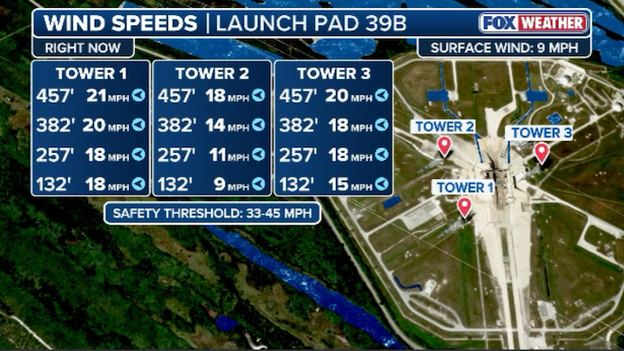
Latest wind speeds from sensors surrounding Launch Pad 39B.
At Launch Pad 39B, the anemometers are currently reporting wind speeds that remain well within the "green" for the SLS rocket's departure. While a light breeze is kicking up off the Atlantic, the sustained speeds and gusts are hovering significantly below the 33-to-45-knot threshold required for a safe ascent.
The clearing trend at Kennedy Space Center is providing a perfect backdrop for tonight's historic mission as weather conditions continue to trend in our favor.
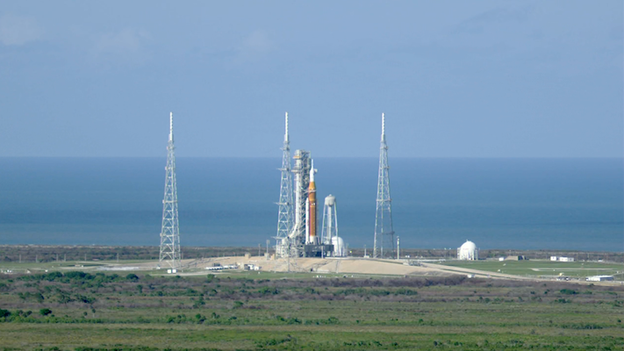
NASA
The stubborn afternoon cloud layers that briefly drifted over Pad 39B have largely dissipated, giving way to the blue sky over the Atlantic that launch teams love to see.
While the 45th Weather Squadron continues to monitor minor surface winds and the potential for late-day thick clouds, the official forecast remains a robust 80% "Go."
Former NASA astronaut Terry Hart joined FOX Weather to share his experience working in space during his spectacular career and his thoughts on the upcoming Artemis II space mission.

Official countdown clock at Kennedy Space Center in Florida.
The countdown has crossed the T-minus 1-hour threshold, and all eyes are now on the final minutes before America’s historic return to the Moon.
Inside the Orion spacecraft, the crew—Reid Wiseman, Victor Glover, Christina Koch, and Jeremy Hansen—has completed their final communications checks and is now waiting for the closeout crew to finish their work at the pad.
The SLS rocket remains in a stable replenish mode, fully fueled and ready to deliver nearly 9 million pounds of thrust.
While technical systems are performing beautifully, the launch team is keeping a vigilant watch on the horizon.
The 45th Weather Squadron has maintained its 80% favorable forecast for this evening, but meteorologists are still closely monitoring a few lingering clouds drifting near the space center.
Provided these clouds remain outside the 10-mile safety buffer, we are on track for a spectacular 6:24 p.m. ET liftoff into the Florida twilight.
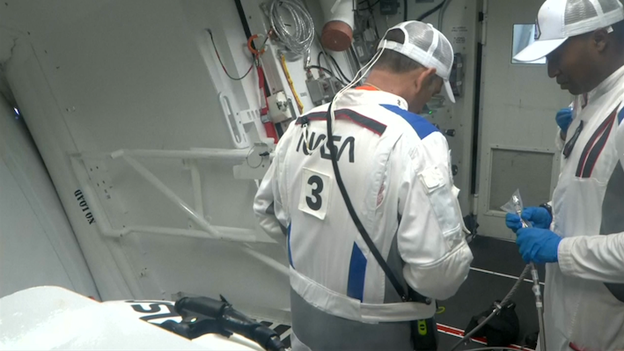
NASA
The final physical bridge to the Orion spacecraft has been closed. Technicians at Launch Pad 39B have officially completed the Launch Abort System (LAS) hatch closure, a high-stakes milestone that signifies the spacecraft is now in its final flight configuration.
This specialized hatch serves as a critical protective barrier for the crew module, designed to shield Reid Wiseman and his team from the extreme thermal and acoustic pressures of ascent.Beyond its role as a shield, the LAS hatch is the key to the crew's emergency exit.
In the unlikely event of a malfunction during the climb to orbit, this system is designed to pull the Orion capsule safely away from the SLS rocket in a matter of milliseconds.
During this final closeout phase, the team meticulously verified hatch alignment, engaged the heavy-duty locking mechanisms, and confirmed the pressure integrity of the seal.
Great news from the Launch Control Center: the technical hurdle involving the Flight Termination System (FTS) has been successfully resolved.
After engineers retrieved legacy hardware from the Vehicle Assembly Building to verify the system's integrity, a comprehensive re-test was performed, and the results came back perfect.
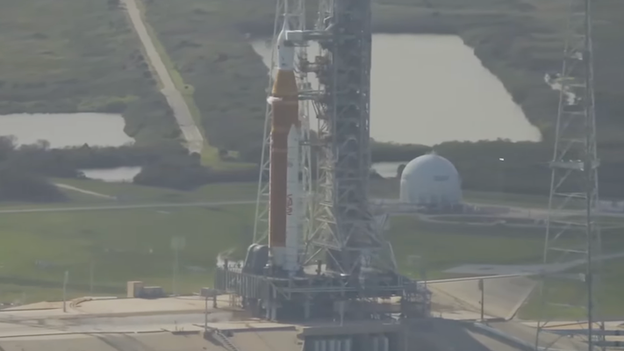
NASA
With the FTS now confirmed to be fully operational, the Eastern Range has officially flipped its status from "Red" to "Green."
This means the final major technical obstacle has been cleared, and Artemis II is officially back to a "GO" for launch.
The countdown is proceeding smoothly toward our 6:24 p.m. ET liftoff, with the crew ready and the rocket primed for its journey to the Moon.
As of right now, the Artemis II mission is in the final stages of its countdown at Kennedy Space Center.
The four-person crew—Commander Reid Wiseman, Pilot Victor Glover, and Mission Specialists Christina Koch and Jeremy Hansen—are currently strapped into the Orion spacecraft, having completed their boarding and initial communications checks.
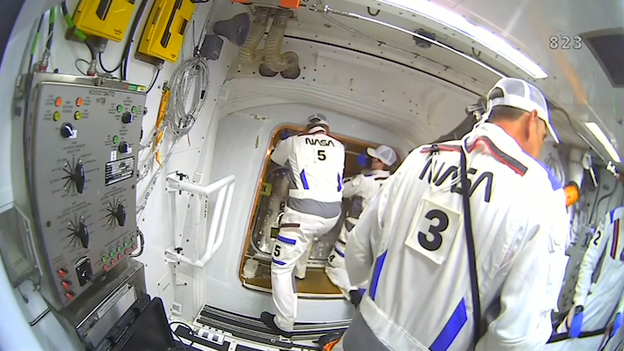
Closeout team preparing the crew module hatch for launch right now. (NASA)
While the countdown is officially proceeding, the launch team is working through a late-breaking technical issue involving the Flight Termination System (FTS), which has temporarily moved the Range status to "No-Go."
Engineers are using legacy equipment from the Space Shuttle era to verify the system's integrity, but NASA remains optimistic.
With weather conditions holding at 80% favorable and the SLS rocket fully fueled, the mission remains on track to send humans around the Moon for the first time in over 50 years.
In the world of rocket launches, the Range refers to the vast network of tracking stations, radar, and safety personnel that monitor a vehicle from the moment it leaves the pad until it safely reaches orbit.
Managed by the U.S. Space Force’s Space Launch Delta 45 (formerly the 45th Space Wing), the Eastern Range ensures that the flight path is clear of ships and aircraft and that the rocket doesn't pose a threat to populated areas.
If a technical issue arises with the Flight Termination System (FTS)—the self-destruct mechanism used for public safety—the Range will go "No-Go."
This means that even if the rocket itself is healthy, the safety referee has pulled a red card because they cannot guaranteed the ability to terminate the flight if something goes wrong.
The countdown can often continue while teams troubleshoot, but the Range must flip back to "Green" before the final terminal count can begin.
The mission has hit a temporary hurdle as the launch team is currently troubleshooting a technical issue with the Flight Termination System (FTS).
In a unique turn of events, the FTS console operator has been dispatched to the Vehicle Assembly Building (VAB) to retrieve a specialized piece of legacy equipment—a tool originally used during the Space Shuttle program.
The operator, who has experience with this specific hardware, was granted immediate permission to access it to help verify the system's integrity.
While this troubleshooting is in progress, the Range is currently listed as "No-Go," meaning the FTS must be cleared before the rocket is allowed to fly.
Despite this snag, the overall countdown is still moving forward, and the launch team is working diligently to resolve the issue without impacting our 6:24 p.m. ET window.
NASA often relies on the deep expertise and tried and true tools of its veteran engineers, and teams are hopeful this legacy fix will get us back to a "Green" status shortly.
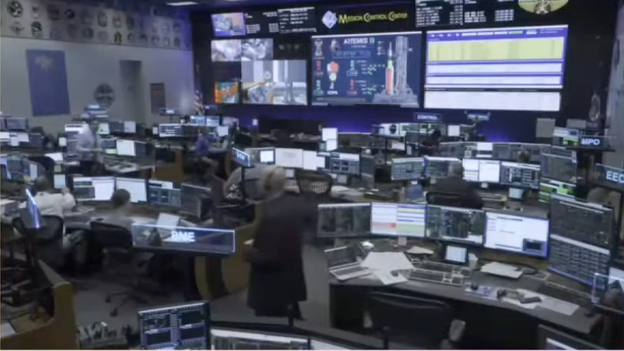
NASA's Mission Control at Johnson Space Center in Houston, Texas.
Right now, in Houston, the atmosphere at the Johnson Space Center is one of quiet, intense focus as Mission Control prepares for its own critical role in the countdown.
Lead Flight Director Jeff Radigan and his team of controllers are currently verifying all deep-space communication links and orbital tracking systems, ensuring they are ready to take the reins the moment the SLS rocket clears the tower in Florida.
As the launch team at Kennedy Space Center works toward the terminal count, Houston will conduct its final internal "Go/No-Go" polls to confirm that the worldwide tracking network and the flight operations team are fully prepared to guide the crew on their 10-day journey.
While the Launch Director in Florida manages the countdown to T-0, it is the team in Houston that will ultimately be responsible for the safety and success of Reid Wiseman and his crew once they reach the vacuum of space.
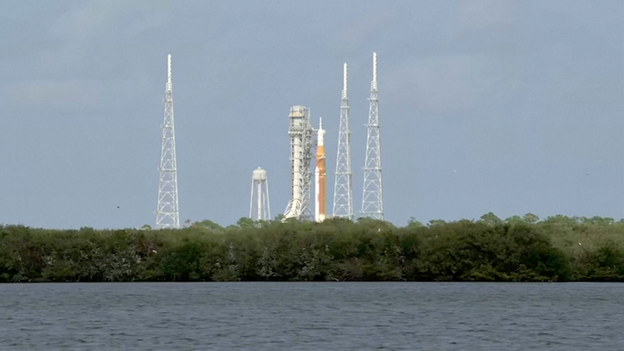
Artemis II sits ready for launch on Launch Pad 39B from Kennedy Space Center in Florida. (NASA)
The countdown has officially reached the T-minus 2-hour mark, and the atmosphere at Kennedy Space Center is electric as we enter the home stretch.
The Space Launch System (SLS) rocket is in a stable replenish mode, with its massive tanks topped off and ready to deliver millions of pounds of thrust.
Inside the Orion spacecraft, named Integrity, the four-person crew—Reid Wiseman, Victor Glover, Christina Koch, and Jeremy Hansen—has completed boarding and is currently performing final communication and life-support system checks with the Launch Control Center.
With the astronauts securely strapped into their seats, the closeout crew in the White Room is conducting final hatch inspections to ensure a perfect, airtight seal for the 10-day journey.
The Space Force 45th Weather Squadron continues to report an 80% favorable weather forecast, noting that the earlier afternoon showers have largely dissipated, leaving a clear path for the 6:24 p.m. ET liftoff.
All systems remain "Go" for America's historic return to deep space.
NASA technicians began installing Orion’s crew module hatch service panel, securing key connections as teams verify all hatch systems are sealed and flight-ready, ahead of the closure of the spacecraft.
An important step in final launch preparations, the panel protects key connections and ensures Orion is prepared for flight. As part of current closeout activities, teams are confirming all systems around the hatch are properly sealed and ready for the mission.
With the hatch area secured, teams will continue final checks and countdown operations at Launch Pad 39B, bringing us closer to sending the four astronauts on a historic journey around the Moon.
The sky over Launch Pad 39B is finally beginning to open up, providing a welcome sight for both spectators and mission managers.
After a period of thick afternoon cloud cover that briefly shrouded the SLS rocket, a clearing trend is now underway as drier air moves across the Space Coast.
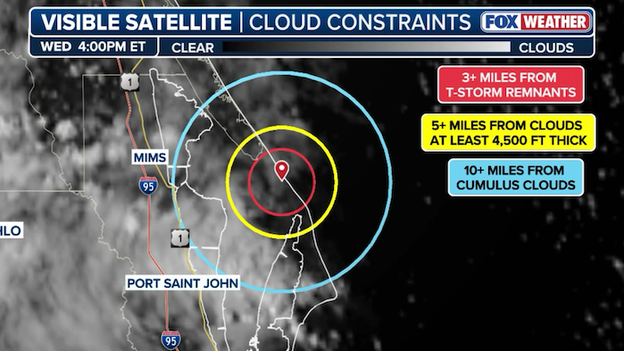
Visible satellite image showing the clouds dissipating and moving away from Kennedy Space Center in Florida.
Meteorologists from the 45th Weather Squadron are noting that the cumulus clouds, which were previously a concern for the Thick Cloud Rule, are now dissipating and moving away from the launch pad.
This clearing significantly lowers the risk of triggered lightning during the rocket's ascent. With the sun breaking through, the forecast remains a solid 80% "Go" as we approach the opening of the launch window at 6:24 p.m. ET.
NASA engineers have completed final hatch checks inside the White Room at Launch Complex 39B, verifying both the counterbalance system and the hatch’s airtight seal ahead of launch.
Technicians confirmed the counterbalance mechanism allows smooth, controlled hatch operation without stressing the seal, then performed pressure decay tests to ensure no leaks—critical for maintaining cabin integrity and astronaut safety throughout the mission.
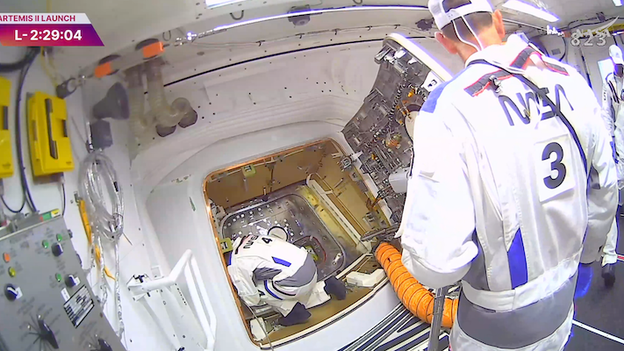
NASA engineers perform final White Room hatch seal tests.
Following these adjustments, the team performs seal pressurization decay checks – monitoring pressure loss over time to confirm the hatch’s integrity.
These checks are vital for astronaut safety, ensuring the cabin remains secure in all mission phases ahead of sealing off Orion.
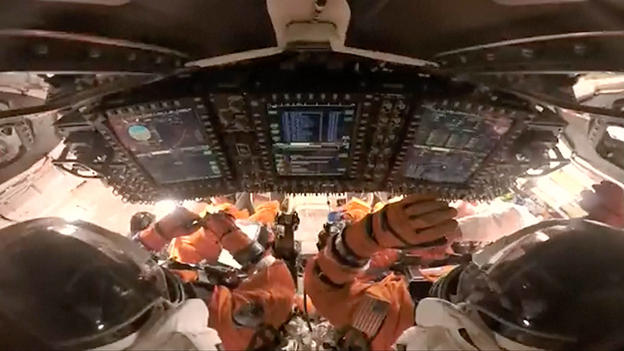
The final closeout of the Orion spacecraft is now underway at Launch Pad 39B, a meticulous process that effectively seals the crew's environment for the duration of the mission.
NASA
The closeout crew in the White Room is performing a final, microscopic inspection of the hatch seals to ensure no dust or debris—even a single strand of hair—could compromise the airtight integrity of the cabin.
Once the interior crew module hatch is securely locked and leak-tested, teams will move on to closing the outer thermal hatch and the Launch Abort System (LAS) shroud.
These layers are critical for protecting Reid Wiseman and his crew from the extreme pressures of ascent and the searing heat of reentry.
As the countdown for Artemis II nears its final hours, the historic mission is drawing major attention on social media.
In a recent post on Truth Social, President Trump hailed tonight’s launch as a defining moment of American leadership, marking the first time in over 50 years that the United States is heading back to the Moon.
He described the SLS as one of the "most powerful rockets ever built," framing the mission as a symbol of how America "dominates" on Earth and beyond the stars.
The post serves as a high-profile rallying cry for the mission, emphasizing the "America First" significance of sending four brave astronauts farther into deep space than any human has ever traveled.
As the world watches Kennedy Space Center, the message underscores a sense of national pride and technological preeminence, offering prayers for the crew and a "God bless" to the teams at NASA as they prepare to make history.

Truth Social post
With the countdown entering its final hours, the atmosphere in the firing room at the Kennedy Space Center is one of cautious optimism.
Launch Director Charlie Blackwell-Thompson and her team are reportedly encouraged by how smoothly operations have proceeded so far.
From the initial call to stations to the complex cryogenic tanking process, the SLS rocket and its ground systems have performed exceptionally well, avoiding the technical hiccups that often accompany such a massive vehicle.
This steady progress has allowed teams to stay ahead of the timeline, successfully transitioning both the core and upper stages into their replenish modes.
While engineers continue to monitor minor data points like avionics temperatures and offshore clouds, the lack of significant red flags has the launch team feeling confident as they move toward the final liftoff.
NASA
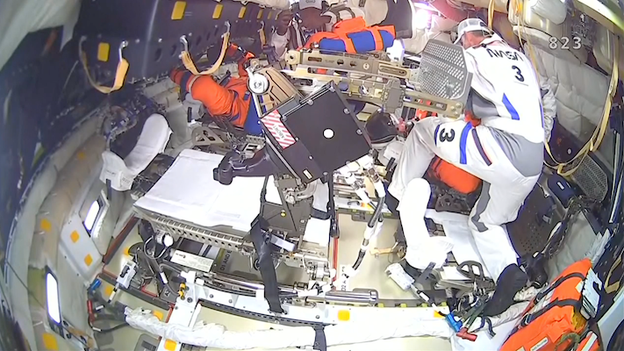
The historic moment has arrived as the four Artemis II astronauts have begun the process of boarding the Orion spacecraft. One by one, the closeout crew is assisting Reid Wiseman, Victor Glover, Christina Koch, and Jeremy Hansen through the side hatch and into their seats, where they are being meticulously strapped into their five-point harnesses.
Suspended 252 feet above Launch Pad 39B, the crew is now performing the critical comm check, verifying their audio links with the Launch Control Center and Mission Control in Houston.
NASA
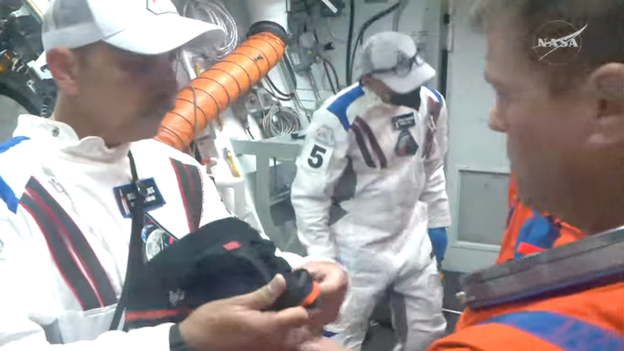
The four Artemis II astronauts have officially entered the White Room, the sterile environmental chamber at the end of the crew access arm that serves as the final gateway to the Orion spacecraft.
Here, the closeout crew is meticulously cleaning the astronauts' boots and performing final suit checks before they cross the threshold into their seats for the 10-day journey.
Inside this small, pressurized room 252 feet above the launch pad, Commander Reid Wiseman and his crew are now just inches away from the capsule that will carry them around the Moon.
Once all four are securely strapped in and the side hatch is sealed, the closeout team will retreat, leaving the crew alone with the countdown for tonight’s 6:24 p.m. ET liftoff.
The Astrovan has officially arrived at the foot of Launch Pad 39B, bringing the four Artemis II astronauts face-to-face with the 322-foot-tall SLS rocket.

NASA
After a nine-mile journey from the crew quarters, Reid Wiseman, Victor Glover, Christina Koch, and Jeremy Hansen are now preparing to take the elevator up the mobile launcher to the 252-foot level.
Once they reach the White Room, the final sterile corridor before entering the Orion spacecraft, the closeout crew will assist them in boarding and performing final communications checks.
The 45th Weather Squadron is keeping a vigilant eye on a deck of clouds currently drifting over Launch Pad 39B.
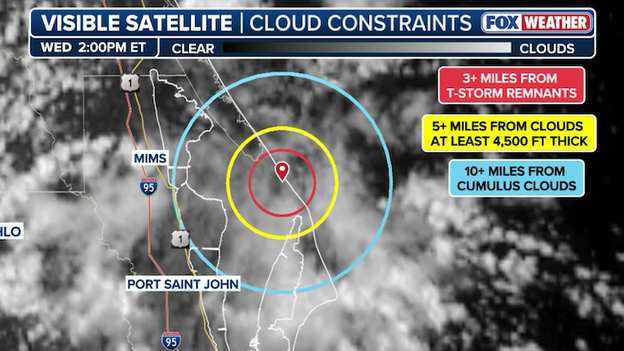
Visible satellite image showing the clouds passing over Kennedy Space Center this afternoon.
While these clouds are providing some shade for the fully fueled SLS rocket, meteorologists are specifically monitoring their thickness and electrical charge to ensure they don't violate the Cumulus Cloud Rule.
NASA’s strict safety criteria require the rocket to remain at least 10 miles away from any clouds that could potentially trigger lightning during ascent.
NASA
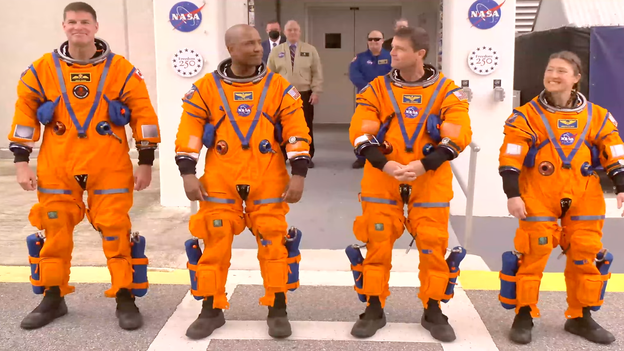
The energy at Kennedy Space Center reached a fever pitch as the four Artemis II astronauts made their historic walk-out from the Neil A. Armstrong Operations and Checkout Building.
Clad in their iconic bright orange Orion Crew Survival System suits, Reid Wiseman, Victor Glover, Christina Koch, and Jeremy Hansen paused to wave to the cheering crowds of NASA employees and families before boarding the Astrovan.
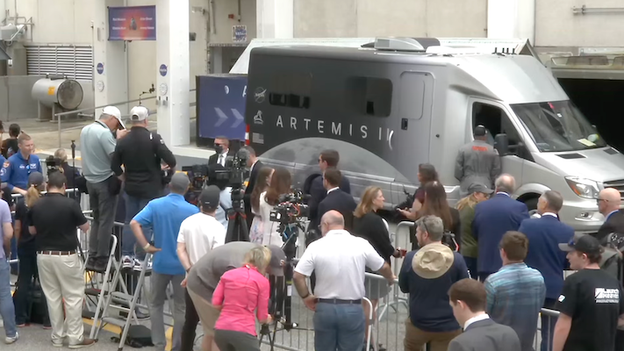
This specialized transport is now carrying the crew on the nine-mile journey to Launch Pad 39B, where the fully fueled SLS rocket awaits.
Once they arrive at the pad, the crew will take the elevator up the mobile launcher to the white room, marking the final time they will be on Earth's surface before their 10-day journey around the Moon.
NASA
Inside the Neil A. Armstrong Operations and Checkout Building, the four Artemis II astronauts are sharing a few final moments with their families before making the historic walk-out to the waiting Astrovan.
Clad in their bright orange flight suits and carrying their portable cooling units, Reid Wiseman, Victor Glover, Christina Koch, and Jeremy Hansen are just minutes away from the traditional wave to the crowds that marks their final departure for Launch Pad 39B.
Launch weather teams are keeping a close watch on the anemometers surrounding Pad 39B as surface winds have begun to pick up this afternoon.
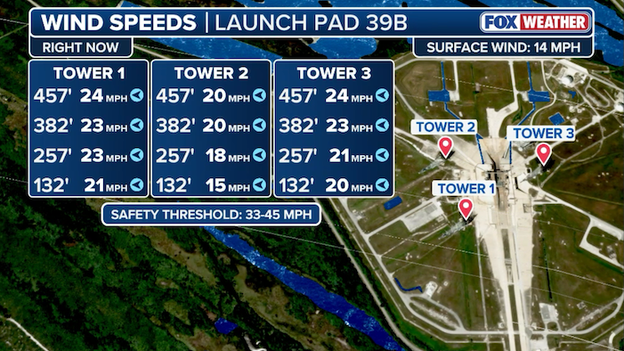
Wind speeds have increased around Launch Pad 39B in the last few hours, but remain below launch limits at this hour.
While the breeze is becoming more noticeable across the Florida coastline, current sustained speeds remain well below the strict safety limits required for the SLS rocket.
To remain "Go" for liftoff, peak winds must stay below a range of 33 to 45 miles per hour, depending on the specific altitude measured between the 132-foot and 457-foot levels of the mobile launcher.
These constraints are in place to ensure the vehicle can safely clear the tower during the first few seconds of flight. For now, the wind remains in the "green," and the 45th Weather Squadron expects conditions to stay favorable through our 6:24 p.m. ET launch window.
Engineering teams in the Launch Control Center are currently keeping a close watch on a specific avionics display unit within the SLS rocket that is showing slightly abnormal temperature readings.
While the thermal data is fluctuating outside of the typical baseline, mission managers emphasize that the unit is currently operating within its design specifications and is not considered a showstopper for today's mission.
This type of real-time monitoring is standard for a vehicle as complex as the SLS, which contains thousands of sensors designed to catch even the slightest deviation.
Technicians are analyzing the data to determine if the trend is stabilizing or if a simple system reset is required.
The countdown has officially crossed the T-minus 5-hour mark, and the path to the Moon is looking clearer by the minute. At this stage, the Space Launch System (SLS) rocket is almost entirely flight-ready.
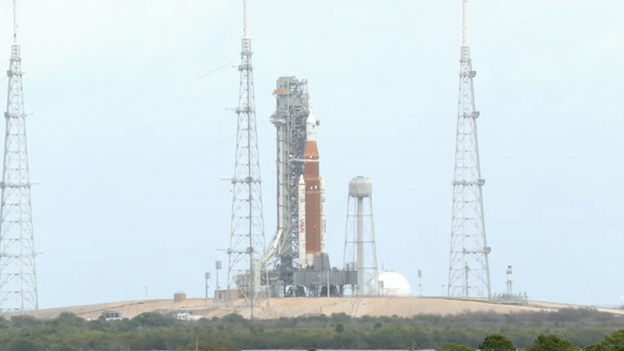
Artemis II ready for launch from Launch Pad 39B at Kennedy Space Center in Florida.
Inside the Neil A. Armstrong Operations and Checkout Building, the energy is electric as the four-person crew—Reid Wiseman, Victor Glover, Christina Koch, and Jeremy Hansen—finish suiting up in their bright orange flight gear.
Having just completed their final weather briefing, which confirmed an 80% "Go" forecast, the astronauts are now preparing for the traditional walk-out to their transport vehicle.
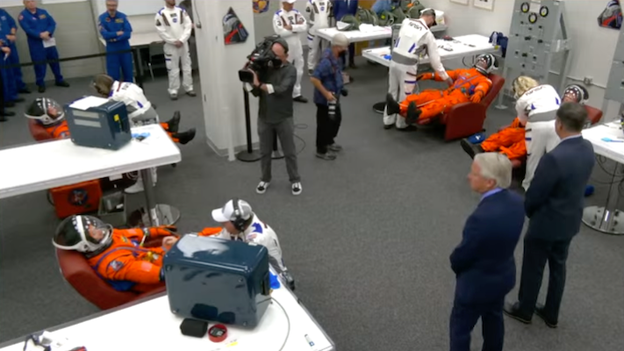
Final leak checks are underway as astronauts suit up ahead of today's launch.
The four Artemis II astronauts—Reid Wiseman, Victor Glover, Christina Koch, and Jeremy Hansen—are now fully suited and performing final leak checks on their Orion Crew Survival System suits. This critical step ensures that their suits are airtight and the communication systems are functioning perfectly before they leave the Neil A. Armstrong Operations and Checkout Building.
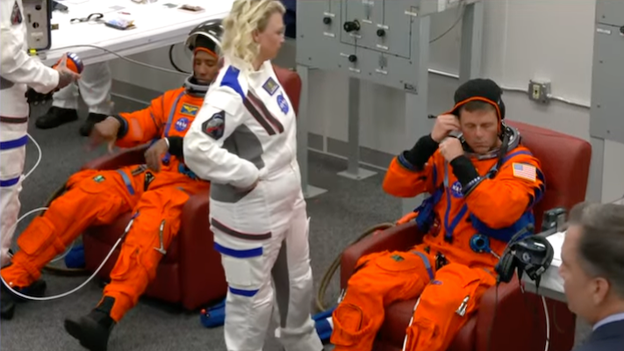
Flight crew suiting up ahead of today's historic launch. (NASA)
The mission has reached one of its most iconic milestones as the four Artemis II astronauts have begun the meticulous suit-up process in the Neil A. Armstrong Operations and Checkout Building.
Assisted by a team of suit technicians, Reid Wiseman, Victor Glover, Christina Koch, and Jeremy Hansen are currently being helped into their bright orange Orion Crew Survival System (OCSS) suits.
These highly specialized garments are designed to protect the crew during the high-pressure environments of launch and reentry, and once the seals are checked and communications are verified, the crew will be ready for their final walk-out.
The Artemis II mission has reached a major fueling milestone as the SLS rocket enters replenish mode.
With the core stage and upper stage tanks now fully loaded with hundreds of thousands of gallons of super-cooled liquid hydrogen and liquid oxygen, this phase ensures the vehicle stays at 100% capacity.
Because these cryogenic propellants naturally boil off and evaporate while sitting on the pad, ground systems are now continuously trickling in small amounts of fuel to keep the rocket flight-ready all the way until the final moments of the countdown.
With the clock ticking down, Launch Director Charlie Blackwell-Thompson confirmed that the four Artemis II astronauts have officially completed their final pre-flight weather briefing.
The news from the blockhouse remains encouraging: Launch Weather Officer Mark Burger reports that the forecast is holding steady at 80% favorable for today’s 6:24 p.m. ET liftoff.
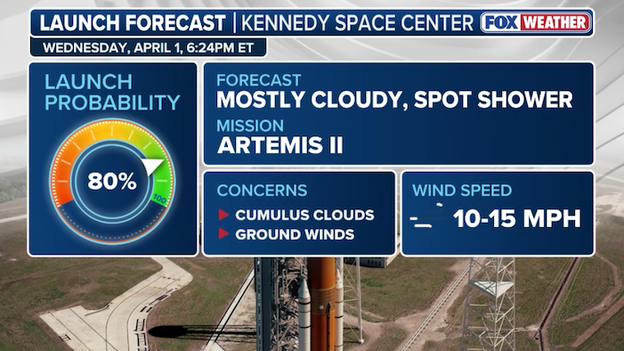
Latest launch weather forecast for Artemis II from Kennedy Space Center in Florida.
While isolated showers are currently visible on radar and moving toward Launch Pad 39B, meteorologists expect these showers to dissipate well before the launch window opens.
This clearing trend is exactly what teams were hoping for, as it ensures the SLS rocket will have a dry, stable path through the lower atmosphere.
With the weather briefing behind them, the crew—Reid Wiseman, Victor Glover, Christina Koch, and Jeremy Hansen—is now moving into the final personal preparations and the meticulously choreographed suit-up process.
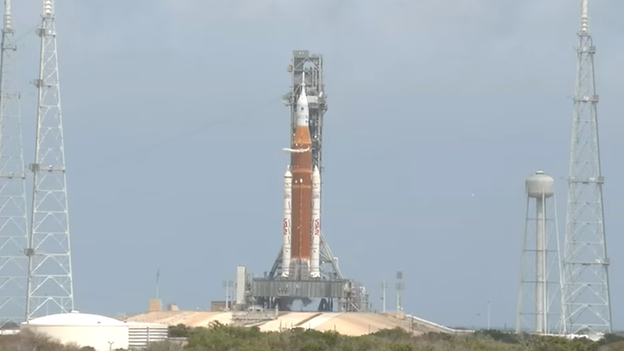
Artemis II sits on Launch Pad 39B ahead of today's scheduled historic launch from Kennedy Space Center in Florida. (NASA)
We have crossed the T-minus 6-hour mark, and the path to the Moon is looking clearer by the minute. At this stage, the Space Launch System (SLS) rocket is almost entirely flight-ready; the core stage is now fully fueled and holding steady in replenish mode, while the upper stage (ICPS) is in the final stages of loading its liquid oxygen.
Inside the Astronaut Crew Quarters, the mood is one of focused preparation. The four-person crew is preparing to attend their final weather briefing, where they are being briefed on the developing showers near the pad and the 80% favorable conditions for their 6:24 p.m. ET liftoff.
Once the briefing concludes, they will move into their pre-flight meal and begin the meticulous process of suiting up in their Orion Crew Survival System suits. With the hardware performing beautifully and the crew nearing their departure for the pad, the reality of today's historic mission is truly setting in.
Launch Weather Officer Mark Burger has informed the Flight Director that isolated showers are likely to develop near Pad 39B within the next two hours, putting teams on high alert due to strict "No Rain" launch constraints.
While these showers are currently small and scattered, their trajectory is being closely tracked to ensure they don't interfere with the 6:24 p.m. ET liftoff. Burger also noted that these showers pose no lightning threat.
Meanwhile, the mission has reached a critical human milestone as the four astronauts prepare for their full weather briefing, scheduled to begin in the next 30 minutes.
During this briefing, Commander Reid Wiseman and his crew will receive the most up-to-date analysis of these developing showers and the 80% "Go" forecast before they begin the final "suit-up" process for their journey to the Moon.
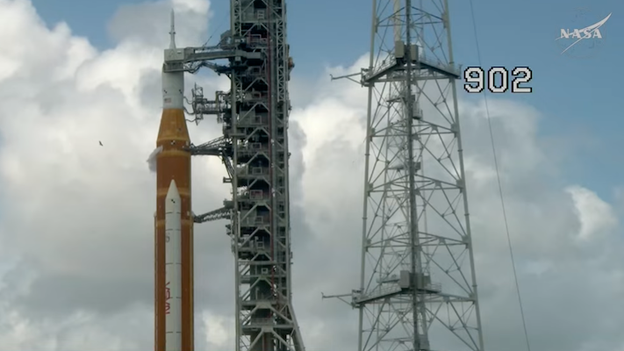
Camera showing clouds casting shadows over Launch Pad 39B at Kennedy Space Center in Florida.
Live cameras at Launch Pad 39B currently show a dramatic scene as thick cumulus clouds drift by over the spaceport, casting shadows over the SLS rocket. While these clouds make for a moody and majestic view, meteorologists are watching them intently to ensure they remain within the strict safety margins required for a "Go" at 6:24 p.m. ET.
Radar as of 11:56 a.m. ET shows isolated rain showers developing just offshore of Launch Pad 39B.
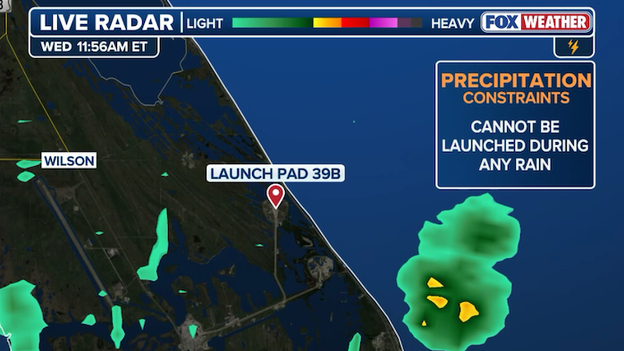
Radar showing showers just offshore of Launch Pad 39B at Kennedy Space Center in Florida.
While these cells are currently small, NASA’s precipitation constraints are absolute: the Artemis II rocket cannot be launched during any rain.
Meteorologists are keeping a very close watch on these showers to ensure they do not drift over the flight path or the pad during the launch window, as even light moisture can pose a risk to the vehicle's thermal protection system and overall flight safety.
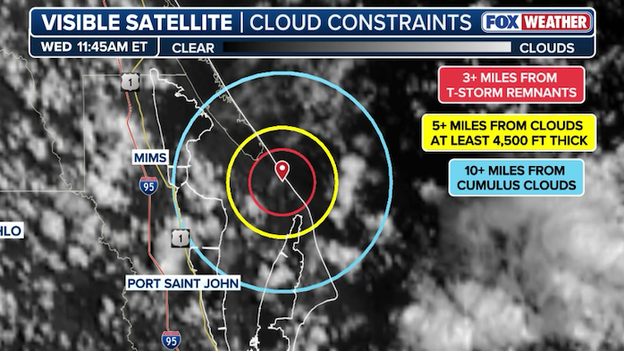
Visible satellite image showing the cloud constraints for Artemis II's launch.
Visible satellite imagery as of 11:45 a.m. ET shows an increase in cloud cover moving toward Kennedy Space Center, keeping meteorologists on high alert.
While the overall forecast remains favorable, launch officials are closely monitoring several specific cloud constraints to ensure the SLS rocket has a clear path to orbit.
To remain "Go" for launch, the mission must stay at least 10 miles away from cumulus clouds and 5 miles away from any cloud layers at least 4,500 feet thick.
These rules are designed to prevent triggered lightning, a phenomenon where the rocket's own exhaust plume can initiate a strike while passing through an electrified cloud.
While scattered clouds are currently drifting over Mims and Port Saint John, the 45th Weather Squadron continues to track these developments to ensure they don't grow into the thick, convective clouds that would halt today's 6:24 p.m. ET liftoff.
Fueling operations for the Artemis II mission have entered a steady rhythm as the countdown clock continues its march toward tonight’s 6:24 p.m. ET liftoff.
With the liquid hydrogen tanks for both the core and upper stages now 100% full, the launch team has transitioned into replenish mode, continuously topping off the propellant to account for natural boil-off.
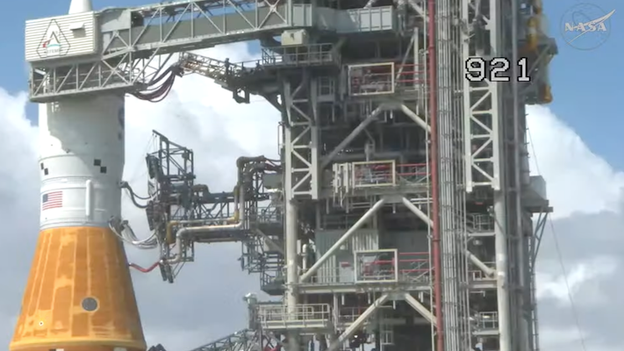
NASA
As the SLS rocket sits fully conditioned and venting white plumes at Pad 39B, the focus is shifting toward the crew.
Commander Reid Wiseman, Pilot Victor Glover, and Mission Specialists Christina Koch and Jeremy Hansen are currently readying for their final weather briefing. During this session, Launch Weather Officer Mark Burger will provide them with the latest look at the 80% "Go" forecast, detailing the specific wind and cloud conditions they can expect during their eight-minute ascent to orbit.
The countdown has officially reached the T-minus 7-hour mark, and the energy at Kennedy Space Center is shifting from technical preparation to the quiet intensity of launch day.
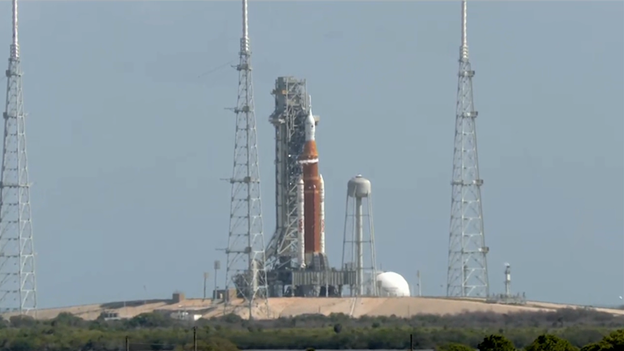
NASA’s Artemis II SLS (Space Launch System) rocket and Orion spacecraft at Launch Pad 39B this morning.
At this stage, the massive SLS rocket is a living machine, fully conditioned and holding nearly its entire 733,000-gallon load of super-cooled propellant.
While the fast-fill operations for liquid hydrogen are complete, teams are now in replenishment mode, trickling in fuel to replace what naturally boils off as the rocket sits on the pad.
Inside the crew quarters, the four astronauts are finishing their final pre-suit-up briefings, while the 45th Weather Squadron remains optimistic with an 80% "Go" forecast.
All eyes are now on the afternoon clouds as the Mission Management Team monitors the final milestones leading to our 6:24 p.m. ET departure for the Moon.
Fueling has reached its final major milestones as the Artemis II rocket sits fully topped off with liquid hydrogen. Both the massive SLS core stage and the Interim Cryogenic Propulsion Stage (ICPS) have hit 100% capacity for liquid hydrogen, holding 537,000 and 17,000 gallons respectively at a bone-chilling -423°F.
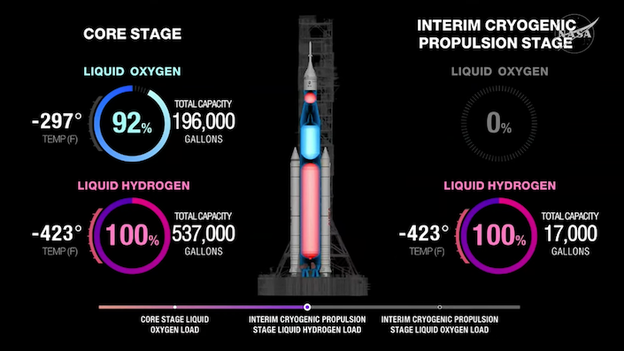
Latest tanking status for Artemis II (NASA)
The core stage is also nearing completion for liquid oxygen, which is currently at 92% capacity. Once these final few thousand gallons are loaded, the launch team will transition into replenishment mode, where they continuously trickle small amounts of propellant into the tanks to account for natural boil-off until the moment of liftoff.
Launch teams at Pad 39B are currently conducting a critical vent and relief test to ensure the SLS rocket’s internal pressures remain perfectly balanced.
This procedure allows engineers to verify that the relief valves are functioning exactly as intended, venting excess gaseous oxygen and hydrogen to prevent over-pressurization within the massive tanks.
These controlled releases are a vital safety check, confirming that the vehicle can exhale properly while sitting fully fueled on the pad before the final sequence toward liftoff begins.
Watch LIVE the Artemis II moon rocket launch and livestream coverage on FOX Weather's exclusive YouTube livestream. We'll be tracking cloud cover, live radar and more as live cameras show the launch as it happens from Kennedy Space Center.
U.S. Air Force Detachment 3 is ready for the Artemis II launch, and they're tasked with contingency planning during the mission launch. Lt. Colonel Kevin Pieper joined FOX Weather to talk about how long Detachment 3 has been preparing for Artemis II, as well as all they prepare for ahead of launch.
As the SLS core stage reaches its full capacity, dramatic plumes of white vapor have become visible venting from the side of the rocket.
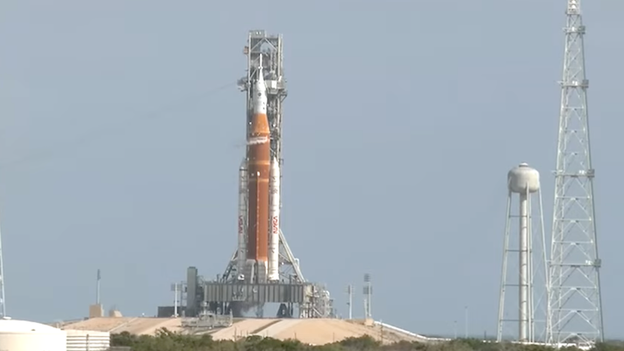
Venting seen on the side of the rocket. (NASA)
NASA engineers confirm this is a completely normal and expected condition, as the cryogenic tanks must constantly bleed off pressure from the super-cooled liquid oxygen and hydrogen to maintain a safe, stable environment.
The Artemis II Mission Management Team (MMT) has just arrived on station at the Kennedy Space Center, marking a pivotal shift in the countdown’s command structure.
This group of senior NASA leaders and engineers is now officially responsible for the "Go/No-Go" decisions regarding mission safety and flight readiness.
Their presence in the firing room signifies that we have moved past routine ground processing and into the final, high-stakes decision-making phase for today's historic journey to the Moon.
We have officially crossed the T-minus 8-hour mark, and the countdown to the Moon is hitting its stride with all systems currently "Go" for tonight’s 6:24 p.m. ET liftoff.
The atmosphere at Kennedy Space Center has shifted into high gear as multiple critical operations run in parallel across the Cape.
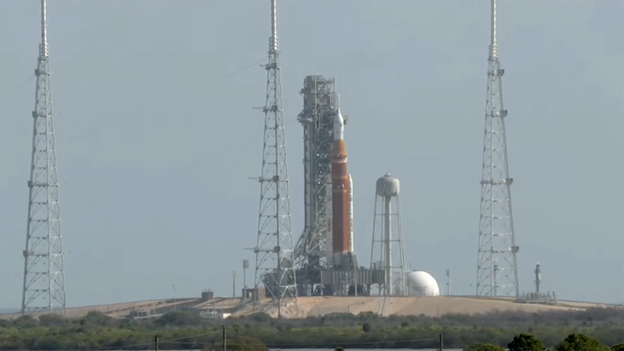
NASA’s Artemis II SLS (Space Launch System) rocket and Orion spacecraft at Launch Pad 39B this morning.
Propellant loading update
Fueling of the massive SLS rocket is well into the fast-fill stage for both the core and upper stages. The core stage is now more than 75% full of its cryogenic cargo, and the Interim Cryogenic Propulsion Stage (ICPS) is rapidly chilling as it takes on its own liquid hydrogen and oxygen. Plumes of white vapor are venting steadily from the pad—a sign that the beast is fully awake and breathing.
Flight crew status
Following their 9:25 a.m. ET wake-up call, astronauts Reid Wiseman, Victor Glover, Christina Koch, and Jeremy Hansen are currently undergoing final medical checks and a high-protein breakfast. They will soon begin their final mission briefing before the suit-up process begins. The crew remains in high spirits, prepared to become the first humans in over 50 years to venture toward the lunar far side.
Launch weather outlook
The 45th Weather Squadron reports that conditions remain 80% favorable. While we are seeing some scattered cumulus clouds drifting over the spaceport, they are currently well within the "Go" parameters. Meteorologists are keeping a watchful eye on the afternoon sea breeze, which could push isolated showers near the pad, but for now, the sky over Pad 39B is cooperating beautifully.
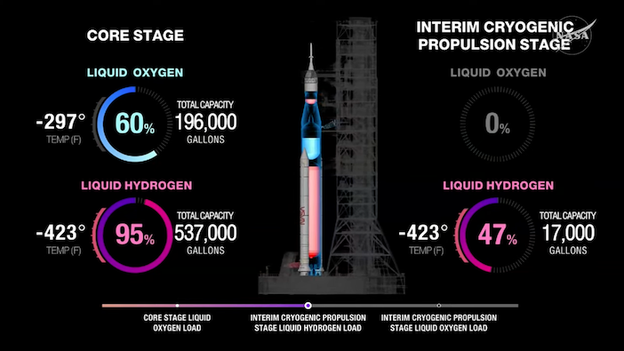
Latest fueling operations status for Artemis II.
Fueling operations are moving at a rapid clip as we approach the final stages of core stage loading. The liquid hydrogen tank in the SLS core stage is now 95% full, nearing its total capacity of 537,000 gallons, while liquid oxygen has reached the 60% mark.
Meanwhile, progress on the Interim Cryogenic Propulsion Stage (ICPS) is also accelerating, with liquid hydrogen loading now at 47%.
As these super-cooled propellants continue to fill the stack, the rocket is visibly breathing, with venting and frost formation indicating that the vehicle is nearly ready for its 6:24 p.m. ET departure.
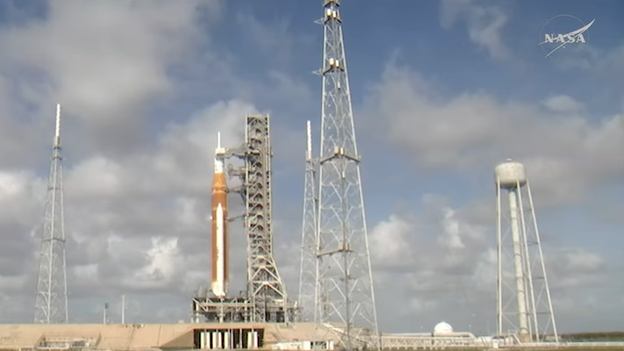
NASA camera showing cumulus clouds around Launch Pad 39B at Kennedy Space Center this morning.
The view from Launch Pad 39B this morning shows a mix of sun and scattered cumulus clouds drifting across the Kennedy Space Center.
While the sky has brightened significantly since the murky dawn, meteorologists are keeping a close watch on these low-level clouds to ensure they don't develop into the thick layers that could trigger a "No-Go" for liftoff.
The primary goal for the 45th Weather Squadron is to ensure these clouds remain sparse enough to meet the strict Cumulus Cloud Rule safety requirements.
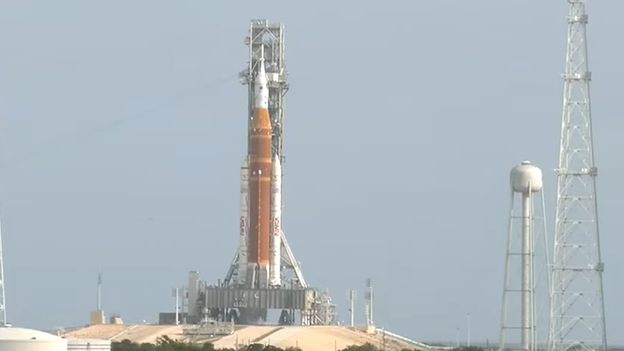
NASA
Following the successful chilldown of the transfer lines, NASA has officially transitioned into the fast-fill stage for the Interim Cryogenic Propulsion Stage (ICPS).
Liquid hydrogen is now surging into the rocket's upper stage at a significantly increased flow rate, bringing the second-to-last major fueling milestone to life.
This critical phase ensures the RL10 engine has the massive volume of super-cooled propellant required to propel the Orion spacecraft and its four-person crew out of Earth's orbit and toward the Moon.
Former NASA Chief Scientist, Jim Green, joined FOX Weather to discuss the complete flight plan for Artemis II's 10-day trip around the Moon, as well as future plans for a lunar base.
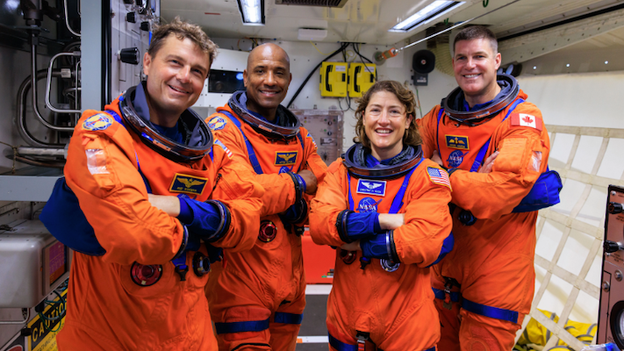
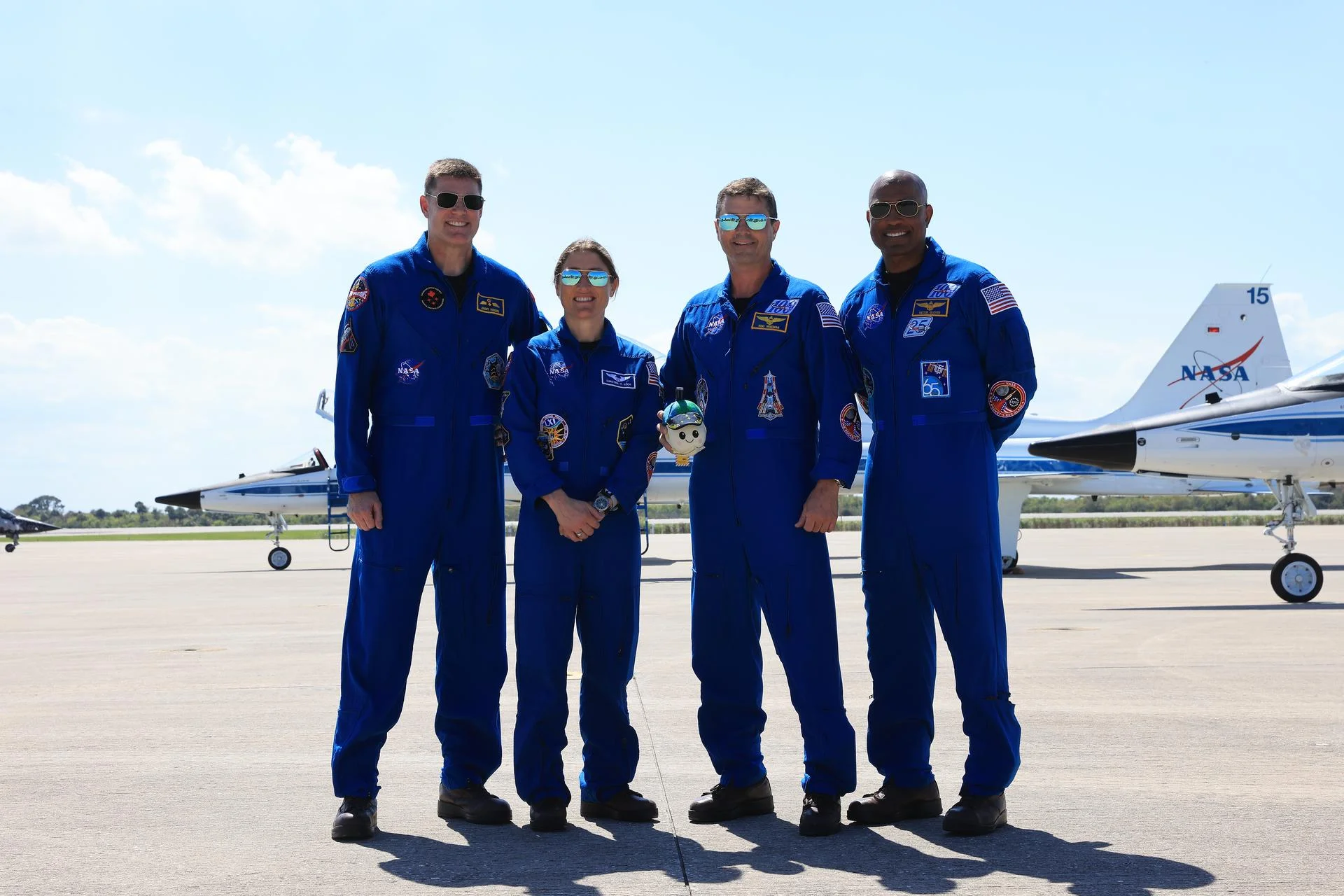
Artemis II NASA astronauts (left to right) Reid Wiseman, Victor Glover, and Christina Koch, and CSA (Canadian Space Agency) astronaut Jeremy Hansen stand in the white room on the crew access arm of the mobile launcher at Launch Pad 39B. (NASA/Frank Michaux)
The mission has reached a heartfelt milestone this morning as the four individuals who will carry our lunar ambitions to the stars have officially begun their launch day.
At 9:25 a.m. ET, NASA astronauts Reid Wiseman, Victor Glover, and Christina Koch, along with CSA astronaut Jeremy Hansen, received their final wake-up call on Earth before their 10-day journey begins.
As the crew starts their morning medical checks and final mission briefings, the Launch Control Center is simultaneously conducting a comprehensive status check.
NASA
With the core stage fueling well underway, NASA teams have now begun the upper stage chilldown process for the Interim Cryogenic Propulsion Stage (ICPS).
This critical step involves circulating a small amount of super-cooled liquid hydrogen through the upper stage's lines and the RL10 engine to gradually lower their temperature.
By chilling the hardware now, engineers prevent thermal shock and ensure the metal is properly conditioned before the high-volume propellant flow begins, keeping the stack stable as we march toward the 6:24 p.m. ET liftoff.
If you’re looking to catch a glimpse of the Artemis II launch tonight, your location and the timing of the ascent will be key.
For those in Florida, residents along the Space Coast will see the SLS rocket's powerful arc within just 10 seconds of liftoff at 6:24 p.m. ET, while viewers in Orlando and Tampa can expect to see it roughly 30 to 50 seconds into flight.
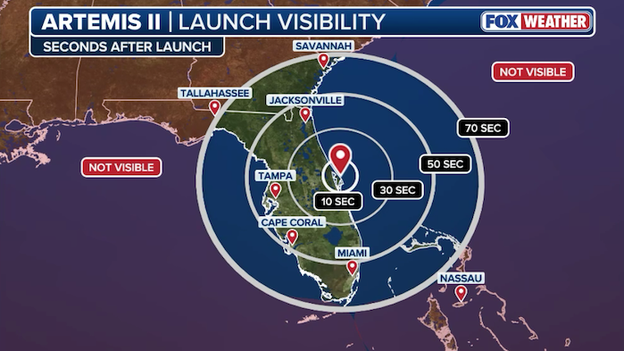
Map showing where you'll be able to view tonight's Artemis II launch.
As the rocket gains altitude and heads northeast, the visibility window expands into Georgia, with residents in Savannah potentially spotting the plume around 70 seconds after launch.
However, visibility quickly drops off further inland; while Jacksonville should have a great view, those in Tallahassee and much of western Georgia will likely sit just outside the visible range of the rocket's trajectory.
Fueling is in full swing at Kennedy Space Center as the Space Launch System (SLS) rocket prepares for its journey around the Moon.
Currently, the core stage is roughly 30% full of liquid hydrogen, chilled to a bone-chilling -423°F, while the liquid oxygen tank is nearing 28% capacity at -294°F.
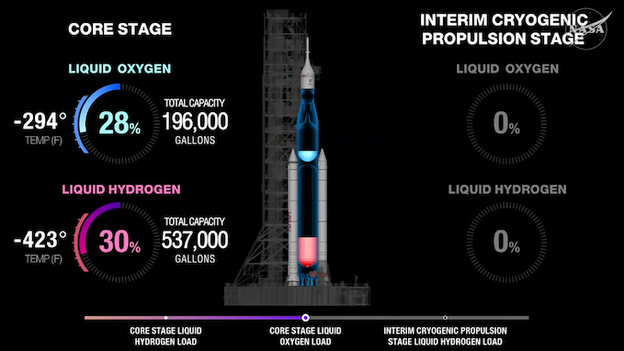
Current tanking status for Artemis II. (NASA)
With fast-fill operations steadily pumping these super-cooled propellants into the massive 733,000-gallon system, the rocket is beginning to come to life, venting white plumes into the Florida air.
Once the core stage is topped off, teams will transition to fueling the Interim Cryogenic Propulsion Stage (ICPS) to complete the propellant loading process.
The countdown has officially crossed the T-minus 9-hour mark, and the massive SLS rocket is now breathing as venting white plumes of oxygen gas escape the pad.
With the fast-fill process in high gear, the core stage is rapidly becoming a super-cooled powerhouse, already holding over half of the 700,000 gallons of cryogenic propellant needed for liftoff.
Inside the Launch Control Center, the atmosphere is shifting from technical preparation to mission execution as controllers verify the structural integrity of the tanks under the immense weight of the fuel.
While the rocket continues to frost over at Launch Pad 39B, the four Artemis II astronauts are just minutes away from their scheduled 9:45 a.m. ET wake-up call, marking their final hours on Earth before their journey to the lunar far side.
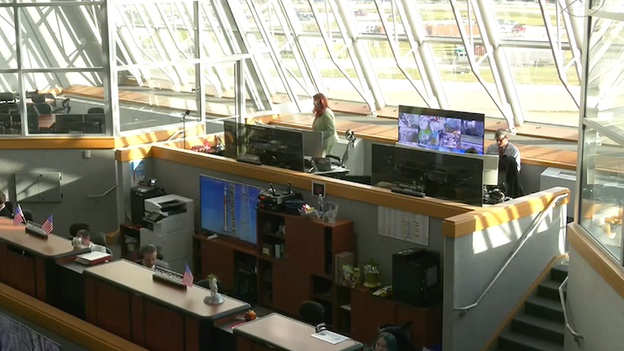
Firing Room 1 inside Launch Control Center at Kennedy Space Center in Florida.
If you look closely at the consoles in the firing room today, you’ll notice a sea of emerald among the high-tech monitors. It is a long-standing NASA tradition for the launch team to wear green for good luck, a superstition that dates back to the early days of the space program.
From lucky neckties and scarves to polo shirts, the "Launch Green" attire serves as a silent nod to the team's shared history and their hope for a smooth "Go" at T-zero.
Launch Director Charlie Blackwell-Thompson and her team lean into these small rituals to build camaraderie and keep spirits high during the intense, multi-hour countdown to the Moon.
With the SLS core stage successfully chilled to cryogenic temperatures, NASA has officially transitioned into fast-fill operations to rapidly load the bulk of the 700,000 gallons of propellant.
Liquid oxygen is now surging into the rocket’s massive tanks at maximum flow rates, bringing the Artemis II mission one giant step closer to its 6:24 p.m. ET liftoff.
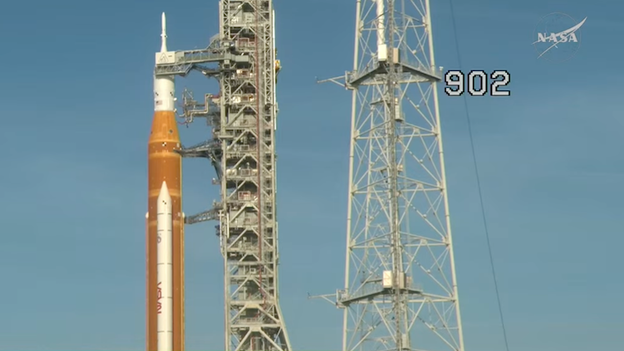
(NASA)
The main event of the morning is now reaching its stride at Kennedy Space Center as propellant loading enters the critical slow-fill stage.
After successfully chilling down the transfer lines to prevent thermal shock, teams are now trickling liquid oxygen and liquid hydrogen into the SLS core stage at a controlled pace.
This deliberate speed allows the massive tanks to adjust to the cryogenic temperatures—-297°F for the oxygen and -423°F for the hydrogen—without causing structural stress to the rocket’s skin.
As the super-cooled fuel begins to fill the bottom of the tanks, observers at the pad can see the first signs of frost and condensation forming on the exterior of the orange insulation.
Once the sensors confirm the tanks have reached a stable temperature and a safe internal volume, the Launch Director will give the command to transition into the fast-fill phase, significantly increasing the flow to meet the 700,000-gallon capacity needed for tonight’s 6:24 p.m. ET liftoff.
While the 45th Weather Squadron scans the Florida clouds, NASA’s Space Weather Prediction Center is looking much further up—monitoring the sun for solar flares and geomagnetic activity.
High-energy solar particles can interfere with the SLS rocket’s sensitive avionics during ascent and, more importantly, pose a radiation risk to the four astronauts once they leave the protective envelope of Earth’s magnetic field.
Space weather analysts are currently tracking "favorable" solar conditions, ensuring that no major coronal mass ejections are headed toward the lunar flight path.
Maintaining a quiet sun is a critical safety requirement for the 10-day journey, as the Artemis II crew will be more exposed to deep-space radiation than any humans in over half a century.
We have officially hit the T-minus 10-hour mark in the Artemis II countdown, and the energy at Kennedy Space Center is palpable as the mission moves into high gear.
Right now, the focus is entirely on the main engine of the launch day: the massive fueling operation. Engineers are currently transitioning from the chilldown phase into the fast-fill stage, pumping hundreds of thousands of gallons of cryogenic liquid oxygen and hydrogen into the SLS core stage.
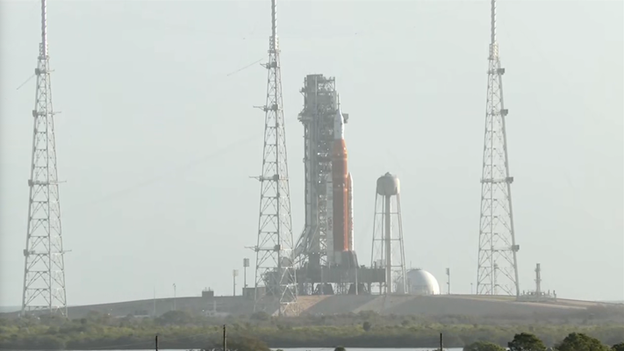
NASA’s Artemis II SLS (Space Launch System) rocket and Orion spacecraft at Launch Pad 39B this morning.
As the rocket’s exterior begins to form a layer of frost from the super-cooled propellants, controllers in the firing room are meticulously monitoring pressure levels and temperature sensors to ensure every system remains stable.
While the SLS takes on fuel, the four astronauts are enjoying some rest before their scheduled wake-up call at 9:45 a.m. ET.
Activity inside Launch Control Center’s firing room is intensifying this morning as controllers monitor every data point of the Artemis II countdown.
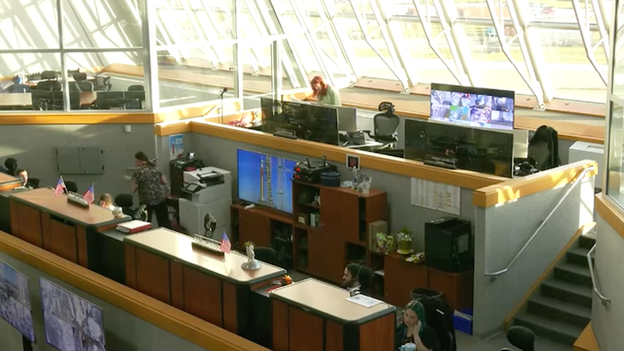
Firing Room 1 in the Launch Control Center at Kennedy Space Center in Florida. (NASA)
With banks of monitors displaying the SLS rocket at Pad 39B and teams stationed at their consoles, the room serves as the nerve center for today’s mission operations. The atmosphere is one of focused calm as engineers coordinate the ongoing tanking process and prepare for the arrival of the four-person crew later today.
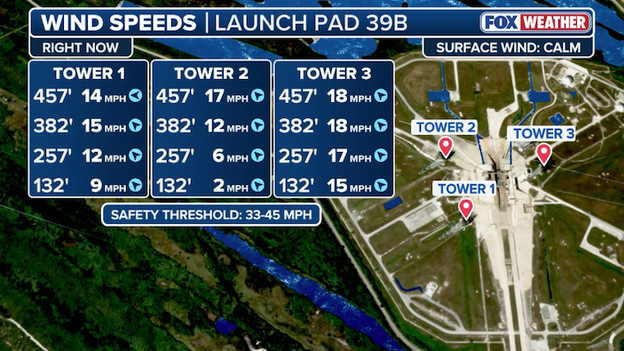
Latest wind speeds from observation sensors surrounding Launch Pad 39B at Kennedy Space Center in Florida.
Current wind data from Launch Pad 39B shows highly favorable conditions as the Artemis II countdown continues.
Surface winds are light, and sensor readings across the three monitoring towers show upper-level speeds ranging from just 2 to 18 mph.
These numbers remain well below the safety threshold of 33–45 mph, providing NASA teams with a perfect meteorological window as fueling operations proceed.
Launch Weather Officer Mark Burger provided a welcome dose of confidence to the mission teams this morning, officially reporting that weather conditions are acceptable and favorable for the start of tanking.
This green light ensures that the delicate process of loading super-cooled propellants can proceed without the threat of lightning or high winds interfering with ground operations.
While meteorologists continue to keep a watchful eye on the afternoon coastal clouds, this favorable window provides the perfect environment for the SLS rocket to drink in its 700,000 gallons of fuel as the countdown remains firmly on track.
If you’ve been watching the countdown clocks and noticed they don’t quite match up, you aren't seeing a glitch. We have officially entered the first built-in hold of the day, highlighting the difference between L-time and T-time.
While L-time (Launch time) reflects the actual wall-clock time remaining until the 6:24 p.m. ET liftoff, T-time (Test time) is the sequence of events choreographed to the rocket's internal logic.
These built-in holds are scheduled pauses that allow teams to catch up on tasks or troubleshoot minor issues without delaying the actual launch.
During this pause, the T-clock stops while the L-clock keeps ticking toward the evening window.
This particular hold is a crucial breather for the launch team to finish chilling the propellant lines and verify that the initial flow of liquid oxygen and hydrogen into the SLS core stage is perfectly stable before the countdown resumes.
The "Go" has been given! At 7:33 a.m. ET, Launch Director Charlie Blackwell-Thompson officially cleared teams to begin the critical process of loading the SLS rocket with propellant.
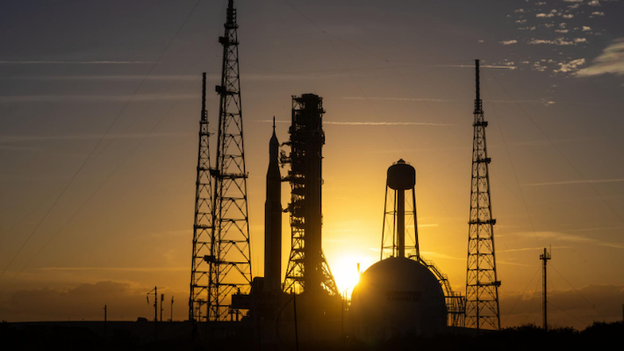
(NASA/Sam Lott)
Tanking operations are now underway at Kennedy Space Center, starting with the chilldown of the transfer lines. This essential phase gradually cools the pipes to handle the extreme temperatures of liquid oxygen (-297°F) and liquid hydrogen (-423°F), preventing the metal from cracking under thermal shock.
Over the next several hours, more than 700,000 gallons of these super-cooled propellants will flow into the core stage, transforming the SLS into a fully fueled moon rocket ready for its 6:24 p.m. ET liftoff.
One of the most high-stakes moments of the morning is fast approaching at Kennedy Space Center. At 7:34 a.m. ET, Launch Director Charlie Blackwell-Thompson will lead the critical "Go/No-Go" poll to begin tanking operations.
This decision is the green light for engineers to start pumping more than 700,000 gallons of super-cooled liquid oxygen and liquid hydrogen into the SLS rocket.
Because these propellants are stored at temperatures as low as -423°F, the "tanking" process is a delicate, hours-long dance of thermal conditioning and pressure checks.
A "Go" here officially transitions the mission from a theoretical countdown into an active, fueled-up launch attempt.
Retired NASA Astronaut Dottie Metcalf-Lindenburger joined FOX Weather to share her expertise and past experience when traveling into space in her career, along with her thoughts on the upcoming Artemis II mission.
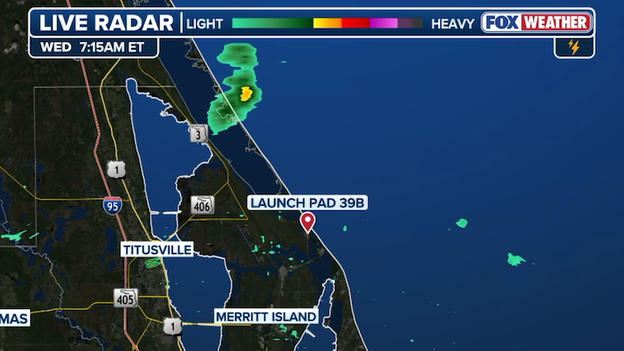
Radar shows isolated showers moving by Kennedy Space Center in Florida this morning.
Meteorologists are currently tracking isolated morning showers near Launch Pad 39B as the John F. Kennedy Space Center prepares to launch Artemis II later today.
These wandering showers remain a key watchpoint for the 45th Weather Squadron to ensure the SLS rocket stays clear of any moisture that could violate strict launch safety rules.
The countdown to the Moon began under a moody Florida sky this morning as clouds shrouded Launch Pad 39B in a murky gray.
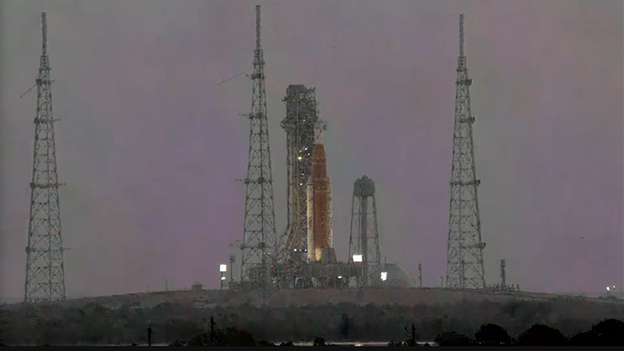
NASA’s Artemis II SLS (Space Launch System) rocket and Orion spacecraft stand vertical at Launch Complex 39B at NASA’s Kennedy Space Center in Florida hours before liftoff.
While the 322-foot Space Launch System (SLS) rocket remains unobscured, the atmospheric scene served as a vivid reminder of the meteorological hurdles teams are watching today.

FOX Weather is providing LIVE, all-day coverage of the historic Artemis II launch.
Stay with FOX Weather for all-day coverage of this historic return to the Moon, featuring real-time analysis of the "Go/No-Go" weather conditions.
Meteorologists Steve Bender and Ian Oliver will lead our live broadcast, providing expert insight into the Florida forecast and the critical cloud rules that could impact the 6:24 p.m. ET launch window.
They will be joined by FOX Weather Correspondent Brandy Campbell and FOX News' Rebekah Castor, Sarah Alegre, and Amy Galo reporting live from the Kennedy Space Center, to bring you the sights and sounds from the pad as the Artemis II crew prepares for liftoff.
Click here to find out how to stream FOX Weather LIVE 24/7 on your favorite device.
The weather outlook for today’s historic Artemis II launch remains a promising 80% "Go," though meteorologists from the 45th Weather Squadron are keeping a close watch on a few potential deal-breakers.
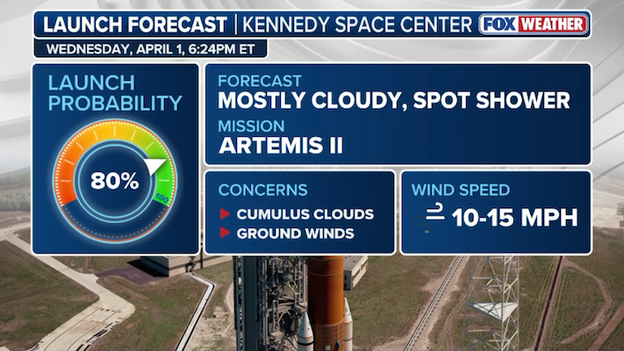
Latest launch weather forecast from the Space Force 45th Weather Squadron.
The primary concerns for the 6:24 p.m. ET liftoff are the Cumulus Cloud Rule and the Thick Cloud Rule, as any significant moisture or cloud layers extending into freezing temperatures could trigger a scrub to protect the SLS rocket from atmospheric electrical discharge.
Additionally, teams are monitoring ground-level winds at Kennedy Space Center to ensure they remain within the safe peak liftoff range of 29 to 39 knots.
While Launch Weather Officer Mark Burger noted a low risk for lightning during a Tuesday weather briefing, the optimistic forecast still hinges on finding clear air between isolated showers wandering near the Space Coast.
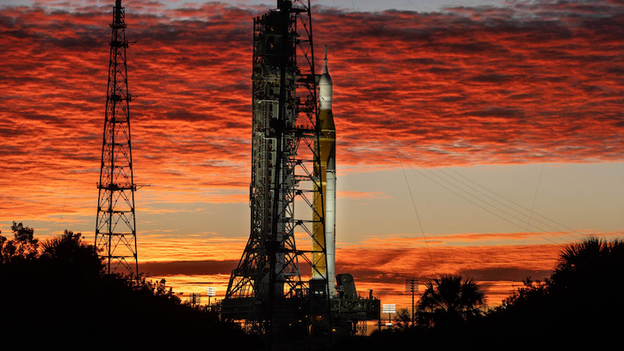
Clouds and the Sun illuminate the sky as NASA’s Artemis II SLS (Space Launch System) rocket and Orion spacecraft stand vertical at Launch Complex 39B at NASA’s Kennedy Space Center in Florida. (NASA/Cory S Huston)
The countdown to the Moon is officially entering its high-stakes final phases. To help you track every critical milestone from fueling to liftoff, here is the tick-tock of the major events scheduled for today.
- 7:34 a.m. ET – The "go/no-go" for tanking: Launch Director Charlie Blackwell-Thompson will poll the team to begin "tanking"—the delicate process of loading the SLS rocket with over 700,000 gallons of super-cooled liquid oxygen and liquid hydrogen.
- 9:45 a.m. ET – Crew wake-up call: Commander Reid Wiseman and his crew of three will receive their final wake-up call on Earth before their 10-day journey begins.
- 12:30 p.m. ET – Final weather briefing: The crew will receive a specialized weather update from the 45th Weather Squadron. While the forecast remains 80% "Go," meteorologists will be looking for any signs of developing afternoon sea breeze showers.
- 1:50 p.m. ET – Crew rollout: Just before 2 p.m., the four astronauts will exit the Neil Armstrong Operations and Checkout Building, wave to family and media, and board the "Artemis Generation" transport vehicles for the drive to Launch Pad 39B.
- 6:07 p.m. ET – Final countdown: Launch Director will conduct the final "go/no-go" for launch and the Ground Launch Sequencer enters terminal count.
- 6:24 p.m. ET – Liftoff: The two-hour launch window officially opens.
The Ground Launch Sequencer (GLS) has officially taken command of the countdown, marking a critical transition from manual oversight to automated precision.
As the brain of the launch pad, the GLS is now responsible for orchestrating thousands of simultaneous operations, including the final chilling of fuel lines and the pressurized loading of liquid oxygen and hydrogen.
If at any point during these final hours the sensors detect a technical glitch or a sudden shift in Florida's weather that violates safety constraints, the GLS can trigger an automatic hold or scrub in milliseconds—faster than any human could react—to protect the crew and the SLS rocket.
ICYMI: We spent yesterday tracking the 80% 'Go' forecast and the first stages of the SLS power-up.
See the full weather breakdown and Day 1 countdown highlights in our archived live blog.
You’ve reached the beginning of this live coverage.