

Researchers turn to using drones to revolutionize tracking of humpback whales in Hawaii
The drone-integrated tagging technology allows scientists to collect detailed data on humpback whale health and behavior while reducing the need for researchers to approach the animals by boat.
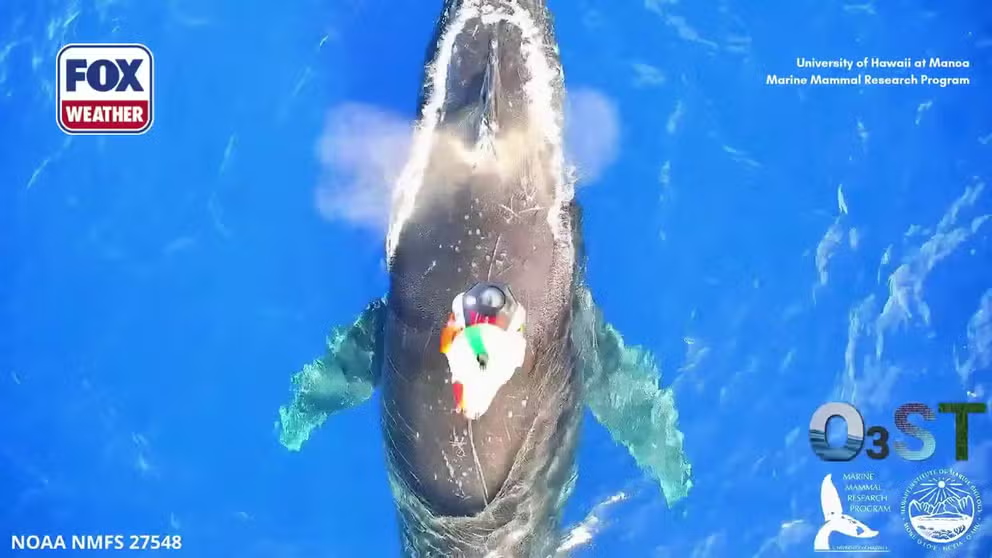
Drone plunges suction-cup tag onto humpback whale off Hawaii
Researchers with the University of Hawaiʻi at Mānoa’s Marine Mammal Research Program are taking whale research to new heights. Dramatic video shows a drone deploying a noninvasive suction-cup tag directly onto a humpback whale off Hawaii. The drone-integrated tagging technology allows scientists to collect detailed data on humpback whale health and behavior while reducing the need for researchers to approach the animals by boat.
HAWAII – Using drones, researchers at the University of Hawaiʻi at Mānoa have developed a safer, more efficient way to tag humpback whales from the air, ushering in a new era for the marine mammal tracking program.
Previously, researchers with the University's Marine Mammal Research Program approached the animals closely on boats, deploying tags using a seven-meter carbon fiber pole.
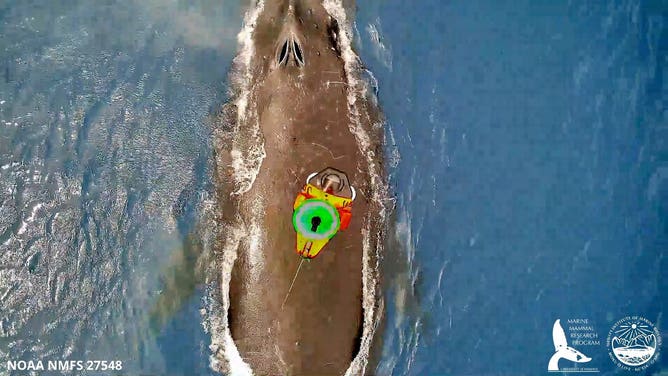
A humpback whale in the Pacific Ocean is targeted for tagging by the University of Hawaii Manoa Marine Mammal Research Program. The high-resolution data collected—including fine-scale movements and energy expenditures—is critical for wildlife management.
(University of Hawaii Manoa Marine Mammal Research Program)
Now, the program is taking to the skies, using drones to reach new heights in its efforts to track, study and protect marine mammals vital to ocean ecosystems.
The high-flying drone tagging technology allows scientists to collect detailed data on humpback whale health and behavior.
MEET THREEHALVES: THE HAUNTING VIRAL ROBOT DESIGNED FOR EARTH'S MOST DANGEROUS ENVIRONMENTS
Since 2019, the program has been tagging marine life vital and present in and around Hawaii and abroad, including humpback whales, gray whales, pilot whales, false killer whales and monk seals.
It wasn't until February of this year, that tagging took on a whole new method: using drones to benefit both data collection and the animals themselves.
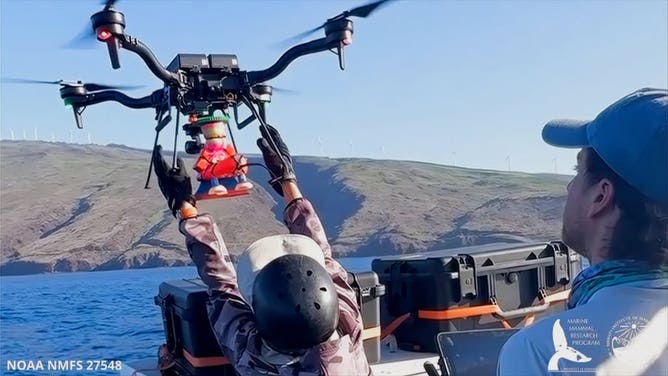
The device’s design ensure the tag lands upright on the whales from a far distance.
(University of Hawaii Manoa Marine Mammal Research Program)
Researchers first track the whales from a boat before launching the drone overhead, where it hovers and waits for the perfect moment — when a whale surfaces and exposes its back. The drone then swoops in, deploying the tag from above, where it gently attaches to the whale with suction cups before it plunges back into the Pacific Ocean.
AFTER GREAT WHITE SHARK ATTACK, AUSTRALIA'S MOST POPULATED STATE DOUBLES DOWN ON DRONE SHARK PATROLS
According to researchers with the Marine Mammal Research Program, the aerial method is safer for both whales and humans. The remote system allows researchers to deploy tags from hundreds of meters away, reducing the need for close vessel approaches and minimizing disturbance while still achieving precise tag placement.

Lars Bejder demonstrates how the device tags whales.
(University of Hawaii Manoa Marine Mammal Research Program)
Marine Mammal Research Program leader Dr. Lars Bejder wrote on a blog, "This opens up many new opportunities for low-impact research on whales and dolphins to inform on their conservation and management."
According to the program, the tagging data provide a critical link between individual behavior and energy use in marine mammals and the potential consequences for the broader population.