

Mysterious 'space waves' could help scientists predict dangerous solar storm impacts on Earth
Researchers say the findings could improve space weather models by showing where solar-wind energy is most likely to enter and disturb Earth’s magnetic environment.
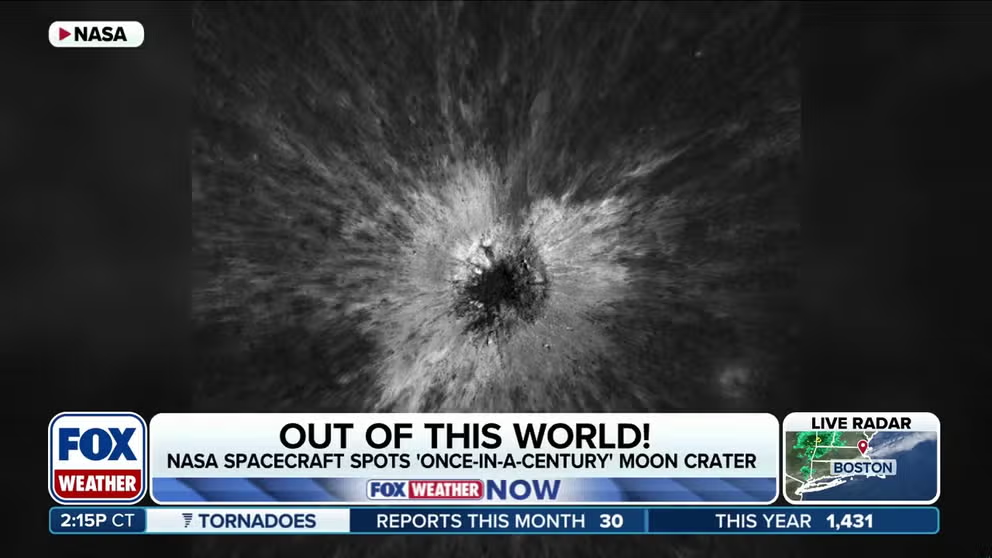
File Video: NASA spacecraft discovers 'once-in-a-lifetime' moon crater
File Video: Bethany Ehlmann, president of The Planetary Society, joins FOX Weather to discuss how a NASA spacecraft spotted a "once-in-a-lifetime" moon crater during a routine data quality check.
THE TAKEAWAY
- Scientists found "space tsunamis" forming along the edge of Earth’s magnetic shield.
- The waves shift location depending on the direction of the solar wind.
- The discovery could help scientists better understand and predict space weather threats to satellites, communications and power grids.
Scientists say "space waves" rolling along the edge of Earth’s magnetic shield could help researchers better understand where solar storms transfer energy into near-Earth space.
The waves, known as Kelvin–Helmholtz waves, form where the fast-moving solar wind brushes past the outer boundary of Earth’s magnetosphere.
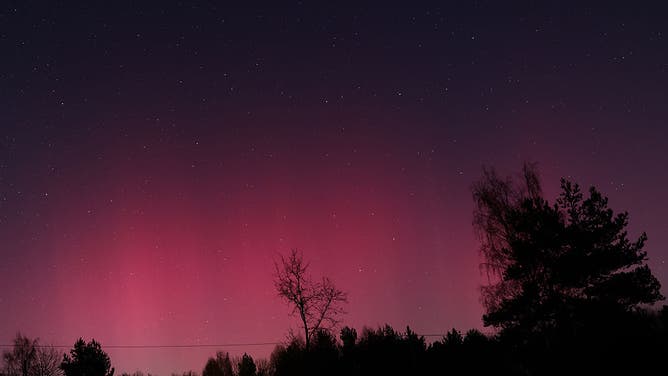
Northern lights are seen in Rudno, Poland on January 20, 2026.
(Jakub Porzycki/NurPhoto via Getty Images / Getty Images)
A new study led by researchers at the University of Oulu in Finland found that the waves do not form evenly around Earth. Instead, their strength and location depend on how the solar wind’s magnetic field drapes around Earth’s own magnetic field.
ARCHAEOLOGISTS IN TURKEY MAY HAVE FOUND THE WORLD’S OLDEST SHIPWRECK
Similar wave patterns can be seen in clouds and other cosmic environments, including the Sun’s atmosphere and around other planets.
Scientists said the process can be compared to water flowing around a breakwater, where waves may form more strongly on one side because the flow and pressure are not symmetrical.
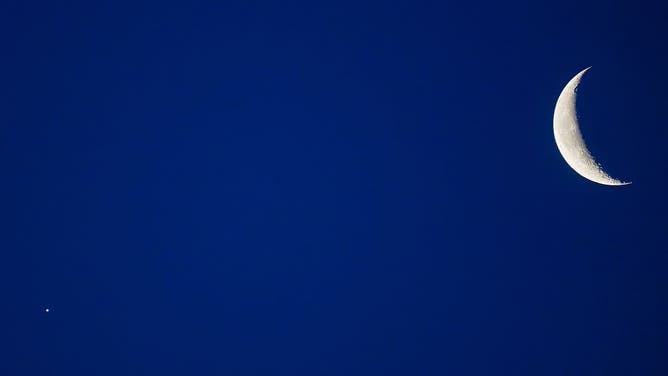
In the eastern morning sky, the Moon currently appears as a narrow, waning crescent about 367,000 kilometers from Earth, while the giant planet Jupiter (visible as a small dot at the bottom left of the image) shines in the background a staggering 885 million kilometers away.
(Patrick Pleul/picture alliance via Getty Images / Getty Images)
"This finding grew out of a long process of thinking through what I was seeing," said Academy Research Fellow Lauri Holappa of the University of Oulu. Holappa said he first noticed unusual wave patterns in magnetosphere simulations while visiting NASA as a postdoctoral researcher in 2020.
"I later realized that they showed Kelvin–Helmholtz waves at the edge of the magnetosphere, and that the different behavior of the waves on different sides was part of the same phenomenon," Holappa said.
7 THINGS TO KNOW ABOUT THE NORTHERN LIGHTS
Although the waves cannot predict exactly where a solar storm will strike next, their location may reveal where solar-wind energy is most likely to enter Earth’s magnetic environment and produce space weather effects that trigger dazzling Aurora Borealis displays.
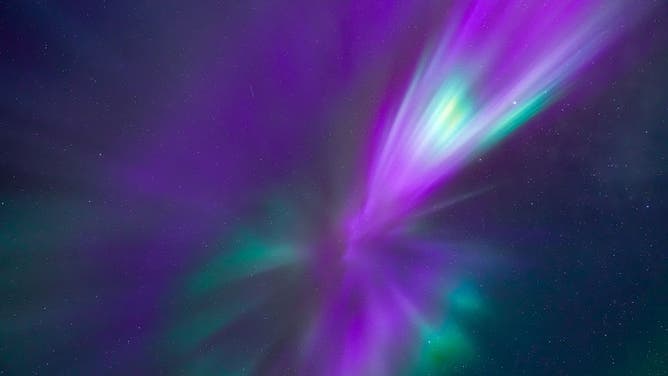
Northern Lights (Aurora Borealis) illuminate the night sky with vivid purple and green hues above a distant cityscape following a strong solar storm coinciding with the spring equinox in Fairbanks, Alaska, United States, on March 20, 2026.
(Hasan Akbas/Anadolu via Getty Images / Getty Images)
The waves can transport solar-wind plasma and energy into the magnetosphere, which could disturb and impact satellites, navigation systems, radio communications and power grids.
According to the study, scientists found that the strongest wave activity forms in the winter hemisphere, the side of Earth tilted away from the Sun, and shifts between the "dawnside" and "duskside" depending on the direction of the solar wind’s magnetic field.
THE BEST CELESTIAL EVENTS IN 2026 YOU WON'T WANT TO MISS
In the U.S., Alaska and northern states are generally more exposed to geomagnetic effects.
Researchers say the findings could improve space weather models by showing where solar-wind energy is most likely to enter and disturb Earth’s magnetic environment.