

Not all bad: Cyborg cockroaches could one day help save lives
With the ability to breathe and operate underwater, these typically creepy critters have been transformed into amphibious cyborgs, opening the door to missions once thought impossible.

FILE: Giant bug found at an Arkansas Walmart identified as a Jurassic-era insect
The giant lacewing was commonly found in eastern North America but mysteriously disappeared in the 1950s. Scientists previously thought that the increase in light pollution and a decrease in raging forest fires in eastern North America potentially played a role in its disappearance.
If you had "cockroach in a scuba suit" on your 2026 bingo card, congratulations, you win.
A recent study published in Nature Communications equipped a Madagascar hissing cockroach with a miniature wearable "diving suit" that supplies oxygen and prevents water from entering the insect's respiratory system, allowing the infamous insect to remotely move on both land and underwater for up to three hours.
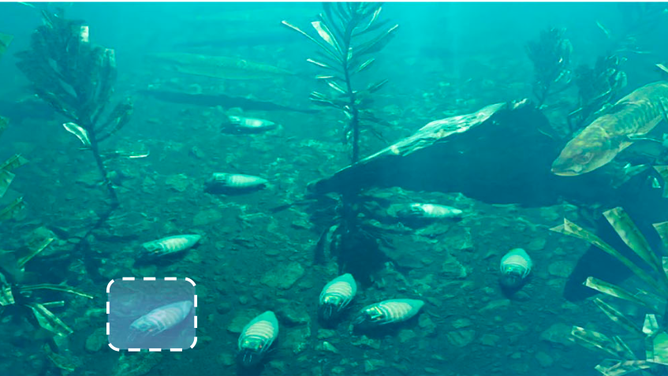
Conceptual illustration of the cyborg insect operating underwater.
(Fan et al., Nature Communications (2026) / FOX Weather)
With the ability to breathe and operate underwater, these typically creepy critters have been transformed into amphibious cyborgs, opening the door to missions once thought impossible.
Researchers steer the cyborg cockroaches remotely using a tiny wireless backpack that delivers electrical pulses, prompting the insects to walk and change direction, with an ultimate goal of sending these tiny cyborgs where people and larger robots can't go.
CAN CONCERTS AND SPORTING EVENTS CAUSE EARTHQUAKES?
The researchers said the cyborg insects can be used for search and rescue missions, infrastructure inspections and exploration of flooded or otherwise hazardous environments that are difficult for people or conventional robots to access.
Don't think this is possible? Well, they've already scurried into disaster areas before. In 2025, a team of 10 cyborg cockroaches was sent with the Singapore Civil Defense Force's Operation Lionheart following the magnitude 7.7 Myanmar earthquake.
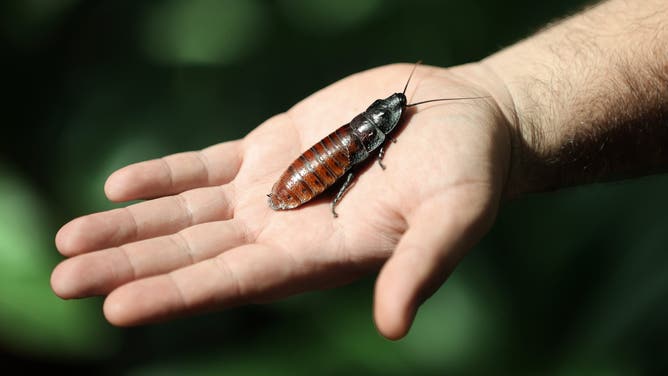
Madagascar hissing cockroaches are surprisingly well suited for cyborg research thanks to their strength, durability and ability to carry relatively heavy payloads while navigating tight, rugged terrain.
(Serhat Cetinkaya/Anadolu via Getty Images / Getty Images)
Researchers engineered a wearable life-support system that gives one of nature's most notorious pests an unexpected new purpose—transforming an unwelcome house guest into a potential search and rescue tool.
Madagascar hissing cockroaches were the ideal recruits for researchers at Singapore's Nanyang Technological University and Japan's Waseda University, which conducted the ground-breaking research project.
COCAINE POLLUTION HAS SHARKS AND SALMON OFF THE RAILS — AND IT'S NOT THEIR FAULT
The Madagascar hissing cockroach proved to be the ideal candidate for the study because they're strong enough to carry the device, agile enough to navigate tight spaces and naturally resilient in harsh environments.
Researchers didn't go easy on these rookie roaches in boot camp, either.
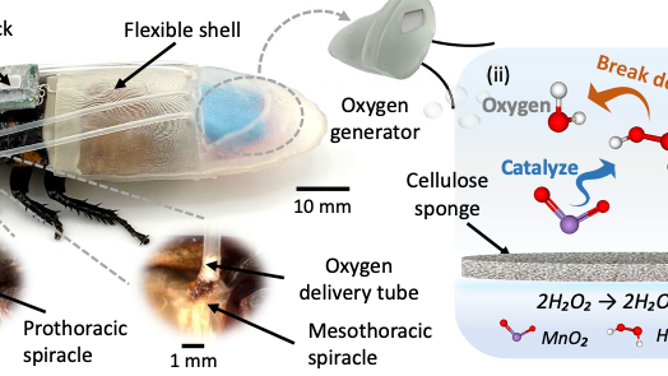
Suited for the mission. The custom-built diving suit transforms a Madagascar hissing cockroach into an amphibious cyborg capable of being remotely guided underwater for up to three hours.
(Fan et al., Nature Communications (2026))
Before they're ever deployed, these cyborg cockroaches have to pass their own version of boot camp, tackling flooded tunnels, hazardous gas, underwater obstacles and endurance tests to prove they're mission ready.
While the diving suits are still in an experimental phase, in the study, researchers found that the diving suit is a proof of concept that shows terrestrial cyborg insects can be adapted for amphibious operation.
So for now, cockroaches may still be public enemy number one in many homes across the U.S., But one day, they could be the unlikely heroes that crawl through collapsed buildings, inspect the tunnels we rely on every day and reach places no human ever could.