

Could humans reach Mars faster? NASA gets boost from new thruster technology
By using electromagnetic thrusters powered by lithium vapor, scientists exceeded the highest power levels ever tested in the U.S.

FILE: NASA seeking volunteers for year-long simulated space journey
Ever wonder what it's like to live in space? NASA scientist Alexandra Whitmire joined FOX Weather to explain NASA's year-long simulated Mars mission and what researchers are learning about preparing humans for deep-space exploration.
THE TAKEAWAY
- NASA officials are more confident that they can send humans to Mars.
- The goal is to get humans to the red planet faster and more efficiently.
- Scientists have exceeded the highest power levels ever tested in the U.S.
Recent technological leaps at NASA’s Jet Propulsion Laboratory in electric thrusters have boosted experts' confidence in sending crew members to Mars more efficiently.
By using electromagnetic thrusters powered by lithium vapor, scientists exceeded the highest power levels ever tested in the U.S., according to NASA.
SEE IT: NASA SATELLITE REVEALS HUMMINGBIRD-SHAPED SECRET BENEATH ANTARCTICA'S ICE
This sort of technology has been researched since the 1960s, but has never been flown operationally.
During five ignition tests, the thruster's tungsten electrode glowed bright white and reached over 5,000 degrees.
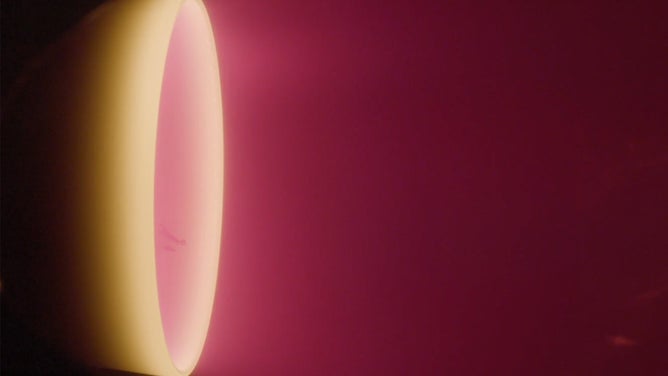
Completed testing of lithium-fed electromagnetic thruster.
(@NASA_Marshall / X)
Despite the raw power of this electromagnetic thruster, the propulsion uses up to 90% less propellant than traditional high-thrust chemical rockets.
Data collected during the tests show that power levels reached up to 120 kilowatts, over 25 times the power of the thrusters used on NASA's Psyche Mission, which is on target to explore an asteroid by August 2029.

Photo of a lithium-fed electromagnetic thruster.
(@NASA_Marshall / X)
The Psyche spacecraft can accelerate to speeds of up to 124,000 mph, according to NASA, underscoring the power and effectiveness of this new electromagnetic thruster.
Because this technology reaches such high temperatures, the next phases of testing will determine whether the hardware can operate in these heated environments over extended periods.
RARE MARS METEORITE SHEDS LIGHT ON BILLION-YEAR MYSTERY IN SOLAR SYSTEM'S PAST
The goal is to reach power levels between 500 kilowatts and one megawatt per thruster.
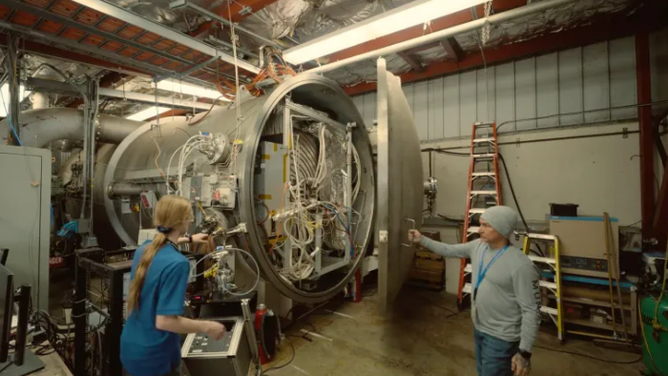
The prototype thruster at NASA's Jet Propulsion Laboratory.
(NASA/JPL-Caltech)
Experts at NASA's Jet Propulsion Laboratory say that a human mission to Mars would require 2 to 4 megawatts of power for more than 23,000 hours.
HOW MANY ROCKETS WILL SPACEX LAUNCH THIS MONTH?
Successful testing could change the way we approach the red planet, enabling much faster, more efficient human and uncrewed missions alike.