

Major magnitude 7.0 earthquake strikes remote region of China, shaking reported
A powerful magnitude 7.0 earthquake struck China’s Tibetan Plateau early Thursday

File Video: Earthquake in Italy sends items flying off shelves in Cafe
A magnitude 4.5 earthquake hit Italy on Friday, causing a tv to fall off a wall and items to fall off shelves at a cafe in Pozzuoli, near where the earthquake happened.
THE TAKEAWAY
- A magnitude 7.0 earthquake struck China’s Tibetan Plateau at 10:33 p.m. local time.
- Approximately 132,000 people were exposed to moderate to severe shaking after the quake
- The quake occurred about 119 miles east-northeast of Nagqu, China.
NAGQU, China – A powerful magnitude 7.0 earthquake struck China’s Tibetan Plateau early Thursday, according to the U.S. Geological Survey.
According to the U.S. Geological Survey (USGS), the earthquake occurred Thursday at 9:33 a.m. ET at a depth of 11.2 miles, roughly 119 miles east-northeast of Nagqu, China, north of the Himalayan Mountain Range.
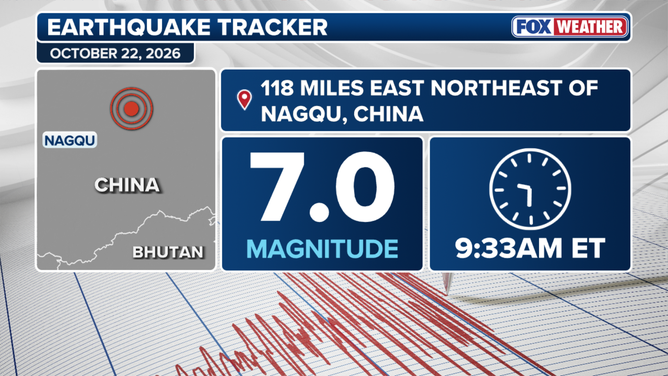
A magnitude 7.0 earthquake struck China’s Tibetan Plateau, roughly 119 miles east-northeast of Nagqu, on Thursday.
(FOX Weather)
The major earthquake produced moderate to severe shaking across an area home to approximately 132,000 people.
The earthquake struck a relatively remote region, limiting exposure to hazards such as landslides and liquefaction, a process in which water-saturated soil loses strength and behaves like a liquid during intense shaking.
WHAT TO DO DURING AND AFTER AN EARTHQUAKE
The quake occurred at 10:33 p.m. local time as a result of normal faulting within the Tibetan Plateau, a seismically active region shaped by the complex crustal motion caused by the convergence of the Indian and Eurasian plates, the USGS said.
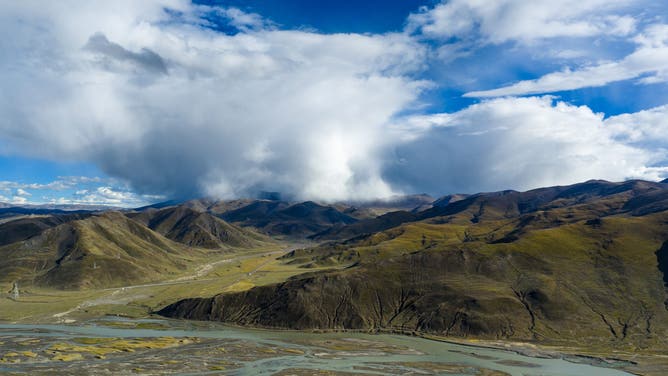
The Yarlung Zangbo River is in Saga County, Tibet, China, on September 27, 2025.
(Costfoto/NurPhoto via Getty Images / Getty Images)
According to the USGS, the Indian Plate began colliding with the Eurasian Plate about 50 million years ago, creating the Himalayas and lifting the Tibetan Plateau.
That collision continues today, with the Indian Plate pushing beneath Eurasia and driving complex crustal movement across the region.
WHAT DOES EACH MAGNITUDE OF EARTHQUAKE REALLY MEAN?
As the plateau spreads east and west under its own weight, the crust stretches and breaks along normal faults, triggering earthquakes such as the magnitude 7.0 quake.
Since 1900, 29 earthquakes of magnitude 7.0 or greater have struck the Tibetan Plateau and its surrounding regions. The largest was the magnitude 8.6 Assam-Tibet earthquake on Aug. 15, 1950, which killed more than 4,000 people.
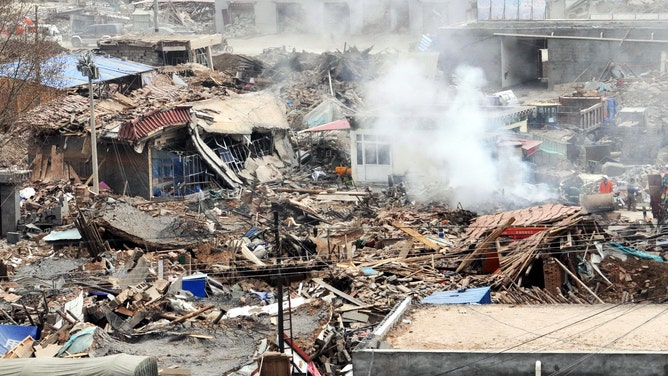
Rescuers search for survivors in the rubble of a quake-demolished building in Yushu county, in northwest Chian's Qinghai province on April 16, 2010.
(CN-STR / AFP via Getty Images / Getty Images)
A magnitude 6.9 earthquake on April 13, 2010, occurred about 169 miles east-northeast of Thursday's earthquake, and killed more than 2,500 people.
CAN CONCERTS AND SPORTING EVENTS CAUSE EARTHQUAKES?
Because of its remote nature, the region is sparsely populated, meaning the impacts of major earthquakes can vary significantly depending on how close the rupture is to population centers.