

First-known blacktip shark nursery discovered in Hawaiian waters
To help monitor the animals' movements, the sharks were tagged with acoustic transmitters, and were tracked from July 2022 to January 2024.
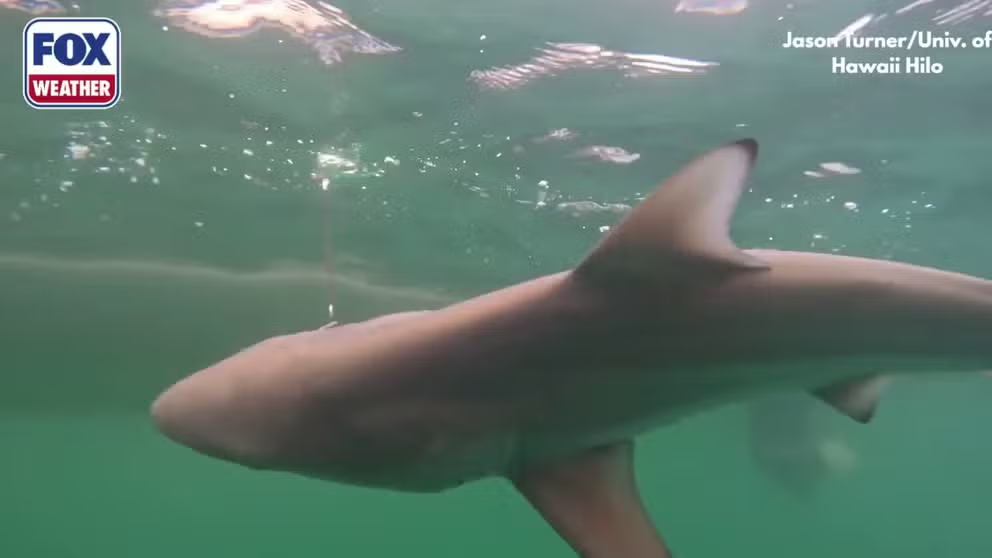
Watch: Researchers with University of Hawaii tag baby blacktip sharks
Researchers found the first-known blacktip shark nursery to be discovered in Hawaii as part of a thesis project at the University of Hawaii Hilo.
The first known nursery for blacktip sharks was discovered in Hilo Bay, Hawaii, by a University of Hawaii graduate student and her thesis advisor.
A study published in the Frontiers In Marine Science journal by graduate student Lauren Moe, her thesis advisor and associate professor Jason Turner and others displayed the findings, offering new insight into how young blacktip sharks spend their earliest years in Hawaii.
SEE IT: STINGRAYS MAKE SURPRISE APPEARANCE IN POLLUTED NEW YORK CITY WATERWAY
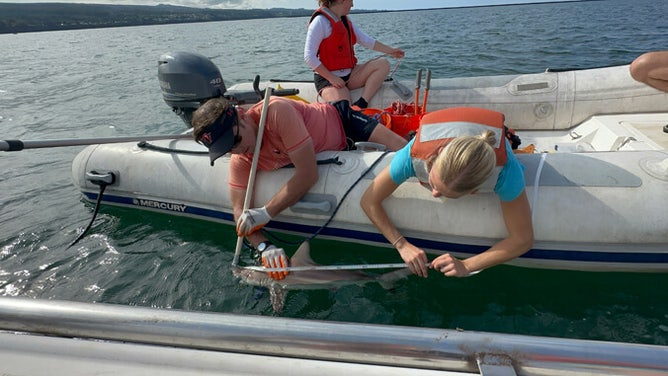
Team from UH Hilo measures a blacktip shark. (All animal interaction is under state and/or federal permits)
(Jason Turner / FOX Weather)
To help monitor the animals' movements, the sharks were tagged with acoustic transmitters, and were tracked from July 2022 to January 2024.
The findings revealed young blacktip sharks were living in Hilo Bay all year, with the most activity from March through August.
HAWAII COULD BE IN PATH OF TROPICAL THREAT AS EL NIÑO BOOSTS EASTERN PACIFIC ACTIVITY
The study focused on oceanic blacktip sharks, which are not considered aggressive toward humans, and bites are rare, the University of Hawaii Hilo said in a news release.
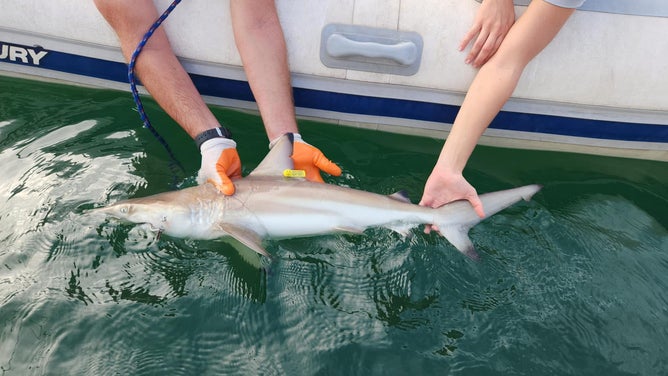
Jason Turner and student hold a baby blacktip shark. (all animal interaction is under state and/or federal permits)
(Jason Turner / FOX Weather)
"Nursery habitats provide food and shelter while these young sharks are growing," said Jason Turner, an associate professor of marine science at UH Hilo and co-author of the study. "When we think about humans impacting sharks we typically think about overfishing, by catch or even taking sharks for their fins. What we often forget is that impacting their habitat can also be devastating, whether that means increased development, maritime traffic, pollution, or the effects of climate change on an area like Hilo Bay."
![A juvenile blacktip shark. (All animal interaction is under state and/or federal permits)]() Image 1 of 2
Image 1 of 2A juvenile blacktip shark. (All animal interaction is under state and/or federal permits) (Jason Turner)
![Jason Turner and grad student Lauren Moe measure a baby blacktip shark in Hawaii. Photo courtesy of Jason Turner, all animal interaction is under state and/or federal permits)]() Image 2 of 2
Image 2 of 2Jason Turner and grad student Lauren Moe measure a baby blacktip shark in Hawaii. Photo courtesy of Jason Turner, all animal interaction is under state and/or federal permits) (Jason Turner)
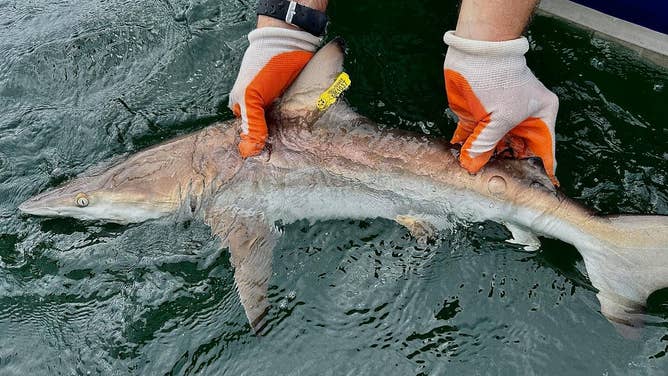
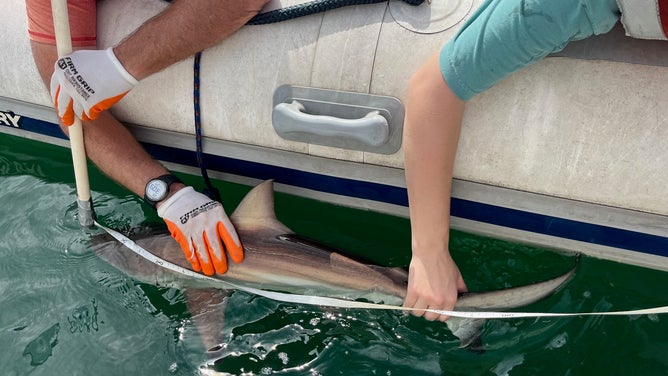
According to the study, the sharks' movement patterns support the notion of Hilo Bay as the first known blacktip shark nursery habitat in Hawaiian waters.
"Our results suggest that this population of blacktip sharks reside predominantly within Hilo Bay for the first few years of their life, and highlight the effect that environmental changes can have on this species’ habitat availability and movement patterns," the study said.
The project combined Western science with native Hawaiian knowledge.
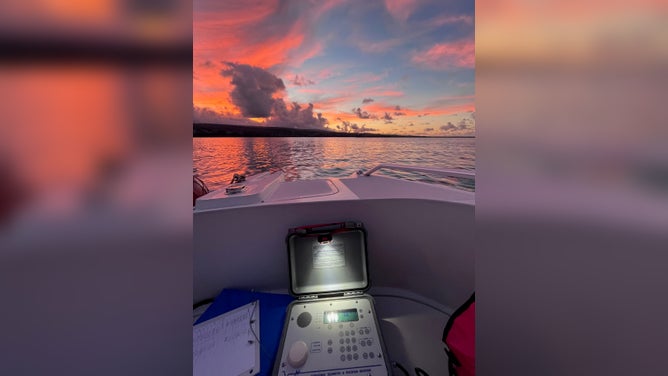
Shark tracking at sunset. (All animal interaction is under state and/or federal permits)
(Jason Turner / FOX Weather)
"In the Hawaiian worldview, setting intention, acknowledging the entities of space and time, asking permission, offering hoʻokupu (ceremonial gifts), and expressing gratitude are rituals required of kānaka (Native Hawaiians) as part of a reciprocal exchange with the elements," Turner said.
Researchers are now expanding their work to examine 15 years of shark and ray population trends in Hilo Bay, University of Hawaii Hilo said.