

Deadly parasite kills hundreds of salmon through well-known river expanding through Pacific Northwest
Numerous Chinook salmon have turned up dead in large groups along the sides of the Scott and Trinity rivers, tributaries of the Klamath River.
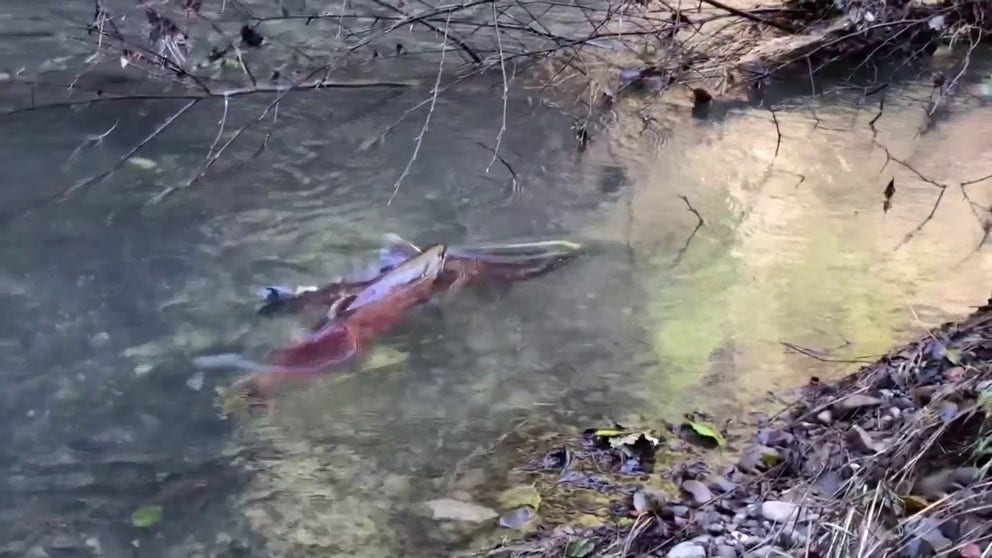
FILE: Coho salmon fighting in Northern California
National Park Service Fishery Biologist Michael Reichmuth found a few male coho salmon fighting in the Olema Creek in the Point Reyes National Seashore, north of San Francisco.
Officials are on alert in California and Oregon following recent reports of deadly parasites in popular rivers that are killing salmon.
According to the U.S. Fish and Wildlife Service, there has been an increase in the presence of the Ceratonova shasta parasite in the well-known Klamath River, which flows into Southern Oregon and Northern California.
HERE'S EVERYTHING YOU NEED TO KNOW ABOUT FLESH-EATING PARASITE IN THE US AS CASES TRIPLE IN SIZE
As a result, numerous Chinook salmon have turned up dead in large groups along the sides of the Scott and Trinity rivers, tributaries of the Klamath River.
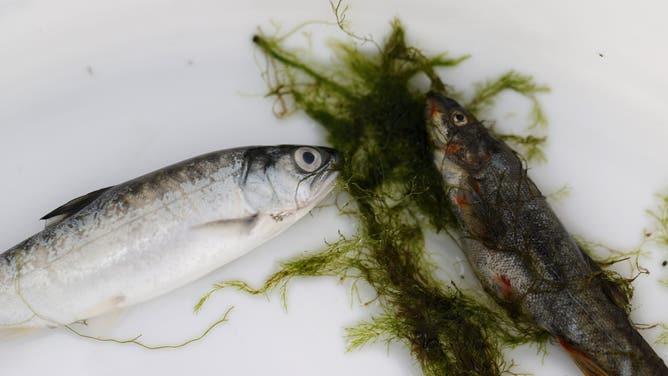
WEITCHPEC, CALIFORNIA - JUNE 09: Two dead juvenile salmon sit in a bucket after being removed from a Yurok Fisheries Department rotary screw trap on the Klamath River on June 09, 2021 in Weitchpec, California. The Yurok Tribal Fisheries Department has been monitoring a drought-caused fishkill of juvenile salmon brought on by an outbreak of Ceratonova shasta (C. Shasta) along the Klamath River. Due to the extreme drought, water flows on the Klamath River have dropped considerably since the beginning of the year causing the river to flow slower and the water temperature to rise, an environment that C. Shasta thrives in. Yurok Tribal officials expect C. Shasta to kill off nearly all of the juvenile Chinook salmon in the Klamath River which will not only negatively impact fish production, but also the Yurok Tribe, California’s largest federally recognized tribe, whose culture, ceremonies and traditions are linked to the annual fish runs.
(Justin Sullivan / Getty Images)
The Klamath River is one of three rivers that bisect the Cascade Mountain Range, beginning in Oregon's high desert interior before cutting through the Klamath Mountains and entering the Pacific Ocean in Northern California, according to the National Wild and Scenic Rivers System.
SEE IT: SPERM WHALE CAUGHT ON CAMERA IN RARE ENCOUNTER OFF SOUTHERN CALIFORNIA COAST
During the 2026 outmigration season, officials collected numerous salmon from March 17 through May 12 to measure the parasite load in the fish.
As a result, officials discovered that 46% (319) of the 696 fish collected tested positive for the deadly parasite.
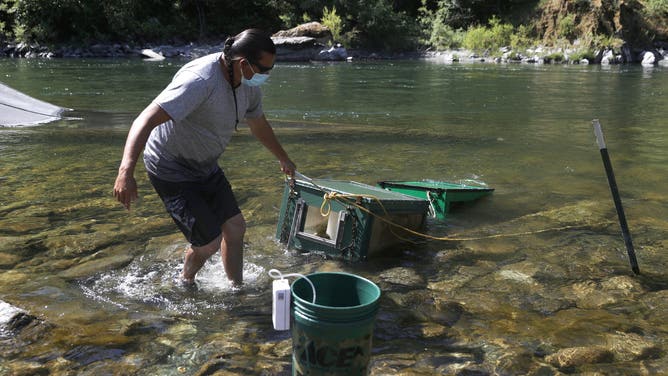
WEITCHPEC, CALIFORNIA - JUNE 09: Gilbert Myers, a fisheries technician with the Yurok Fisheries Department, pulls fish traps out of the Klamath River on June 09, 2021 in Weitchpec, California. The Yurok Tribal Fisheries Department has been monitoring a drought-caused fishkill of juvenile salmon brought on by an outbreak of Ceratonova shasta (C. Shasta) along the Klamath River. Due to the extreme drought, water flows on the Klamath River have dropped considerably since the beginning of the year causing the river to flow slower and the water temperature to rise, an environment that C. Shasta thrives in. Yurok Tribal officials expect C. Shasta to kill off nearly all of the juvenile Chinook salmon in the Klamath River which will not only negatively impact fish production, but also the Yurok Tribe, California’s largest federally recognized tribe, whose culture, ceremonies and traditions are linked to the annual fish runs.
(Justin Sullivan / Getty Images)
This is a large jump from 2025, when only 22% (39) of salmon exhibited these conditions.
The parasite can affect several freshwater species and typically makes fish appear darker, with swollen abdomens.
RARE COZUMEL DWARF FOX FEARED EXTINCT IS PHOTOGRAPHED FOR FIRST TIME IN DECADES
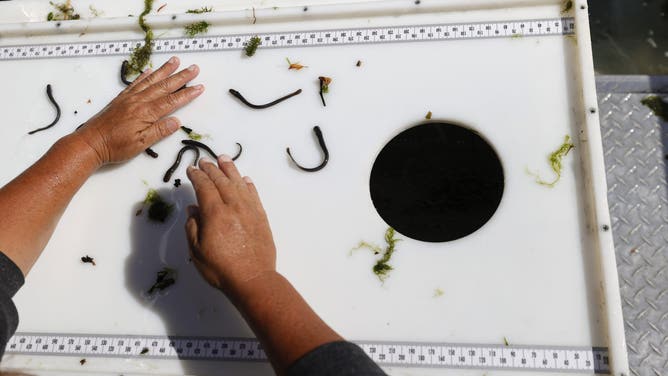
WEITCHPEC, CALIFORNIA - JUNE 09: Jamie Holt, lead fisheries technician with the Yurok Fisheries Department, tries to contain river lamprey as she sorts through fish caught in a rotary screw trap on the Klamath River on June 09, 2021 in Weitchpec, California. The Yurok Tribal Fisheries Department has been monitoring a drought-caused fishkill of juvenile salmon brought on by an outbreak of Ceratonova shasta (C. Shasta) along the Klamath River. Due to the extreme drought, water flows on the Klamath River have dropped considerably since the beginning of the year causing the river to flow slower and the water temperature to rise, an environment that C. Shasta thrives in. Yurok Tribal officials expect C. Shasta to kill off nearly all of the juvenile Chinook salmon in the Klamath River which will not only negatively impact fish production, but also the Yurok Tribe, California’s largest federally recognized tribe, whose culture, ceremonies and traditions are linked to the annual fish runs.
(Justin Sullivan / Getty Images)
This parasite is transmitted to fish through the gills by infectious actinosporean tetractinomyxon stages in the water, shed by parasitized freshwater polychaete worms, according to the Alaska Department of Fish and Game.
OFFICIALS ISSUE WARNING TO BEACHGOERS ABOUT INVASIVE PUFFERFISH WITH INSANELY STRONG TEETH
Despite the scary news, there are no human health concerns associated with the Ceratonova shasta parasite.