

40-million-year-old fossilized animal bones discovered at California construction site
The discovery consisted of several different bones from a large, hoofed mammal including a femur, ribs and numerous other bones and fragments, the City of Oceanside said.
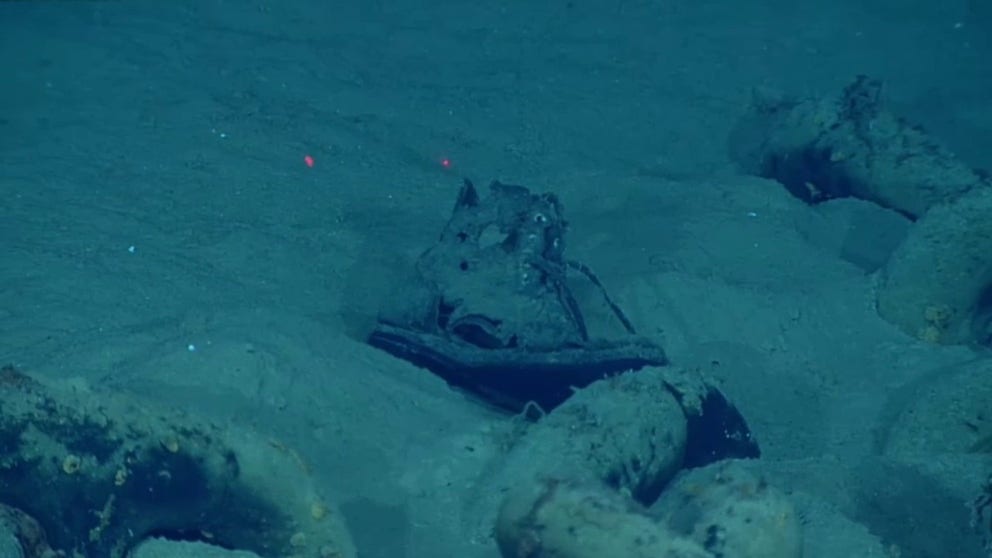
FILE: An unlikely discovery was made by researchers while exploring the wreckage of the USS Nevada.
Researchers with the NOAA discovered a boot amid other debris from the USS Nevada Battleship off the coast of Pearl Harbor, Hawaii.
THE TAKEAWAY
- Workers discovered a series of fossils from an animal that lived between 40 and 45 million years ago.
- The discovery happened about 12 feet below the surface during routine excavation in September.
- Once fully excavated from the rock, paleontologists should be able to determine the type of species the fossils are.
OCEANSIDE, Calif.– While working on a city construction site in Oceanside, California, workers discovered a series of fossils from an animal that lived between 40 and 45 million years ago.
The discovery happened about 12 feet below the surface during routine excavation in September and consisted of several different bones from a large, hoofed mammal including a femur, ribs and numerous other bones and fragments, the City of Oceanside said.
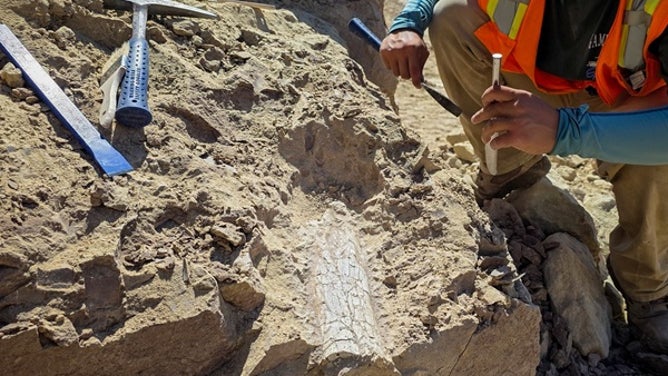
Workers at the site as they uncovered the fossilized bone.
(City of Oceanside, California / FOX Weather)
They were discovered in Member C of the Santiago Formation, a thick sequence of sedimentary rocks exposed across parts of northwestern San Diego County, the city said.
The City of Oceanside said the formation dates to the Eocene Epoch, which began 56 million years ago and ended 33.9 million years ago, and has revealed fossils from that time period within the city before, as well as elsewhere in the region.
Joseph El Adli, Ph.D. and principal paleontologist, made the discovery on site during routine monitoring and secured the area immediately, the city said.
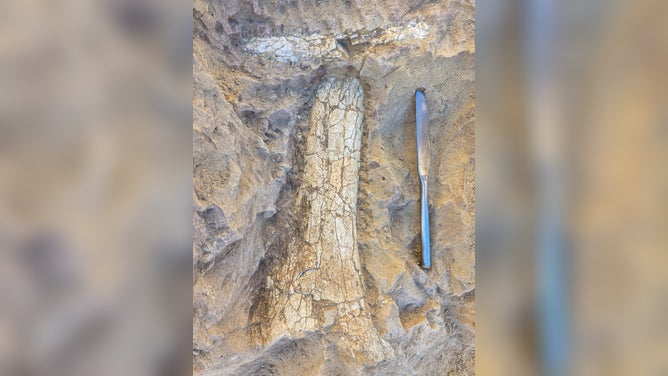
A fossil next to a knife for scale.
(City of Oceanside, California / FOX Weather)
For a week, he and his team excavated to expose the fossil bones from beneath several tons of hardened mudstone and sandstone.
They then encased the fossils in a hardened plaster field jacket to transport them off-site to a lab for preparation.
7-YEAR MYSTERY ENDS AS LONG-LOST FISHING VESSEL IS DISCOVERED ON OCEAN FLOOR NEAR BLOCK ISLAND
"Based on the known age of the surrounding rock and the types of organisms found within the unit, paleontologists estimate that the fossils are between 40 and 45 million years old, falling within the Uintan North American Land Mammal Age," the City of Oceanside said in a news release.
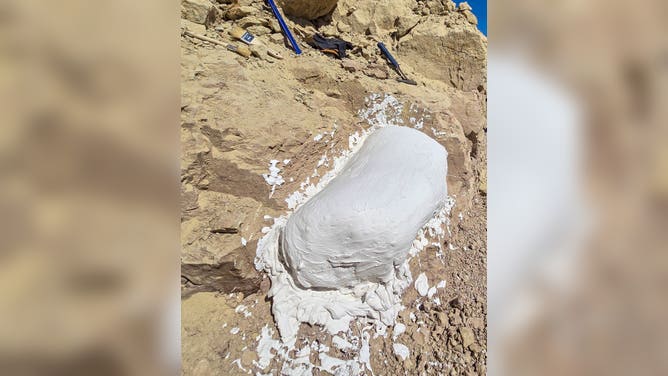
The plaster jacket over one of the fossils.
(City of Oceanside, California / FOX Weather)
El Adli believes they most likely belonged to an animal from one of two extinct mammal families that once roamed North America, both of which belong within the order Perissodactyla otherwise known as odd-toed-hoofed mammals.
The first possibility is an animal often called titanotheres or "thunder beasts," massive hoofed mammals that had deep chests and a distinct hump on the shoulder. This species was roughly the size of a black rhino and had small horns.
HURRICANE SWELLS REVEAL FORGOTTEN HISTORY BENEATH ICONIC CALIFORNIA BEACH
The other possible animal is an amynodon, historically referred to as a "swamp rhino," a member of an extinct family of large-bodied herbivores distantly related to rhinos, the City of Oceanside said.
Amynodon had no horns and squat, hippopotamus-like bodies.
Next, the plaster jackets will be carefully removed from the fossils, and they will be hardened and stabilized using museum-grade glues and resins to ensure long-term preservation.
Once fully excavated from the rock, paleontologists should be able to determine the type of species the fossils are.
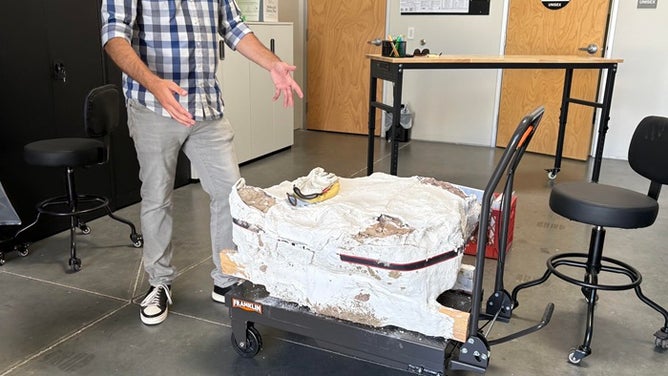
One of the bones after being moved to an off-site lab.
(City of Oceanside, California / FOX Weather)
"The specimens are expected to ultimately join a museum collection, where they will be preserved and made accessible to the public and to other scientists for further study," Oceanside said.
The site of the discovery is being kept confidential to protect both public safety and the integrity of the site, the city said.