

Live updates: Artemis II astronauts break all-time distance record during historic Moon flyby
Live updates: Artemis II astronauts break all-time distance record during historic Moon flyby
Download the AppLooking ahead: Artemis II begins the journey home as spring storms hit the U.S.
View postCoverage for this event has ended.
Our live coverage of the historic Artemis II lunar flyby continues on a new page for Tuesday, April 7, 2026.
While the crew officially sets their sights on Earth after reaching a record-breaking distance of 252,756 miles, we are also tracking significant weather shifts back home—including a late-season snow threat in the Northeast and ongoing flood risks for Florida spring breakers.
FOLLOW TUESDAY'S LIVE UPDATES HERE: Northeast April Snow and Artemis II Return Journey
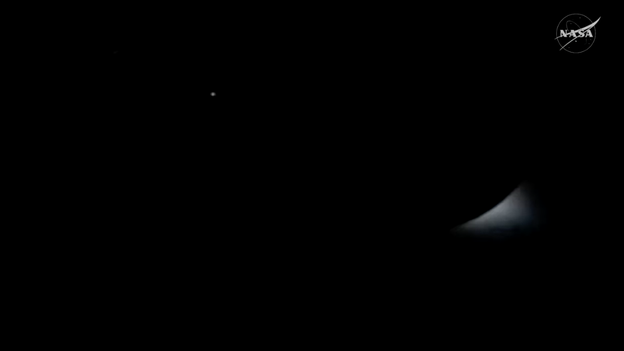
A solar eclipse is visible as the Orion spacecraft, the moon and the sun align.
Artemis II is now entering a solar eclipse that will last for about an hour as Orion, the sun and the moon align.
During this phase, the crew will see the sun disappear behind a mostly darkened moon, according to NASA.
The crew will use the opportunity to study the solar corona - the sun's outermost atmosphere - as it glows around the lunar edge, NASA said.
The astronauts will also watch for flashes of light from meteoroids striking the surface, which could offer insight into potential hazards on the moon.
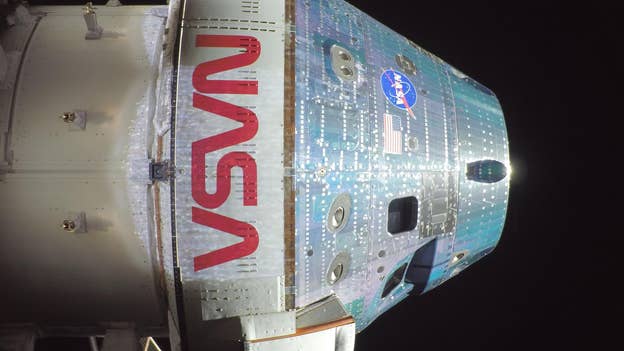
Orion snapped this high-resolution selfie in space with a camera mounted on one of its solar array winds during a routine external inspection of the spacecraft on the second day into the Artemis II mission.
The Orion spacecraft is officially headed back to Earth as the crew reaches its halfway point in the mission.
Shorty after 7 p.m., Orion had its closest approach with the moon, and they reached the furthest point from home at approximately 252,670 miles from Earth.
That number will only go down from here as the crew heads back to Earth for an anticipated splash down in the Pacific Ocean Friday night.
The Artemis II crew is taking in the views of Earthrise just minutes after regaining communication with NASA Mission Control.
They are now preparing to see a rare celestial treat as the sun passes behind the moon from their vantage point in deep space.
The solar eclipse is expected to happen around 8:35 p.m. ET, and NASA expects to remain in communication with the crew during that time.
NASA said the crew will be wearing solar eclipse glasses.
After a 40-minute-long communication blackout, the Artemis II crew is back in touch with NASA.
The crew lost communication with Mission Control as they passed behind the far side of the moon.
They'll soon witness the spectacular sight of Earth rising over the lunar limb.
For the first time in decades, we have completely lost contact with the Artemis II crew as they pass behind the far side of the moon.
The communication blackout is expected to continue for about 40 minutes, with communication expected to be restored around 7:25 p.m. ET.
During that time, the crew will be able to see Earthset, in which Earth will appear to set behind the lunar horizon.
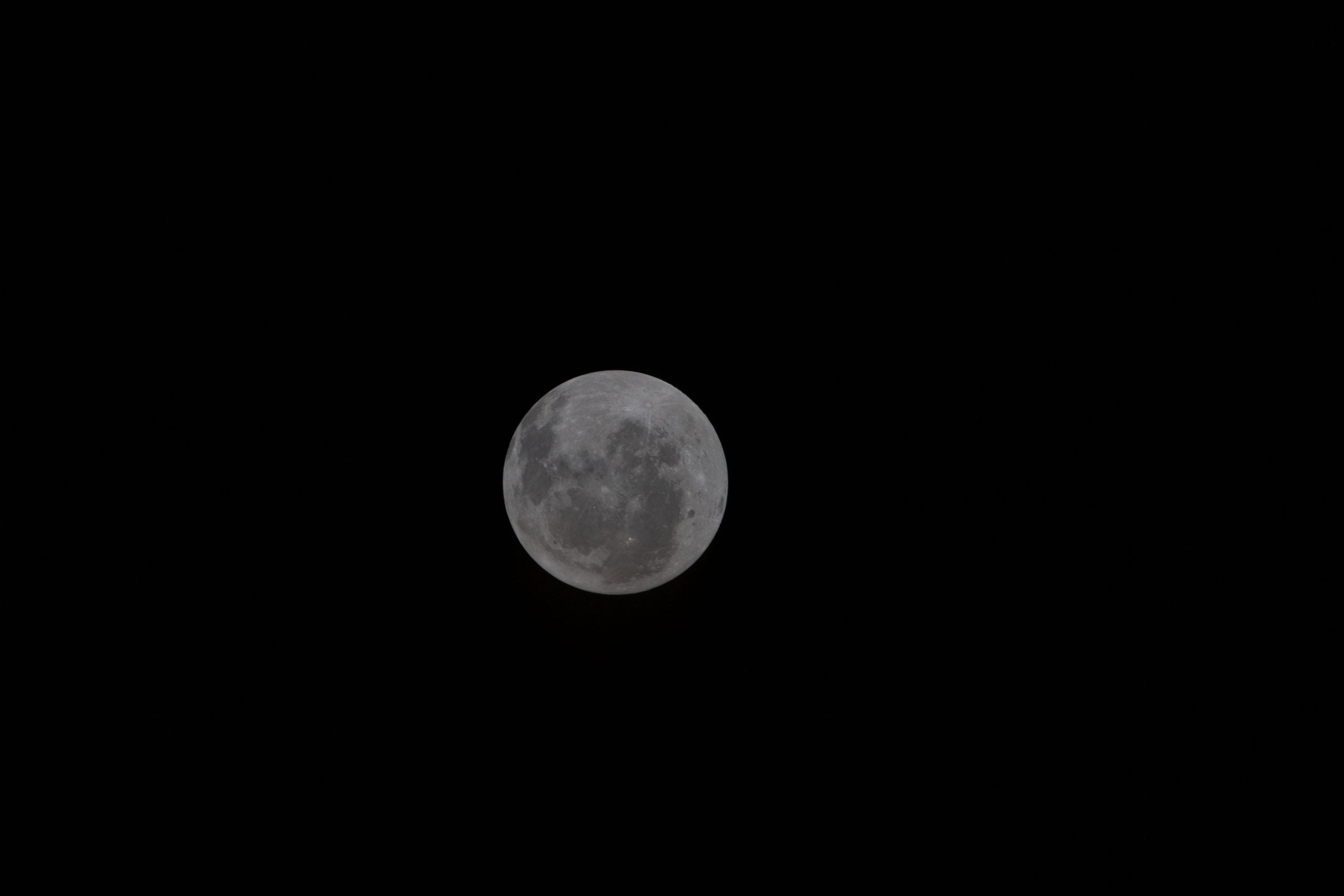
Shorty after 7 p.m., Orion will have its closest approach with the moon. They'll also reach their furthest point from home at approximately 252,670 miles from Earth.
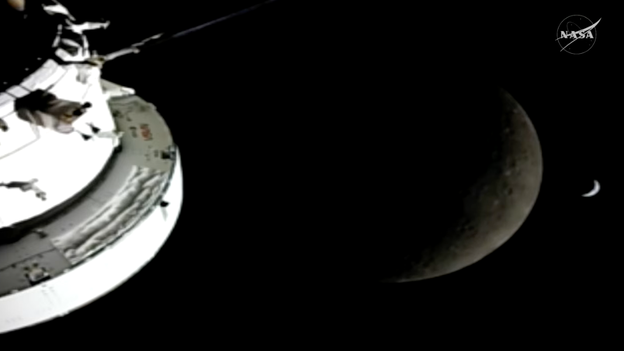
The Moon and Earth both visible from the Orion spacecraft.
New footage of the view from outside the Orion spacecraft shows the Moon and Earth in the distance. It's a sight only a handful of humans have ever witnessed.
The crew is getting ready for a communications blackout in the matter of minutes, and will lose contact with NASA for about 40 minutes.
The Artemis II crew continues its journey around the moon and in the process, they'll get a firsthand view of the moon's surface.
NASA astronaut Chris Williams said one of the most striking features the crew members will see is the craters that mark its surface, which there are many of on the far side. They'll be able to directly see these craters on their mission.
"The Earth has had many impacts over its history that have had big consequences on our planet (just ask the dinosaurs...), but plate tectonics, weathering, and volcanism have erased many craters on the Earth, and with them, the record of this history. The Moon helps us fill in the picture and tells us a unique story about our planet's past!" Williams said on X.
The Artemis II crew has reported seeing color nuances in their observations, which will help enhance scientific understandings of the moon.
NASA said the shades of brown and blues that can be picked up with human eyes can help reveal the mineral composition of a feature and its age.
As crew reports are received, the science team is updating the observation plan based on their follow up questions and sending up new guidance to the crew, NASA said.
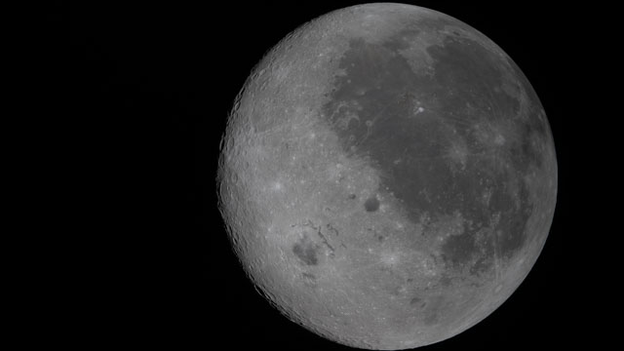
A new photo captures the moon's near side on the right and its far side on the left. The Artemis II crew are the first to see the far side with human eyes.
The Artemis II crew is now in a several-hour window blocked out for making impactful, scientific observations of the moon.
This is happening now because the crew is the closest to the moon it will be - 4,070 miles altitude at closest approach - and the spacecraft is oriented such that the windows are pointed at the moon, according to NASA.
As Orion approached the moon on the near side, the side we can see from Earth, people in parts of the eastern hemisphere could see some of the same features the astronauts observed.
This includes future CLPS landing site Reiner Gamma, which is a bright, mysterious swirl that scientists are still trying to understand, and Glushko, a 27-mile-wide crater known for the white streaks that shoot out from it for up to 500 miles, NASA said.
Take a look at Artemis II's whereabouts using the below interactive map released by NASA.
The tool lets you follow Artemis' journey, and even scroll forward and backward in time.
We're just hours away from temporarily losing communication with the Orion spacecraft as it passes behind the "Far Side" of the moon.
The crew will be out of contact with Earth for approximately 40 minutes.
Click here to see the spacecraft's location in real time.
The four astronauts on the Artemis II mission have proposed renaming certain features on the moon that are currently unnamed to honor the Orion spacecraft and a lost loved one.
Shortly after surpassing the record for farthest from Earth that humans have ever been, the crew suggested naming an unnamed crater they spotted in honor of Integrity, the spacecraft they are on.
The crew also recommended naming a bright spot on the moon - a lunar crater - in honor of Commander Reid Wiseman's late wife, Carroll.
The feature at the nearside boundary, which is in a "really neat place on the moon," may be visible from Earth at certain times during the moon's transit around the Earth.
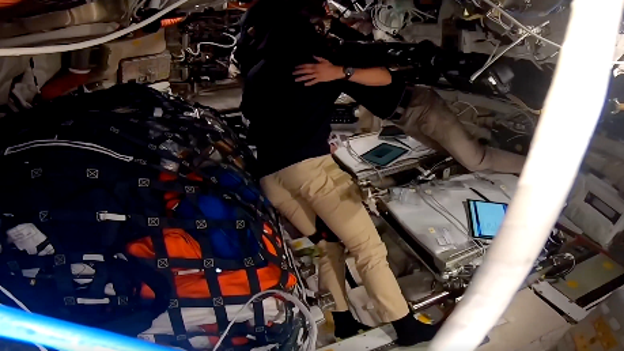
The four crew members onboard the Orion spacecraft embrace in a hug during Artemis II mission.
You can see the crew getting emotional and embracing each other in a hug while communicating back down to Earth. Watch the moment here.
The Artemis II crew has officially reached a new milestone, breaking the record as the farthest any human has ever traveled, reaching a maximum distance of 252,752 miles from Earth.
This surpasses the previous record set by Apollo 13 in 1970 by about 4,102 miles.
"From the cabin of Integrity, as we surpass the furthest distance that humans have ever traveled from planet Earth, we do so in honoring the extraordinary efforts and feats of our predecessors in human space exploration," the crew said shortly after surpassing the record.
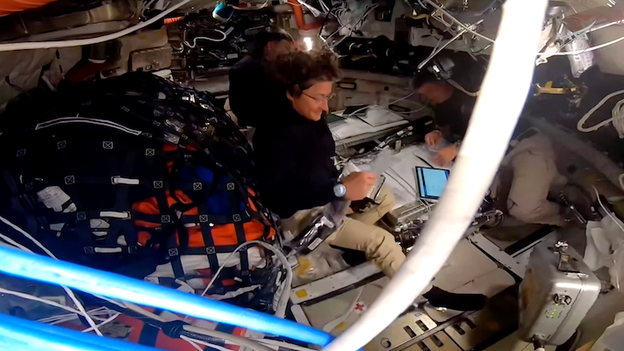
NASA
A 56-year-old record has officially fallen.
At 1:57 p.m. ET, the four astronauts of the Artemis II mission traveled further from Earth than any human beings in history, surpassing the milestone of 248,655 miles set by the crew of Apollo 13 in 1970.
While the Apollo 13 record was the result of a harrowing emergency free-return trajectory after an onboard explosion, today’s achievement by Commander Reid Wiseman, Victor Glover, Christina Koch, and Jeremy Hansen is a triumphant planned step in NASA’s return to the lunar surface.
As the Orion spacecraft continues its high-speed approach toward the Moon’s far side, every mile traveled from this point forward pushes the boundaries of human exploration into uncharted territory.
To put this distance into perspective, the crew is now more than 1,000 times further from Earth than the International Space Station.
The record-breaking moment was marked by a quiet professional pride in Mission Control Houston, acknowledging that while the numbers are historic, the most critical part of the mission—the 7:02 p.m. ET lunar flyby—is still to come.
The Artemis II crew began their historic Flight Day 6 with a poignant bridge between generations of lunar explorers.
During their 10:53 a.m. ET wake-up call, Mission Control played a pre-recorded message from the late Captain Jim Lovell—the legendary commander of Apollo 13 and one of the first humans to orbit the Moon on Apollo 8.
Lovell, who recorded the greeting in 2025 before his passing specifically for this mission, welcomed the four astronauts to his "old neighborhood" and reminded them that while their schedule would be grueling, they must take a moment to "enjoy the view."
Hello, Artemis II! This is Apollo astronaut Jim Lovell. Welcome to my old neighborhood! When Frank Borman, Bill Anders, and I orbited the Moon on Apollo 8, we got humanity’s first up-close look at the Moon and got a view of the home planet that inspired and united people around the world. I’m proud to pass that torch on to you — as you swing around the Moon and lay the groundwork for missions to Mars … for the benefit of all. It’s a historic day, and I know how busy you’ll be. But don’t forget to enjoy the view. So, Reid, Victor, Christina, and Jeremy, and all the great teams supporting you – good luck and Godspeed from all of us here on the good Earth.
The message carries deep significance as the Artemis II crew prepares to shatter the all-time human distance record of 248,655 miles—a record held by Lovell and his Apollo 13 crewmates for 56 years.
By following a similar free-return trajectory to the one that famously brought the Apollo 13 crew safely home after an onboard explosion, this new generation of explorers is quite literally following in Lovell's footsteps while pushing the boundaries of human reach even further into the cosmos.
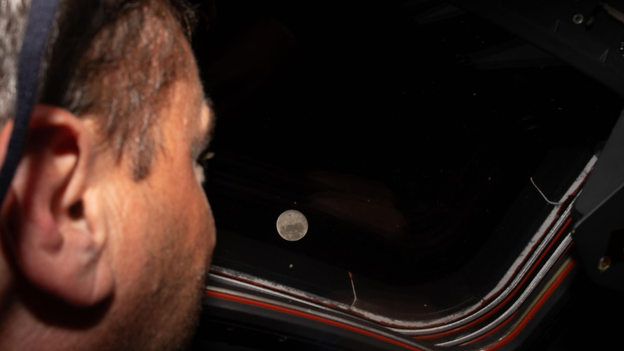
Artemis II commander and NASA astronaut Reid Wiseman looks out one of the Orion spacecraft's main cabin windows at the Moon ahead of the crew's lunar flyby. (NASA)
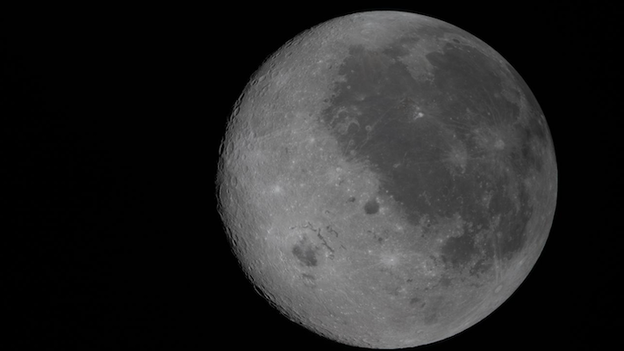
In this fully illuminated view of the Moon, the near side (the hemisphere we see from Earth), is visible on the right. It is identifiable by the dark splotches that cover its surface. These are ancient lava flows from a time early in the Moon’s history when it was volcanically active. The large crater west of the lava flows is Orientale basin, a nearly 600-mile-wide crater that straddles the Moon’s near and far sides. Orientale's left half is not visible from Earth, but in this image we have a full view of the crater. Everything to the left of the crater is the far side, the hemisphere we don’t get to see from Earth because the Moon rotates on its axis at the same rate that it orbits round us. (NASA)
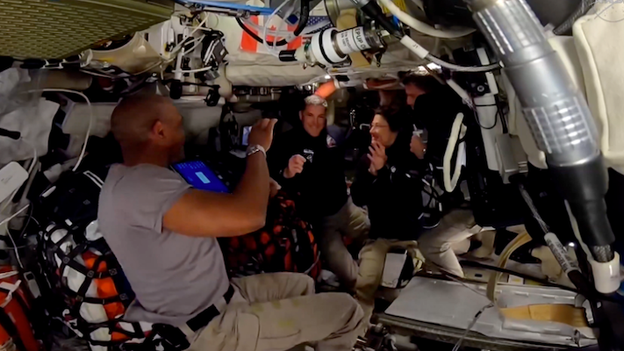
The Artemis II crew - NASA Astronaut Victor Glover (far left), CSA (Canadian Space Agency) Astronaut Jeremy Hansen (center left) and NASA Astronauts Christina Koch (center right) Reid Wiseman (right) present Jeremy Hansen with his Gold Wings signifying his first flight into space during Flight Day 5. (NASA)
The Artemis II crew officially began their historic "Flyby Day" with a wake-up call at 10:53 a.m. ET this morning.
After a well-deserved eight-hour rest period that started late last night, Commander Reid Wiseman, Pilot Victor Glover, and Mission Specialists Christina Koch and Jeremy Hansen were greeted by Mission Control in Houston to prepare for the most demanding 24 hours of their mission so far.
This morning’s wake-up marks the start of Flight Day 6, a day that will see the team shatter the all-time human distance record from Earth and capture unprecedented high-resolution imagery of the lunar far side.
With the spacecraft already under the dominant pull of the Moon's gravity, the crew is now moving through their morning checklist to configure the Orion cabin for the high-stakes science operations and maneuvers scheduled for later this afternoon.
After entering the Moon’s sphere of influence shortly after midnight, Orion is now being re-accelerated by lunar gravity as it speeds toward tonight’s 7:02 p.m. ET closest approach.
Having spent the last few days slowing down while climbing uphill away from Earth, the spacecraft is now essentially falling toward the lunar surface, gaining the velocity it needs for a historic gravity-assisted slingshot.
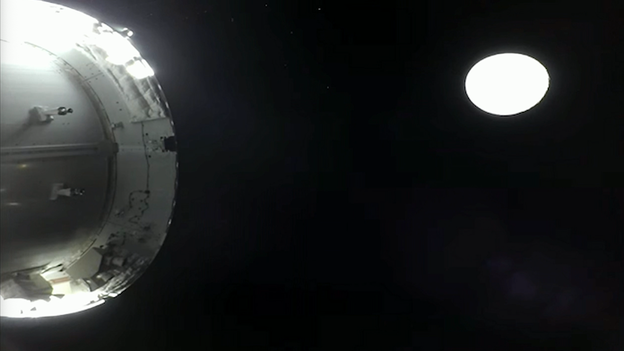
Camera aboard the Orion spacecraft showing the Moon growing larger by the minute. (NASA)
The crew is currently hurtling through the final stretch of their 232,000-mile journey, with the Moon appearing to grow larger in their windows by the hour.
This surge in speed is a critical part of the mission’s free-return trajectory, ensuring that even without further engine burns, the Moon's gravity will whip Orion around the far side and fling it safely back toward a Friday splashdown on Earth.
The Artemis II crew will set a record for human space travel Monday in their historic lunar flyby. On the far-side of the moon the crew will have a 7-hour window to make nuanced lunar observations.
As the Artemis II crew completes their historic loop around the Moon later today, NASA and FOX Weather forecasters are already eyeing the splashdown zone in the Pacific Ocean off the coast of San Diego.
The Orion spacecraft is scheduled to return home on Friday with splashdown expected at approximately 8:06 p.m. ET.
Recovery teams, led by the USS John P. Murtha, are tracking a specific landing target where they will use specialized cranes and inflatable rafts to safely retrieve the four astronauts and their capsule from the water.
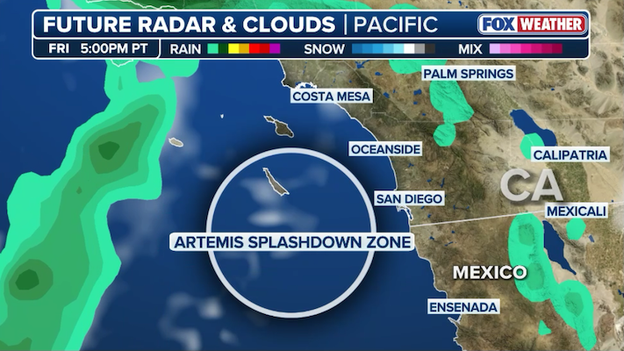
Forecasters are closely monitoring the splashdown recovery zone weather forecast for Friday.
Meteorologists are currently monitoring the long-range marine forecast to ensure conditions remain within strict safety limits.
For a "Go" on Friday evening, sustained winds must stay below 25 knots and significant wave heights must not exceed 6 feet.
While the current outlook for Friday at 8:06 p.m. ET remains favorable, forecasters are keeping a close eye on any potential for isolated afternoon thunderstorms or shifts in swells that could impact visibility for the recovery helicopters and divers.
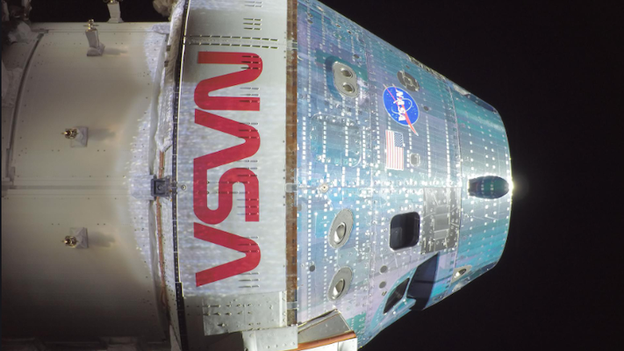
Orion snapped this high-resolution selfie in space with a camera mounted on one of its solar array wings during a routine external inspection of the spacecraft on the second day into the Artemis II mission. (NASA)
Today, is the big day for the Artemis II mission. After launching from Kennedy Space Center on April 1, the crew—Commander Reid Wiseman, Pilot Victor Glover, and Mission Specialists Christina Koch and Jeremy Hansen—are currently reaching the apex of their 10-day journey.
While they won't be landing on the surface today, they are about to become the farthest-traveling humans in history. Here is the play-by-play for today’s major milestones.
10:50 a.m. ET: Wake-up call – Mission Control will wake-up the crew of Artemis II with a special song for flyby day.
1:56 p.m. ET: Surpassing Apollo 13 – Artemis II is expected to officially surpass the distance record set by Apollo 13 in 1970 (248,655 miles from Earth).
2:45 p.m. ET: Lunar observation window opens – For nearly seven hours, the crew will have their windows pointed at the Moon to capture high-resolution imagery and perform manual geological observations.
6:44 p.m. ET: Communications blackout – As Orion passes behind the "Far Side" of the Moon, the lunar bulk will block all radio signals. The crew will be out of contact with Earth for approximately 40 minutes.
6:45 p.m. ET: Earthset – From the astronauts' perspective, the Earth will appear to set behind the lunar horizon—a view only a handful of humans have ever witnessed.
7:02 p.m. ET: Closest approach – Orion will scream past the lunar surface at an altitude of just 4,070 miles.
7:07 p.m. ET: Maximum distance – The crew reaches their furthest point from home: 252,760 miles from Earth.
7:25 p.m. ET: Earthrise & signal re-acquisition – As Orion emerges from behind the Moon, the crew will regain contact with Mission Control and witness the spectacular sight of Earth rising over the lunar limb.
8:35 p.m. – 9:32 p.m. ET: Solar eclipse – In a rare celestial treat, the crew will witness the Sun pass behind the Moon from their vantage point in deep space.
9:20 p.m. ET: Observation period ends – The crew concludes their science mission as Orion begins its high-speed slingshot journey back toward Earth.
You’ve reached the beginning of this live coverage.